Un nœud solaire qui se défait tout seul express
Sur le Soleil, de minces jets de plasma s'élèvent sans cesse — ce sont les jets coronaux. Ils ressemblent à des fontaines de gaz surchauffé jaillissant de l'atmosphère de l'étoile. L'un de ces jets, survenu le 10 novembre 2022, a attiré l'attention des scientifiques : il était accompagné d'une éruption de classe C1.1 et présentait un cône inhabituellement large.
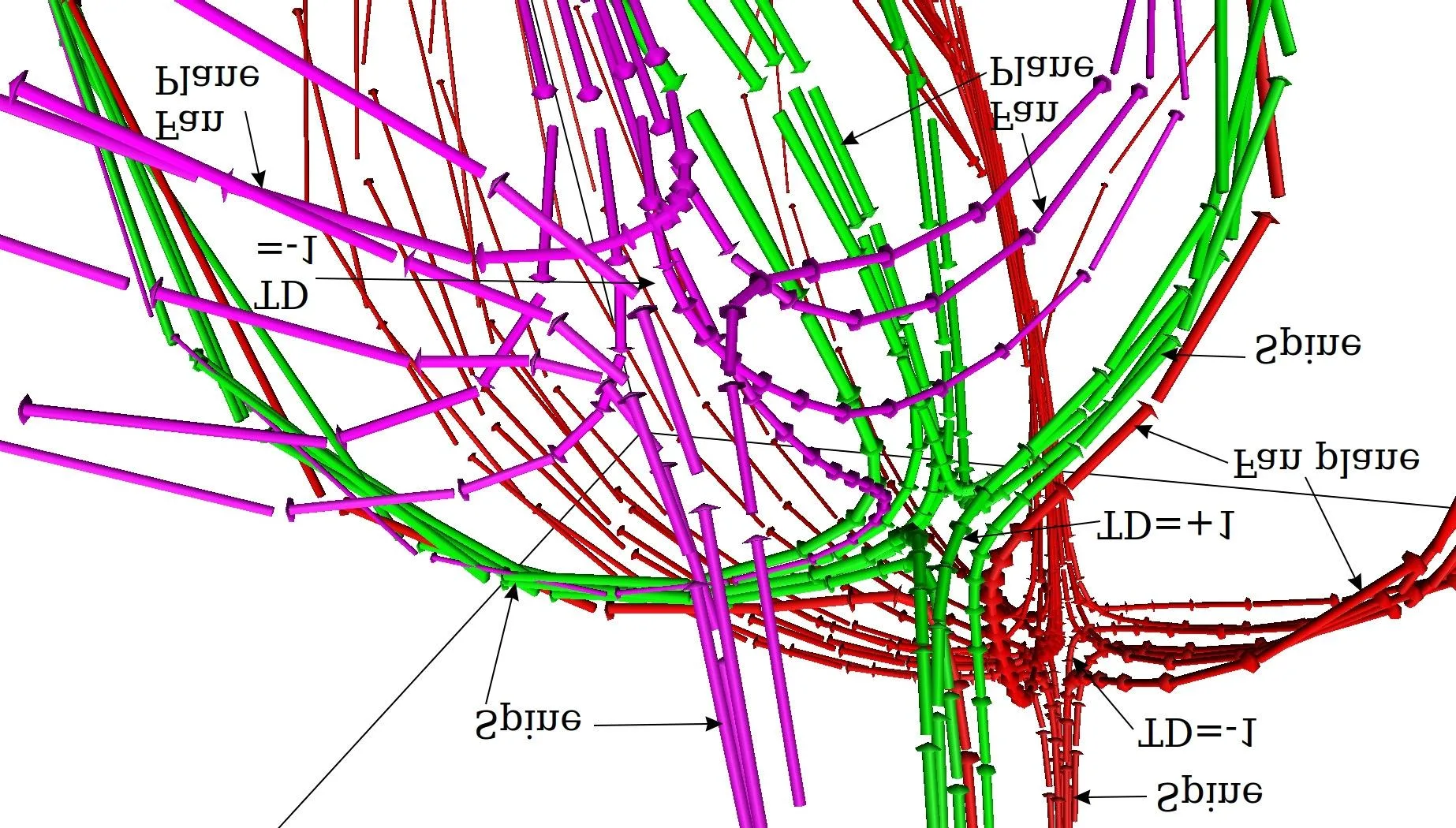
Pour comprendre ce qui avait déclenché cette fontaine, les chercheurs ont construit un modèle informatique du champ magnétique dans la région active du Soleil. Ils y ont découvert un point particulier — un point nul tridimensionnel, où le champ magnétique est nul, ainsi qu'une structure magnétique torsadée — un faisceau. Lorsque le faisceau s'est mis en mouvement, les lignes magnétiques ont commencé à se reconnecter : elles se sont rompues puis reconnectées, libérant de l'énergie.
Dans le modèle, la reconnexion a engendré des paires de nouveaux points nuls qui se sont immédiatement annihilés. Cette cascade a déclenché simultanément le jet et l'éruption. Un tel comportement n'avait jamais été observé en détail auparavant — il ouvre une nouvelle direction dans l'étude des jets solaires.
Résumé original
tel que rédigé par les auteurs, en anglais arXiv:2602.01742
Coronal jets are collimated plasma eruptions which are ubiquitous in the solar atmosphere. Believed to be triggered by magnetic reconnection, these jets can contribute to various phenomena, including coronal heating and particle acceleration. Coronal jets are a contemporary area of research with their onset mechanism meriting further attention. Importantly, a subclass of jets, the blowout jets, are particularly interesting because of their broad spire, suggesting substantial three-dimensional (3D) reconnection between open and closed field lines involving 3D null points. Consequently, here we explore the onset of a blowout jet associated with Active Region (AR) SPoCA 29093 detected by Spatial Possibilistic Clustering Algorithm (SPoCA). This AR produced a C1.1-class flare on 10 November 2022 and we investigate it using a data-constrained magnetohydrodynamic simulation initiated with a non force-free-field (NFFF) extrapolation of the photospheric magnetic field. Key elements of the extrapolated field lines are the presence of a 3D null and a magnetic flux rope (MFR) co-located with the jet activity region, the evolution of which is further traced in the simulation. The simulation suggests that magnetic reconnection is responsible for the evolution of the MFR, leading to a near-simultaneous onset of the flare and jet as observed by the AIA/SDO. In particular, the simulation shows spontaneous creation and annihilation of 3D null pairs via magnetic reconnection near the jet region. Such spontaneous null pair generation, in principle, can trigger or contribute to coronal jets; opening up a new avenue for further research.
Les jets coronaux peuvent accélérer des particules à des énergies élevées, contribuant au vent solaire et à la météo spatiale.