Comment une planète avalée a fait tourner une étoile plus vite express
L'étoile GJ 504, jumelle de notre Soleil en âge, se comporte comme une patineuse artistique accomplie : elle fait un tour sur elle-même en 3,4 jours, en brillant dans les rayons X. D'habitude, les étoiles du même âge que le Soleil tournent paresseusement, mais celle-ci semble avoir reçu un dopage cosmique.
Le secret a été révélé par la modélisation. L'analyse de la lumière (spectroscopie) a montré que le freinage normal par le vent stellaire n'aurait pas pu la ralentir. La seule explication : dans le passé, l'étoile a avalé une exoplanète de la taille de Jupiter. Ce « partenaire de danse » lui a transmis son moment orbital, et l'étoile s'est mise à tourner comme une patineuse après une figure. Sans cela, elle tournerait lentement — un tour complet en un mois.
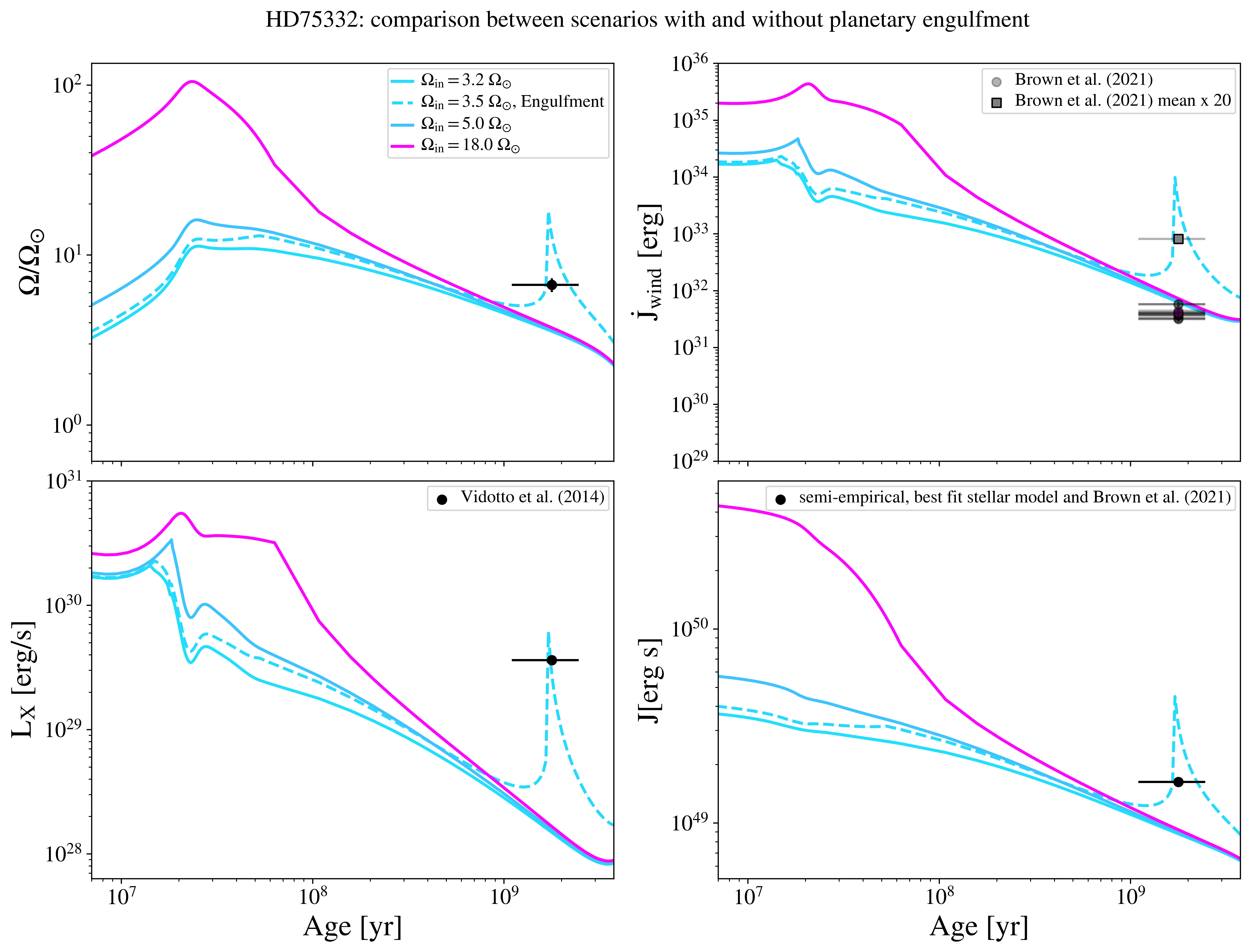
Une autre « danseuse » a été trouvée autour de HD 75332 — il semble que la chorégraphie céleste soit plus fréquente qu'on ne le pensait.
Résumé original
tel que rédigé par les auteurs, en anglais arXiv:2602.22979
With the discovery of a few thousand exoplanets, questions have been raised regarding star-planet interactions and whether the presence of a companion may affect stellar properties. GJ 504 is an evolved (2 Gyr) Sun-like star with a short rotation period (3.4 d) and an intense magnetic activity, which is in stark contrast with what would be expected at such an evolutionary stage. One possible explanation is that a close-in, Jupiter-mass planet was pushed starwards by the action of stellar tides, inducing a stellar spin-up and ultimately a rejuvenation of the stellar magnetic dynamo. By characterising the large-scale magnetic field and magnetised wind of GJ 504, we aim to provide additional observational constraints to test such scenario. We analysed spectropolarimetric observations of GJ 504 collected with ESPaDOnS. Using Zeeman-Doppler imaging, we found a large-scale, dipolar, non-axisymmetric magnetic field with an average strength of 5.3 G, similar to that of evolved early-G type stars. We fed the magnetic field information into our 3D MHD simulation of the stellar wind and space environment of GJ 504, from which we constrained the wind-driven angular momentum loss ($$\rm \dot{J}$$). We then compared $$\rm \dot{J}$$ to rotational evolutionary tracks of GJ 504 for two scenarios: evolution with and without the engulfment of a close-in, Jupiter-mass companion. Between the two scenarios, only the planet engulfment can explain the observational constraints obtained previously in the literature, such as the stellar rotation and X-ray luminosity, and the $$\rm \dot{J}$$ we derived and rescaled to account for underestimated magnetic field strength. Although there are many other stars with similar masses and rotation periods whose rotation evolution does not require planet engulfment, we also identified HD 75332 as a candidate for planet engulfment, suggesting that GJ 504 may not be an isolated case.
L'étoile GJ 504 fait un tour complet en 3,4 jours — sept fois plus vite que notre Soleil.