Chaudron de fusion à plasma brûlant express
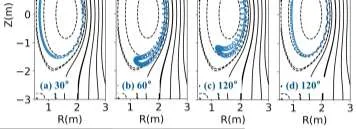
Un piège magnétique en forme de beignet confine un plasma de bore et d'hydrogène. À l'intérieur, la température dépasse les cent millions de degrés — plus chaud qu'au cœur du Soleil. À cette chaleur, les noyaux entrent en collision et fusionnent, libérant de l'énergie.
Le plasma dans l'installation tourne comme un manège : les ions lourds de bore restent en arrière par rapport aux protons légers. Le champ magnétique et les forces électriques retiennent chaque groupe à sa manière. Grâce à cela, la zone chaude ne se désagrège pas et la réaction dure plus longtemps.
Ce schéma convient à un réacteur compact de rayon 1.4 mètre avec un courant de 13 millions d'ampères. S'il peut être réalisé, l'énergie sera produite sans rayonnement neutronique — plus propre et plus sûr.
Résumé original
tel que rédigé par les auteurs, en anglais arXiv:2604.04002
A spherical torus (ST) p B11 plasma model that satisfies multi-magnetofluid force balance is developed, which includes small fractions of suprathermal ions with temperatures around 0.5 MeV and suprathermal electrons in the MeV range. Alongside the primary thermal plasma with ion temperatures exceeding 100 keV and densities above 10E20 m-3, these components enhance fusion reaction rates by leveraging the p B11 double-peak fusion cross section. Suprathermal ions and strong toroidal rotation driven by neutral beam injection have been observed in devices such as START, MAST, NSTX, Globus-M2, and ST40. Central-solenoid-free plasma initiation, ramp-up, and sustainment were tested on EXL-50 and replicated on EXL-50U with partial central induction, demonstrating efficient current drive and consistent with the multi-magnetofluid equilibrium model. Motivated by ENN's aneutronic commercial fusion roadmap, this paper presents a rotating, thermally un-equilibrated ST p B11 plasma with unique properties: fluid components experience separate balance under centripetal, electrostatic, and Lorentz forces with common electric and magnetic fields, leading to large rotation speed differences between thermal boron ions and suprathermal protons; a large outboard region with magnetic well and omnigeneity is created, affecting neoclassical transport and gradient-driven turbulence; suprathermal charged particles can extend beyond the last closed flux surface and be limited by plasma-facing components, influencing recycling and pedestal conditions; and the superposition of these plasma components modifies sources and sinks of free energy, prompting renewed evaluation of stability, turbulence, transport, heating, current drive, and flux diffusion. Challenges and opportunities for sustained burn are discussed for a compact p B11 ST with 1.4-meter major radius, 13-MA current, and 3-T toroidal field.
Dans ce plasma, les ions lourds de bore tournent nettement plus lentement que les protons légers — comme des patineurs sur une patinoire : les partenaires massifs restent plus près du centre, tandis que les légers les dépassent sur le cercle extérieur.
L'idée de la fusion sans neutrons rappelle les réacteurs de « Star Trek », où le carburant est le deutérium, mais ici, c'est le bore avec l'hydrogène.