Champs magnétiques dans les cœurs des géantes rouges express
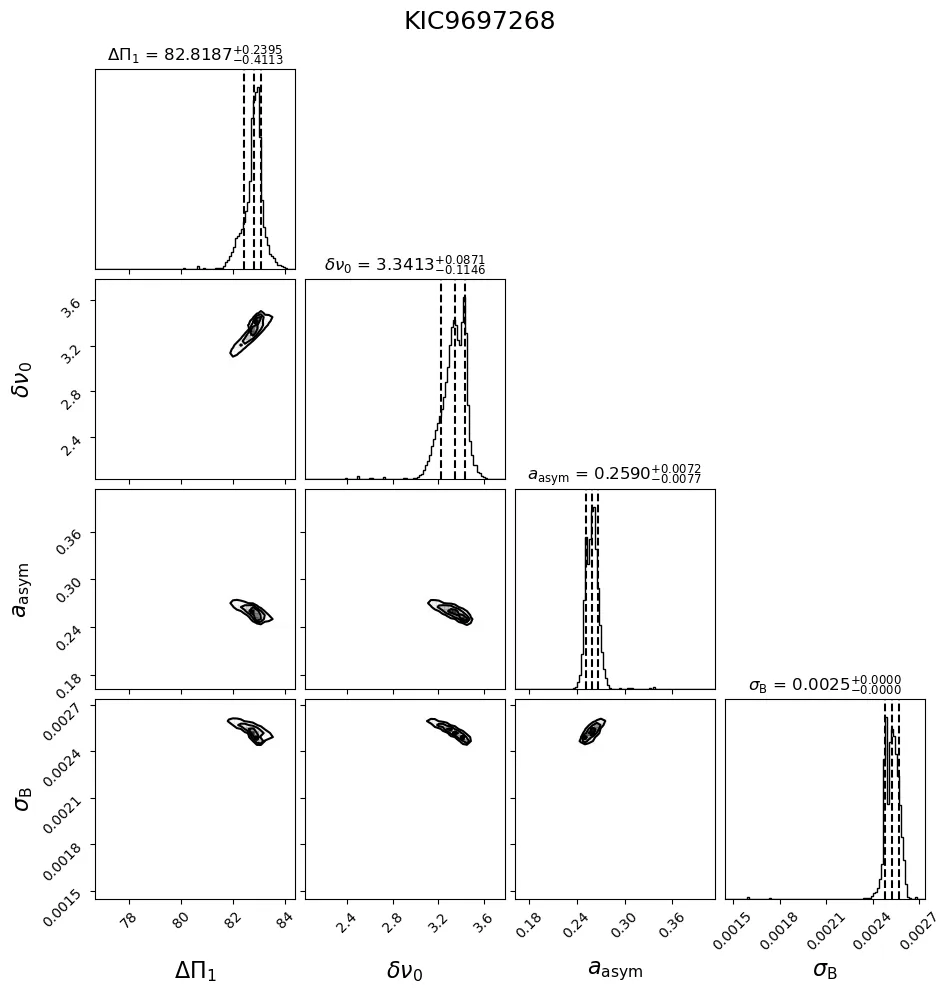
Huit géantes rouges — de vieilles étoiles gonflées, semblables à ce que deviendra notre Soleil — jouent faux. Leur surface oscille régulièrement, comme une cloche, mais dans cette sonnerie on entend des ratés : certains tons disparaissent, le rythme se brise. Les scientifiques ont soupçonné qu'une main invisible se cachait à l'intérieur — un champ magnétique — et ont tenté d'en calculer la force.
Pour expliquer les observations, il a fallu admettre que le champ est très intense — de 100 à 700 kilogauss. Pour comparaison : le champ d'un aimant de réfrigérateur est d'environ 0,001 kilogauss. Un champ aussi puissant n'a pas pu apparaître par hasard. Il est probablement né dans la jeunesse de l'étoile, quand, comme dans une casserole d'eau bouillante, son cœur chaud bouillonnait, mélangeant la matière et créant une dynamo magnétique.
Ces huit étoiles se sont révélées peu massives — environ comme le Soleil. La taille de leur champ magnétique correspond à celle du cœur que l'étoile avait dans sa jeunesse. Autrement dit, le champ est un souvenir de cette jeunesse turbulente, figé dans les profondeurs. Désormais, les astronomes peuvent utiliser ces étoiles comme des laboratoires naturels pour comprendre comment les champs magnétiques vivent et meurent à l'intérieur des astres.
Résumé original
tel que rédigé par les auteurs, en anglais arXiv:2604.09901
The recent seismic detection of magnetic fields in red giants cores has given the opportunity to characterize these fields, potentially giving information about their origin and their role in the internal transport of angular momentum. We detect strong deviations from the regular pattern of g-mode periods in eight Kepler red giants showing $$l=1$$ doublets. In three of these stars, the modes show partial suppression. We investigate the magnetic origin of these features and determine the characteristics of the core fields that can produce such signatures. We need to invoke strong, near-critical fields. Assessing the effects of such fields on the mixed mode frequencies requires a non-perturbative approach. We use and adapt a formalism that was recently proposed following a similar development as the traditional approximation for rotation (TAR). We then compute asymptotic expressions of mixed mode frequencies including magnetic effects and attempt to reproduce the observed oscillation spectra. We show that for near-critical fields, information can be obtained about the radial profile of the radial field $$B_r$$, as opposed to weaker fields for which only a weighted average of $$B_r^2$$ can be measured. For the eight targets, we find that the $$l=1$$ doublets cannot be identified as the $$m=\pm1$$ components. Instead, we show that very good fits to all the observations can be obtained by identifying the two components as $$m=0$$ and $$m=1$$. These solutions correspond to fields with intensities ranging from 100 to 700 kG that are confined well below the H-burning shell. Our best-fit models for the eight stars have low masses (1.1-1.2 $$M_\odot$$) and the maximal size of their convective core during the main sequence approximately corresponds to the radial extent of the measured magnetic fields. The detected fields could thus have been generated by dynamo action in the main-sequence convective core.
Le champ magnétique dans le cœur d'une géante rouge est des millions de fois plus fort que celui d'un aimant de réfrigérateur, mais il est caché profondément sous la surface de l'étoile.
Dans le roman « Solaris » de Stanislas Lem, l'océan de la planète se comporte comme un être vivant ; ici, c'est l'étoile elle-même qui conserve la « mémoire » de sa jeunesse sous la forme d'un champ magnétique.