Comment capter le frémissement d'une molécule express
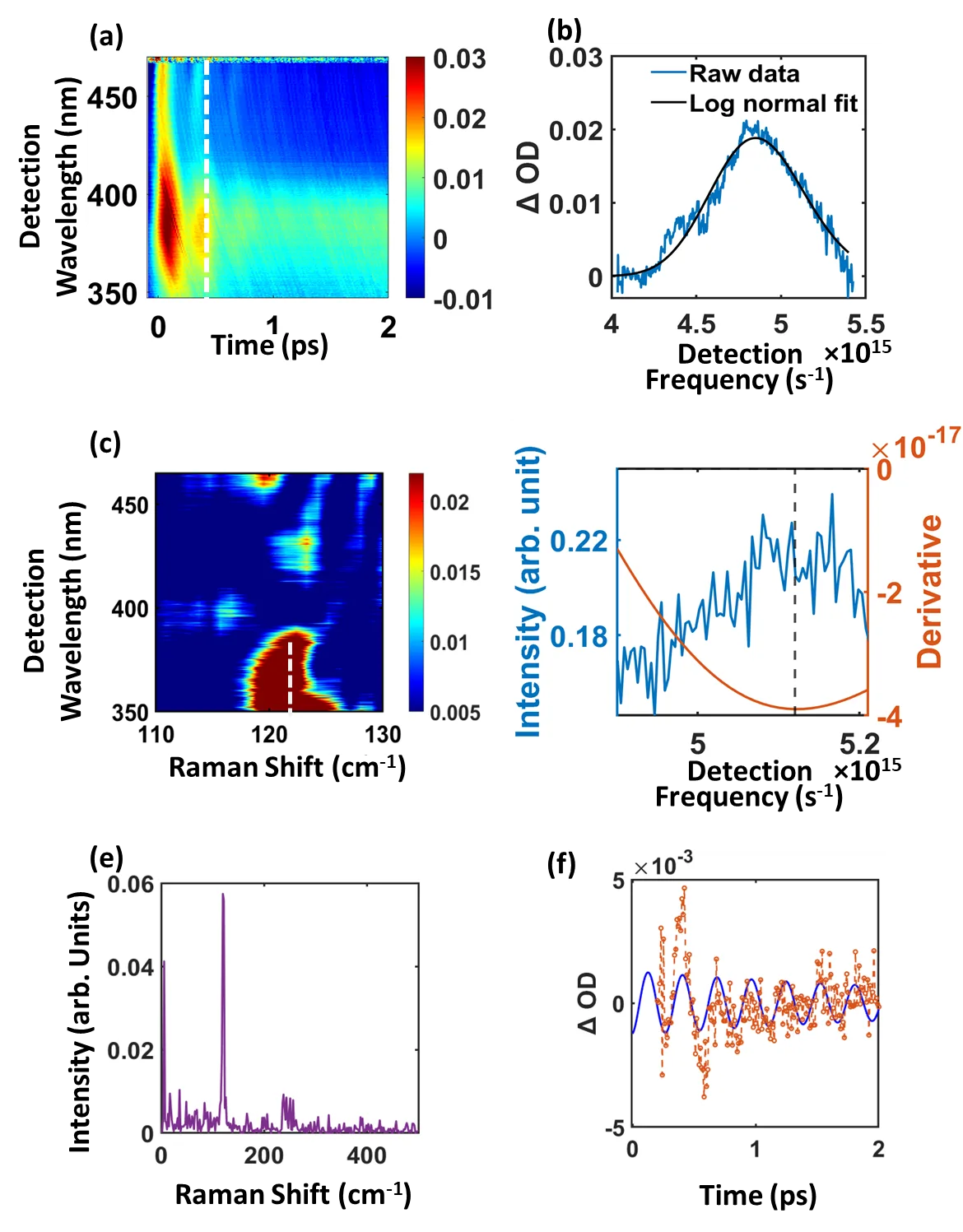
Une brève impulsion laser frappe une molécule d'iode, et ses atomes se mettent à osciller, comme une bille au bout d'un ressort. Les scientifiques suivent ces oscillations à l'aide d'une seconde impulsion à large bande, qui enregistre le spectre à différents instants.
Il s'avère que les oscillations dans l'état excité B glissent rapidement en fréquence et s'estompent, puis des oscillations apparaissent dans l'état A. C'est un peu comme un relais : la molécule se dissocie, mais le solvant, telle une cage, maintient les fragments à proximité, et ils se reassocient, transférant l'énergie vibratoire au nouvel état.
L'analyse par ondelettes (ces « microscopes » mathématiques pour les fréquences) a permis de voir comment les fréquences d'oscillation changent de picoseconde en picoseconde. Cela aide à séparer des signaux qui, dans un spectre ordinaire, se superposent.
Cette approche est comme un stéthoscope qui n'entend pas seulement les battements du cœur, mais aussi chaque froissement dans la poitrine. Elle ouvre la voie à l'étude de la cohérence dans des processus photochimiques complexes.
Résumé original
tel que rédigé par les auteurs, en anglais arXiv:2604.23731
Vibrational wavepacket dynamics in the ground (X) and excited (B) electronic states of iodine under impulsive-pump/broadband-probe excitation are revisited. A method for accurate chirp correction, necessary to determine the zero time for each component of spectrally dispersed data and thereby separate coherent vibrational dynamics from coherent artifacts and population kinetics, is introduced. While from these processed time-domain data the absolute Raman cross-section in the ground electronic state can be calculated using steady-state absorption, we show that the same can be done using the pump-probe data itself, and further extend this method as a benchmark to calculate the same for the excited electronic state; these cross-sections report on vibronic couplings specific to these states. Further, since the Fourier transform of the processed data yields information on vibrational modes averaged over the dephasing time, a wavelet analysis is performed to yield a joint time-frequency distribution of the vibrational modes, demonstrating how the time evolution of their frequencies can be extracted. The vibrational modes of the ground and excited electronic states are shown to exhibit distinct dispersion characteristics. Since overlapping spectral features appear at different time windows, such an analysis can disentangle spectral congestion, even from a simple one-dimensional measurement. Most interestingly, a rapid time-dependent spectral shift and decay of the B state mode, followed by the appearance and growth of the A-state mode, directly correlates with the pre-dissociation, followed by solvent caging-induced recombination. Thus, the present work reveals transfer of vibrational coherence from one electronic state (B) to another (A), mediated via nonadiabatic coupling to the intermediate dissociative state (a), underscoring the importance of electronic coherence.
L'iode en solution paraît violet, mais ses vapeurs sont bleu-violet ; la couleur dépend de la façon dont les molécules interagissent avec leur environnement.