Pourquoi la maladie du bananier ne lâche pas prise express
La plantation de bananiers se couvre de stries rouille. C'est la cercosporiose noire, un champignon dont les spores voyagent dans l'air comme un pollen invisible. Il frappe les feuilles, privant la plante de sa vigueur. Le cultivateur réduit l'infection, mais la maladie revient soudainement — telle une mauvaise herbe qui faisait la morte.
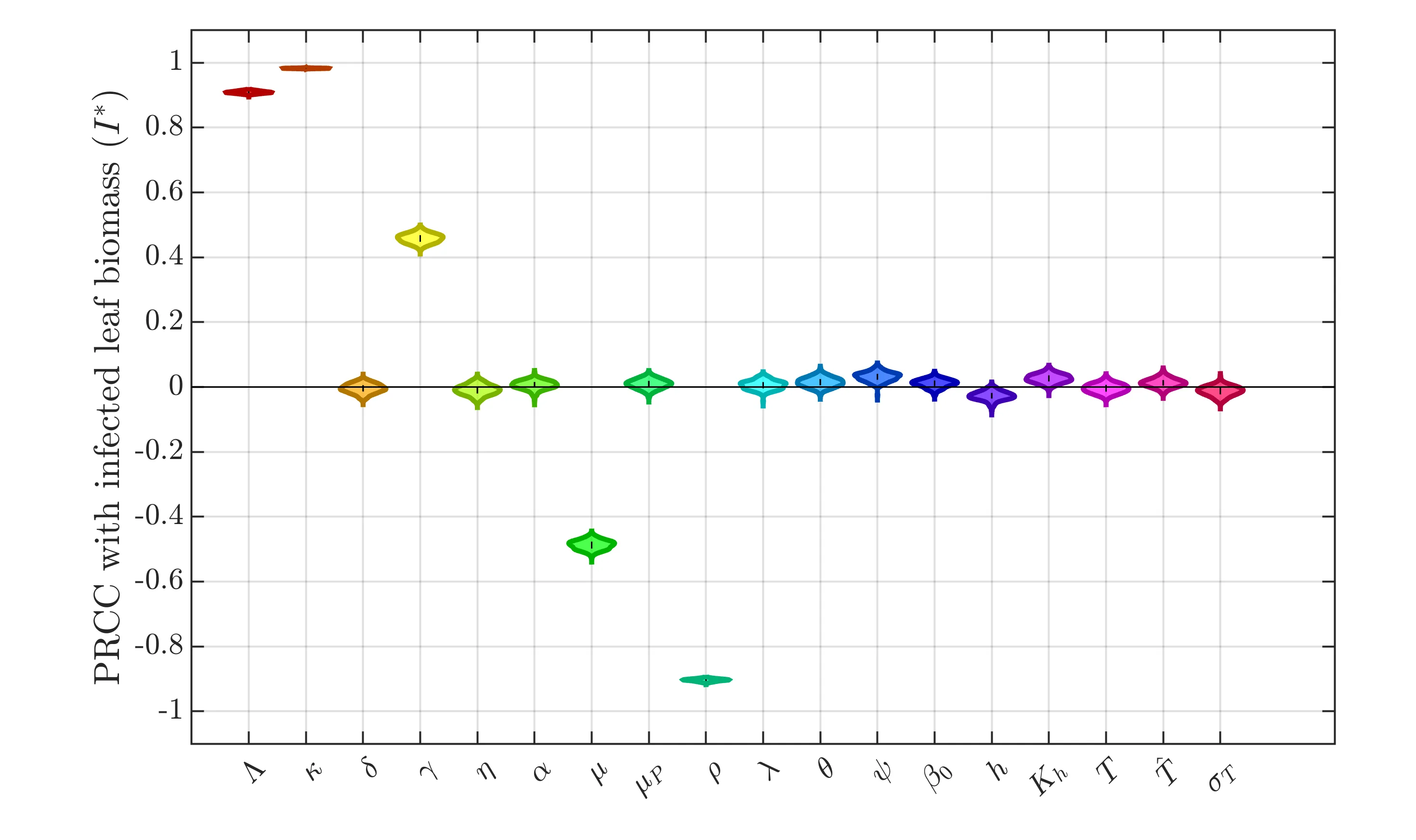
Le modèle mathématique a révélé le piège : le taux d'infection peut tomber en dessous de un, et pourtant le foyer couve toujours. Aussi, les seules quarantaines ne suffisent pas. Les calculs pointent vers deux leviers : la sélection de variétés résistantes et la protection des jeunes feuilles en saison des pluies. Le modèle a aussi pris en compte les pics aléatoires d'infection (par exemple dus à la météo), en testant des milliers de scénarios. Le tableau est clair : on ne peut vaincre le champignon qu'en le frappant des deux côtés à la fois.
Résumé original
tel que rédigé par les auteurs, en anglais arXiv:2604.26060
Black Sigatoka disease (BSD), also known as black leaf streak disease, is an airborne fungal infection caused by \textit{Pseudocercospora fijiensis} that severely impacts global banana and plantain production. Its persistence and resistance to eradication make it one of the most challenging plant diseases to manage. In this paper, we propose a deterministic pathogen-host model to describe BSD dynamics. Due to dual transmission pathways (ascospores and conidia) and mate limitation in sexual reproduction, the model exhibits a backward bifurcation: a stable endemic equilibrium coexists with the disease-free equilibrium for certain parameter values in which the basic reproduction number, $$\mathcal{R}_0$$, is less than 1. This phenomenon explains why control strategies that solely reduce $$\mathcal{R}_0$$ below one may fail. For the backward bifurcation regime, we perform sensitivity analysis of the endemic equilibrium using normalized forward sensitivity indices, Latin Hypercube Sampling, and Partial Rank Correlation Coefficients. Results indicate that effective control must extend beyond $$\mathcal{R}_0$$ reduction and prioritize (1) limiting production of new susceptible leaves during high-risk periods and (2) developing and deploying disease-resistant plant varieties. To incorporate transmission variability, we also formulate a stochastic version of the model using the Stochastic Simulation Algorithm (SSA). Extensive numerical simulations compare stochastic realizations with deterministic predictions and quantify variability in disease dynamics. To identify the principal drivers of persistence and variability, we analyze the endemic equilibrium using Sobol's variance-based sensitivity method, which highlights the role of nonlinear parameter interactions in shaping variability.
Un centimètre carré de feuille de bananier malade peut libérer jusqu'à 20 000 spores dans l'air par jour — assez pour infecter toute une plantation.
Dans le roman « L'Année des miracles » de Geraldine Brooks, l'isolement du village ne sauve pas de la peste — il en va de même pour les bananes : tant qu'il reste un foyer caché, la maladie attend son heure.