Как Сатурн прячет магнитное поле экспресс
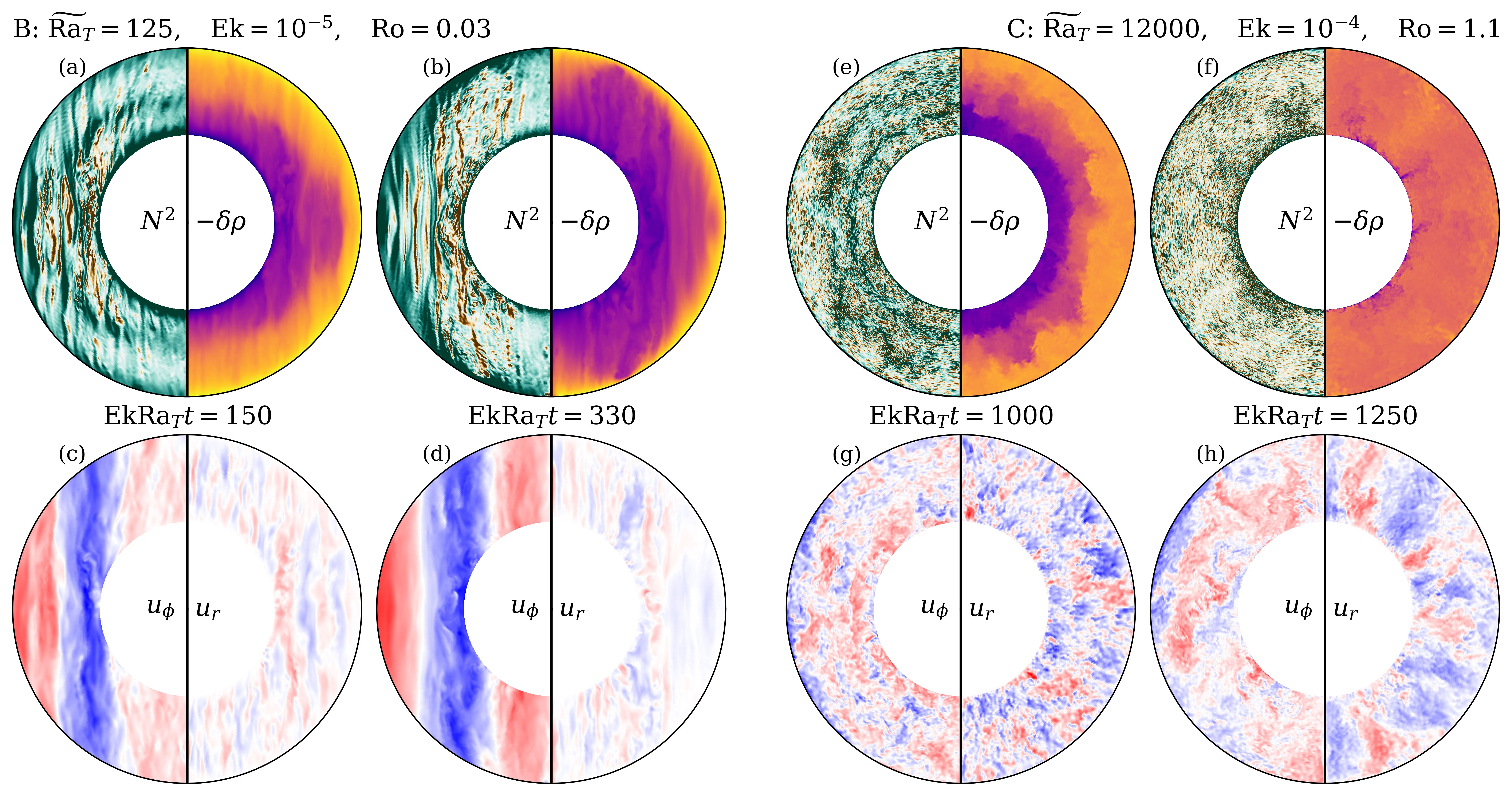
Внутри планет-гигантов, таких как Юпитер и Сатурн, тепло не всегда поднимается свободно. Тяжёлые элементы, которых больше в одних слоях и меньше в других, не дают горячей жидкости всплывать. Возникает полуконвекция — перемешивание, при котором тепло и состав распространяются с разной скоростью.
Учёные впервые просчитали этот процесс в условиях, близких к реальным: внутри вращающегося шара, как у планеты. Сначала жидкость сама расслаивается на ступеньки плотности — тонкие слои с чёткими границами. Потом слои начинают сливаться. В итоге остаётся либо один полностью перемешанный слой, либо перемешанный слой под устойчивым слоем сверху.
Когда в таком состоянии запускали расчёты магнитного поля, оно получалось очень ровным и направленным вдоль оси вращения — как у Сатурна. Верхний устойчивый слой работал как фильтр: пропускал только самые простые и гладкие линии поля. Это объясняет, почему магнитное поле Сатурна такое спокойное по сравнению с полем Земли.
Оригинальная аннотация
как её написали авторы, на английском arXiv:2601.09358
Large regions of giant planets are thought to possess unstable thermal gradients stabilised by gradients in heavy-element composition. The fluid can then develop semi-convection, a double-diffusive instability driven by the unequal molecular diffusivities of heat and composition. While previous studies have focus mainly on local Cartesian models, we investigate semi-convection in rotating spherical shells, the geometry relevant to planetary interiors, using direct numerical simulations In a first non-linear phase, the flow spontaneously forms concentric density staircases composed of well-mixed layers separated by thin, strongly stratified interfaces. We propose scalings for both the thickness of these layers and their survival time in terms of the rotation rate and stratification. Over longer timescales, layers merge to produce statistically steady states consisting either of a fully convective shell or of a convective layer overlain by a persistent stably stratified layer (SSL), depending on the balance between stratification and rotation. Dynamo simulations show that flow within the convective region can generate a self-sustained magnetic field, which is filtered by zonal flows in the overlying SSL. This results in a strongly dipolar and axisymmetric external field, in encouraging agreement with Saturn's magnetic field. Across the explored parameter range, both the Rossby number and the thickness of the stably stratified layer are governed by a single combination of control parameters. This enables identification of a regime favourable to planetary-like dynamos.
Магнитное поле Сатурна почти идеально ровное — его ось совпадает с осью вращения планеты. Среди всех планет Солнечной системы такое больше нигде не встречается.