Солнечная вспышка: два пика — одна магнитная лента экспресс
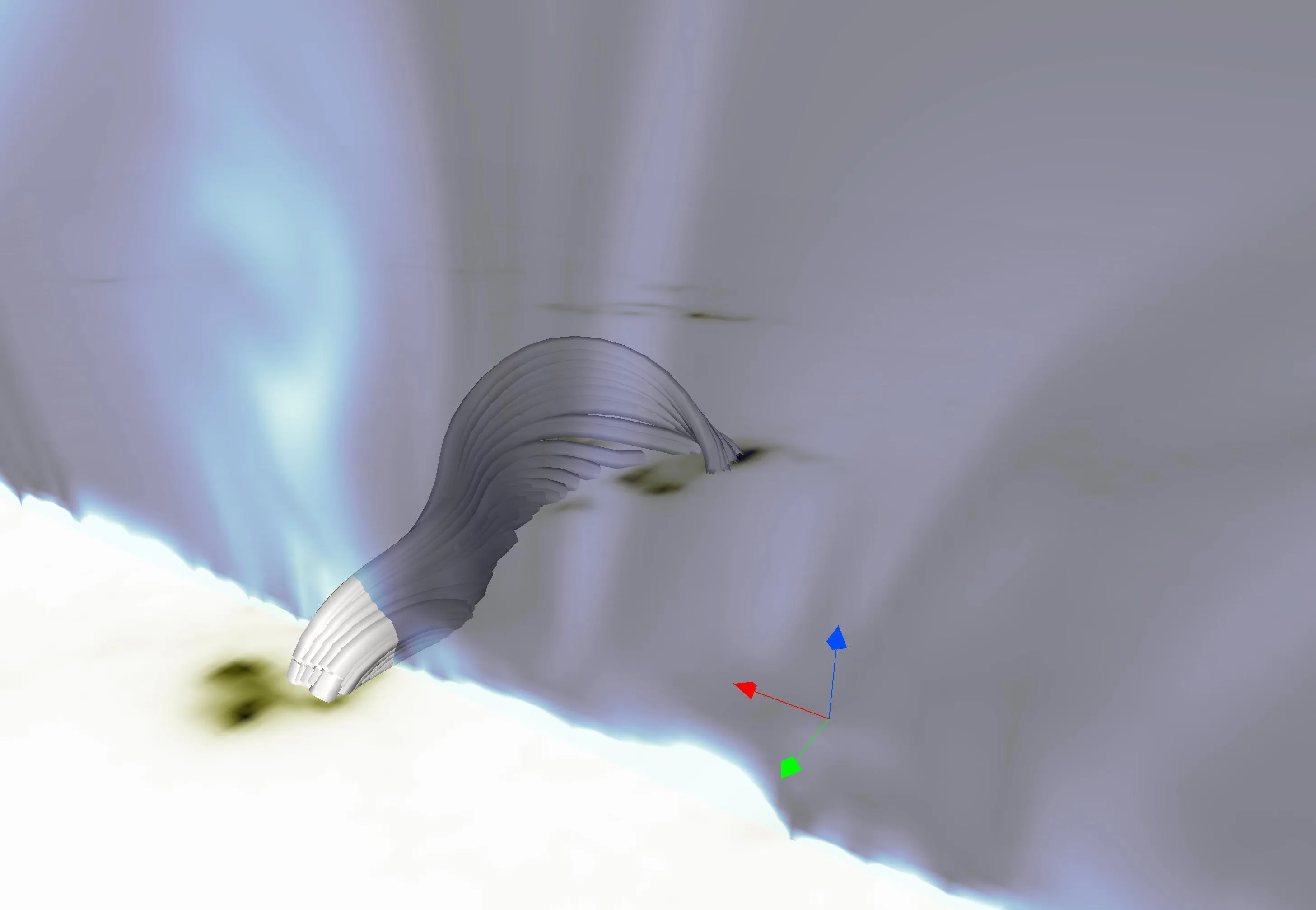
Первого октября 2024 года на Солнце произошла вспышка класса X7.1 — одна из самых мощных. Два космических аппарата, HXI и STIX, смотрели на неё с разных сторон, как два глаза, и вместе с компьютерной моделью помогли восстановить трёхмерную картину.
В разгар вспышки рентгеновское излучение мигнуло дважды, и каждый раз яркие пятна на поверхности Солнца появлялись в разных местах. Это означало, что магнитные поля рвутся и пересоединяются не в одной точке, а вдоль длинной изогнутой границы — как трещина, бегущая по льду. Модель показала, что оба пика родились в одной и той же магнитной ленте, просто в разных её частях.
Второй аппарат, STIX, увидел ещё и вертикальный столб горячего газа, поднимающийся от поверхности вверх. Его центр смещался между двумя пиками, как будто энергия перетекала по невидимой трубе. Это первый шаг к тому, чтобы понять, как именно вспышки разгоняют частицы до скоростей, близких к световой.
Оригинальная аннотация
как её написали авторы, на английском arXiv:2601.23046
We investigated the three-dimensional (3D) magnetic structures and dynamics responsible for particle acceleration in an X7.1-class flare that occurred on October 1, 2024, in NOAA active region 13842. We combined stereoscopic hard X-ray (HXR) observations from the Advanced Space-based Solar Observatory/Hard X-ray Imager (HXI) and the Solar Orbiter/Spectrometer Telescope for Imaging X-rays (STIX) with a 3D magnetohydrodynamic (MHD) simulation constrained by observed photospheric magnetic fields. During the two main peaks of the impulsive phase, HXR footpoints appeared at different locations, indicating a migration of the primary reconnection site in the corona. Our data-constrained MHD simulation successfully reproduced the reconnected field lines linking the observed conjugate HXR footpoints. Furthermore, the simulation shows that these primary reconnections occur along a single quasi-separatrix layer (QSL) system. Therefore, the two main peaks of HXR can be interpreted as episodic energy release within the single QSL system. This study demonstrates that the data-constrained MHD model provides a realistic 3D magnetic context for interpreting HXR emission. Notably, STIX observations revealed a vertically distributed thermal HXR source, extending from the footpoints to the looptop, with its centroid migrating between the two peaks. This marks a first step toward understanding the particle acceleration processes in solar flares.
Энергия одной вспышки X-класса сравнима с миллиардами атомных бомб, но Солнце выделяет её за считанные минуты.