Bin Chen

11 articles · 30 co-authors · latest: 2026-09-06
225 citations · h-index 8 · 21 papersData: Semantic Scholar

We have retold 11 papers by this author. 5 of them with a full read. most often about: solar corona, fast radio burst, electromagnetic radiation. 30 co-authors across our retellings.

Links in the knowledge graph
Stellar2025-09-193 minarXiv:2509.16453
Fireflies in a Solar Cloud
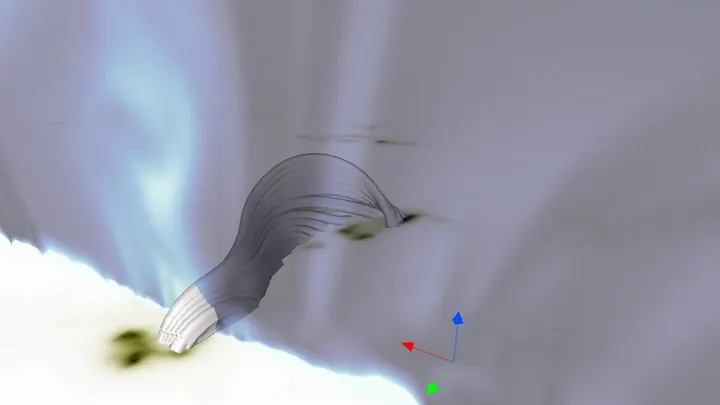
On the night of March 9–10, 2024, a cloud of plasma ejected by the Sun raced away from the star. It had already passed a distance of five solar radii when a ground-based array of 352 antennas in California's Owens Valley caught a brief radio signal from it.
Stellar2026-01-301 minarXiv:2601.23046express
Solar Flare: Two Peaks, One Magnetic Ribbon
On October 1, 2024, a class X7.1 flare erupted on the Sun — one of the most powerful. Two spacecraft, HXI and STIX, watched it from different angles, like two eyes, and together with a computer model helped reconstruct the three-dimensional picture.
Stellar2026-02-012 minarXiv:2602.01323express
The Solar Flare Mystery: Light That Shouldn't Have Been There
A solar flare is like an explosion in the atmosphere: bright, fast, with different 'voices.' X-rays come from electrons that have been accelerated and then abruptly slowed down, losing energy. But in 2017, detectors on the Fermi satellite caught a different signal — gamma rays that didn't fit this picture.
Stellar2026-02-101 minarXiv:2602.09819express
The Solar Corona: A New Way to Measure Its Density
The solar corona, the Sun's outer atmosphere, stretches millions of kilometers, yet it's visible only during a total eclipse or with specialized instruments. Typically, we gauge the corona's density by how it scatters white light, but that method relies on simplifications that can skew the results.
High Energy2026-04-232 minarXiv:2604.21883express
The Invisible Star at the Center of the Galaxy
At the center of the Milky Way lurks something invisible but extremely massive — about four million times heavier than the Sun. It is usually called a black hole and designated Sagittarius A*. But astronomers are not letting their guard down: what if it is not a hole but something more exotic, like a giant ball of ultralight particles — a boson star?
Polarization Echo: Light Catches the Gravitational Ringing of a Black Hole
When two black holes merge, they shake the very fabric of spacetime. The newborn giant doesn't settle instantly (it rings like a cosmic bell, emitting a characteristic pattern of damped gravitational waves) the so-called ringdown.
General Relativity2026-05-271 minarXiv:2605.28376express
Shadow of a Shaggy Beast: How Scalar Hair Shatters a Black Hole’s Image
A black hole isn’t a perfectly smooth ball. Einstein’s theory allows invisible 'hair' — clumps of scalar field — to swarm around it, warping spacetime. The shadow — the dark region from which light can’t escape — was predicted by Penrose in the 1960s.
The Universe's Radio Concert: How 30 Seconds of Silence Are Changing Physics
Listening to the cosmos requires patience and a finely tuned ear. Astronomers chose the most sensitive low-frequency instrument for this: the OVRO–LWA antenna array — 352 dipole antennas scattered across two and a half kilometers of California desert.
General Relativity2026-08-092 minarXiv:2608.08711express
Energy from the void: how a star without a black hole amplifies light
A black hole pulls in anything that gets too close. But if you toss in not one object but a pair, one of them can fly back out, carrying off some of the hole's rotational energy. This trick, devised by Roger Penrose in 1969, works only because a black hole has a horizon — a boundary beyond which nothing returns. Now it turns out the horizon isn't necessary.
A Thermostat 2,000 Kilometers Down
Inside Earth, at depths from 660 to 2,900 kilometers, lies a layer known as the lower mantle. There, pressures reach 1.3 million atmospheres, and temperatures rival the surface of the Sun. Under these conditions, the mineral davemaoite exists as the third most abundant mineral in the lower mantle.
How to Keep Time in the Frame of a Black Hole
A cinematographer filming a black hole faces a fundamental problem: light from different parts of the accretion disk reaches the camera at different times. The near edge flares up today, the far edge a week ago, and the jet trails months behind. If you splice all the frames without paying attention to age, you get not a movie but a collage of pieces from different times.