Кто кого растит: галактика или её чёрная дыра экспресс
Взросление галактики похоже на танец двух партнёров: в центре почти каждой крупной галактики сидит сверхмассивная чёрная дыра, и они растут вместе. Но кто ведёт в этом танце? Наблюдения за реальными галактиками дали противоречивый ответ: у спиральных, вроде нашего Млечного Пути, чёрная дыра словно тянет за собой рост галактики, а у эллиптических, похожих на раздувшиеся шары, она лишь пассивно следует за ней.
Чтобы разобраться, исследователи запустили компьютерную симуляцию NIHAO — виртуальную вселенную, где можно проследить судьбу каждой галактики от рождения до наших дней. Они сравнивали массу чёрной дыры с разбросом скоростей звёзд в центре галактики: чем быстрее мечутся звёзды, тем массивнее дыра. И тут выяснилась любопытная вещь: до пика звездообразования, когда галактика рождает звёзды как горячие пирожки, первой растёт галактика, а дыра подтягивается. После пика роли меняются — теперь уже чёрная дыра набирает массу и определяет, какой станет галактика.
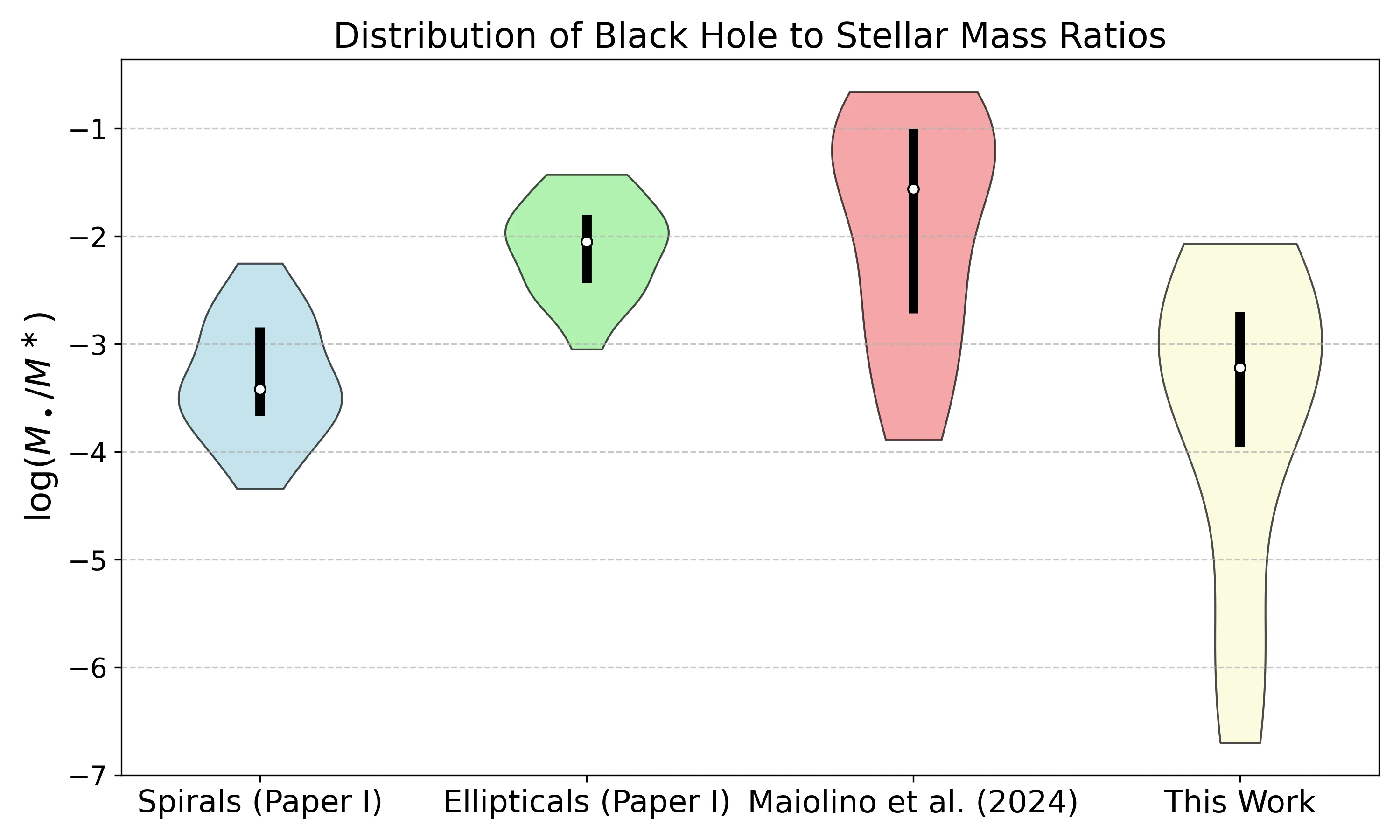
Этот разворот имеет неожиданное следствие для далёких галактик, которые мы видим в молодости Вселенной. Если применять старые формулы, чёрные дыры там кажутся непомерно раздутыми — в сотни раз тяжелее, чем должны быть. Но новые, учитывающие причинно-следственные связи, оценки показывают: древние дыры были скромнее, и никакого перекоса в их массе нет.
Оригинальная аннотация
как её написали авторы, на английском arXiv:2602.16775
The nascent methodology of applying the principles of causal discovery to astrophysical data has produced affirming results about deeply held theories concerning the causal nature behind the observed coevolution of supermassive black holes (SMBHs) with their host galaxies. The key results from observations have demonstrated an apparent causal reversal across different galaxy morphologies$$\unicode{x2014}$$SMBHs causally influence the evolution of the physical parameters of their spiral galaxy hosts, whereas SMBHs in elliptical galaxies are passive companions that grow in near lockstep with their hosts. To further explore and ascertain insights, it is necessary to utilize galaxy simulations to track the time evolution of the observed causal relations to learn more about the temporal nature of the changing SMBH/galaxy evolutionary directions. We conducted experiments with the NIHAO suite of cosmological zoom-in hydrodynamical simulations to follow the evolution of individual galaxies along with their central SMBH masses ($$M_\unicode{x25CF}$$) and properties, including central stellar velocity dispersion ($$\sigma_0$$). We reproduce the causal results from real galaxies, but add clarity by observing that the SMBH/galaxy causal directions are noticeably inverted between the epochs before and after the peak of star formation. The implications for causal reversal of the $$M_\unicode{x25CF}\unicode{x2013}\sigma_0$$ relation portend larger concerns about the reliability of SMBH masses estimated at high redshifts and presumptions of overmassive black holes at early epochs. Toward this problem, we apply updated causally-informed scaling relations that predict high-$$z$$ black hole masses that are approximately two orders of magnitude less massive, and thus not overmassive with respect to local $$z=0$$ SMBH$$\unicode{x2013}$$galaxy mass ratios.
Сверхмассивная чёрная дыра в центре Млечного Пути весит как четыре миллиона солнц, но по сравнению с галактикой это песчинка — всего одна десятитысячная процента её массы.