Как защитить квантовую память: гибридный подход экспресс
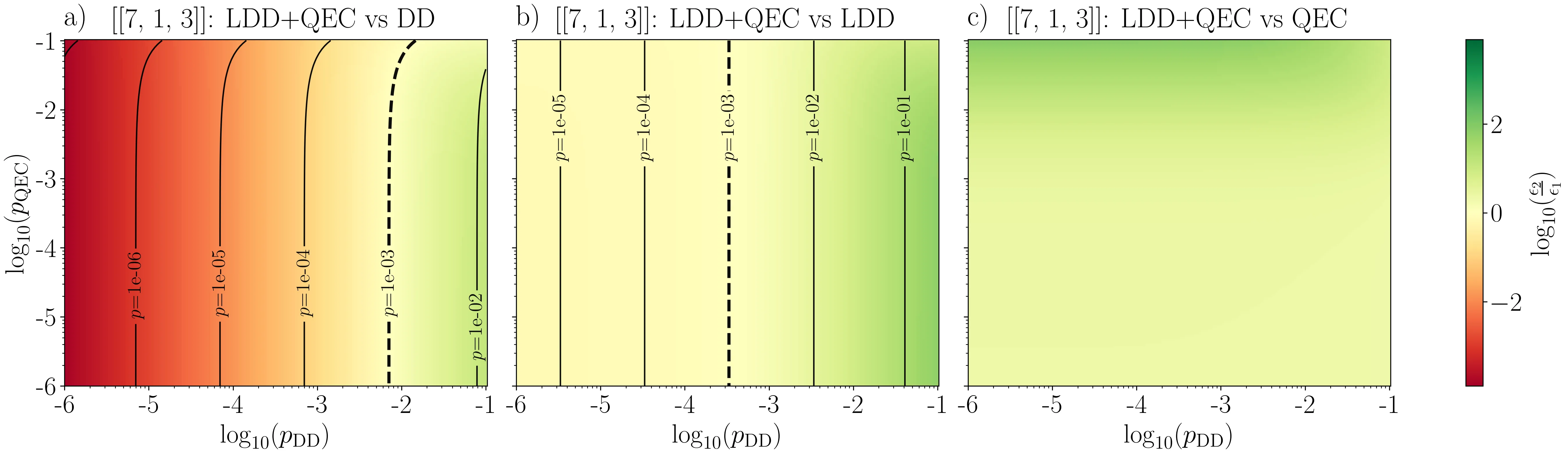
Квантовая информация хрупка: малейший шум может её разрушить. Поэтому придуманы два способа защиты. Первый — динамическая развязка: на кубиты подают быстрые импульсы, которые усредняют шум до нуля. Это похоже на то, как трясут коробку с хрупкими предметами, чтобы они не ударялись о стенки. Второй — квантовая коррекция ошибок: информацию кодируют в несколько кубитов, а затем измеряют специальные проверки, которые выявляют ошибки, не разрушая сами данные.
Но просто соединить эти методы не получается: динамическая развязка может нарушить кодовое пространство, а коррекция работает с теми ошибками, которые остались после развязки. Авторы статьи предложили делать развязку логически — то есть с помощью операций, которые сохраняют кодовое пространство. Они вывели формулы, показывающие, когда такой гибрид выигрывает у каждого метода по отдельности.
Для кода Стина [[7,1,3]] и кода [[13,1,3]] численно найдены области параметров, где гибрид лучше. Это показывает, что код, декодер и группу развязки нужно проектировать совместно, а не по отдельности.
Оригинальная аннотация
как её написали авторы, на английском arXiv:2602.19042
Quantum error correction/detection (QEC/QED) and dynamical decoupling (DD) are tools for protecting quantum information. A natural goal is to combine them to outperform either approach alone. Such a benefit is not automatic: physical DD can conflict with encoded subspace, and QEC performance is governed by the errors that survive decoding, not just those DD suppresses. We analyze a hybrid memory cycle where DD is implemented logically (LDD) using normalizer elements of an $$[[n,k,d]]$$ stabilizer code, followed by a round of syndrome measurement and recovery (or, in the detection setting, postselection on a trivial syndrome). In an effective Pauli model with physical error probability $$p$$, LDD suppression factor $$p_{DD}$$, and recovery imperfection rate $$p_{QEC}$$ (or $$p_{QED}$$), we derive closed-form entanglement-fidelity expressions for QEC-only, QED-only, LDD-only, physical DD, and the hybrid LDD+QEC protocol. The formulas are expressed via a small set of code-dependent weight enumerator polynomials, making the role of the decoder and the LDD group explicit. For ideal recovery LDD+QEC outperforms QEC-only iff the conditional fraction of uncorrectable Pauli errors is larger in the LDD-suppressed sector than in the unsuppressed sector. In the low-noise regime, a sufficient design rule guaranteeing hybrid advantage is that LDD suppresses at least one minimum-weight uncorrectable Pauli error for the chosen recovery map. We show how stabilizer-equivalent choices of LDD generators can enforce this condition. We supplement our analysis with numerical results for the $$[[7,1,3]]$$ Steane code and a $$[[13,1,3]]$$ code, mapping regions of hybrid-protocol advantage in parameter space beyond the small-$$p$$ regime. Our work illustrates the need for co-design of the code, decoder, and logical decoupling group, and clarifies the conditions under which the hybrid LDD+QEC protocol is advantageous.
Код Стина — один из самых известных квантовых кодов, исправляющих одну ошибку. Он использует 7 кубитов для защиты одного логического кубита.
В сериале «Пространство» квантовые компьютеры защищают от шума с помощью сложных кодов — как раз то, что исследуется в этой работе.