Солнечные спикулы: как корона получает тепло экспресс
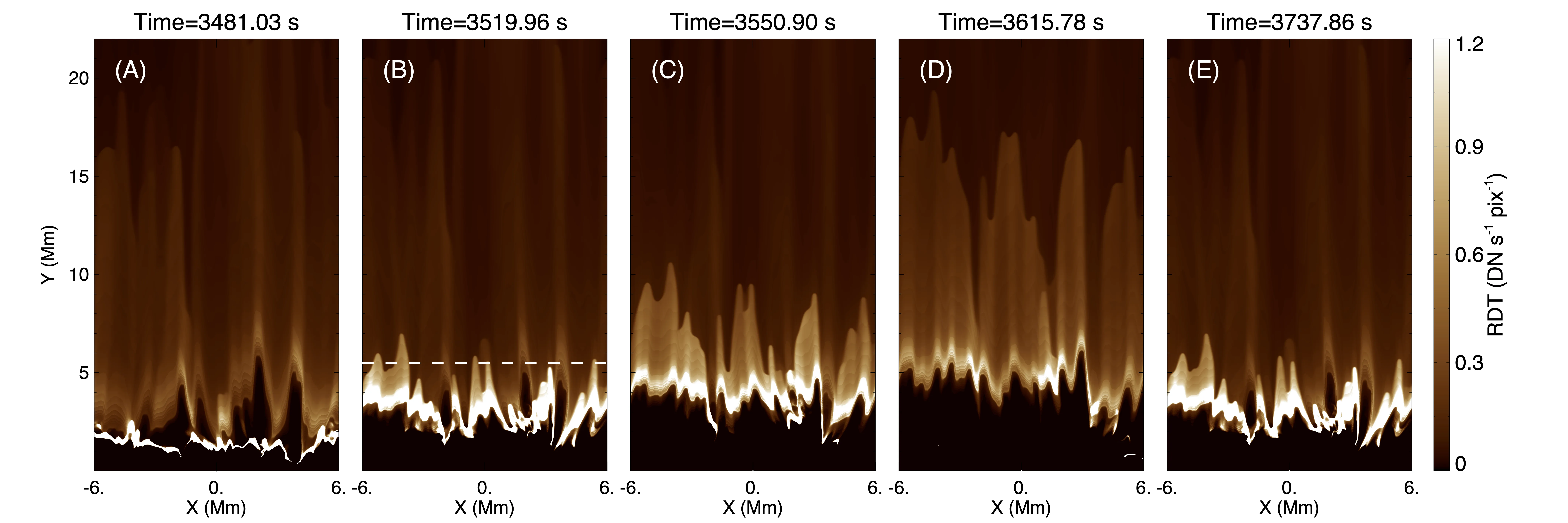
Поверхность Солнца кипит, как вода в кастрюле. Горячий газ поднимается, остывает и опускается — это конвекция. Вокруг бурлят магнитные поля, которые рвутся и снова соединяются. В этой суете рождаются спикулы — узкие струи плазмы, которые взлетают на тысячи километров вверх. Они живут всего несколько минут, но успевают передать энергию внешней атмосфере Солнца.
Спикулы не просто взлетают — они толкают перед собой волны и ударные фронты. Эти волны сжимают газ и нагревают его. Так энергия от поверхности добирается до короны — разреженного внешнего слоя, который в сотни раз горячее самой поверхности. Без спикул корона остыла бы, и солнечный ветер в корональных дырах иссяк.
Так одна маленькая струя за другой, как насос, качает тепло в корону. Спикулы — не просто красивое зрелище на краю солнечного диска. Это ключ к загадке, которая мучила астрофизиков 80 лет: почему корона горячее поверхности.
Оригинальная аннотация
как её написали авторы, на английском arXiv:2602.19953
How the solar atmosphere is heated from a temperature of about $$5,000-6,000$$\,K in the lower atmosphere to about $$1-2$$\,MK in the corona has challenged the astrophysical community for about 80 years. The same puzzle exists for the stellar coronae heating as well. In this study, we present a series of findings on solar spicules and their subsequent impact on the corona within a coronal hole environment, characterized by locally open magnetic field lines, combining insights from MHD simulations with observations. We find that the convective and turbulent motions around the solar surface cause plenty of shocks and small-scale magnetic reconnection in the lower atmosphere. The combined effects of shock compression and reconnection outflows then drive the formation of groups of spicules with a quasi-period of about $$300$$\,s and width of $$\sim 200-500$$\,km. The spicule upflows provide an averaged mass flux above $$10^{-9}$$\,kg\,m$$^{-2}$$\,s$$^{-1}$$ in the lower corona to sustain the solar wind in coronal holes, and they continuously trigger further new local slow-mode waves and shocks. These waves supply an energy flux of $$10-100$$\,W\,m$$^{-2}$$ in the lower corona, and they are dissipated by heat conduction and compression heating to sustain the corona temperature of about $$1$$\,MK. The results also indicate that the upward propagating disturbances (PDs) observed in extreme ultraviolet (EUV) passbands are caused by both spicule upflows and slow-mode waves and shocks. Our findings help to understand the long standing problem of coronal heating and the origin of solar winds in coronal hole regions.
Температура короны Солнца — около миллиона градусов, а поверхность — всего 5500 градусов. Это как если бы воздух вокруг костра был горячее самого пламени.