Квантовый судья: решение без улик экспресс
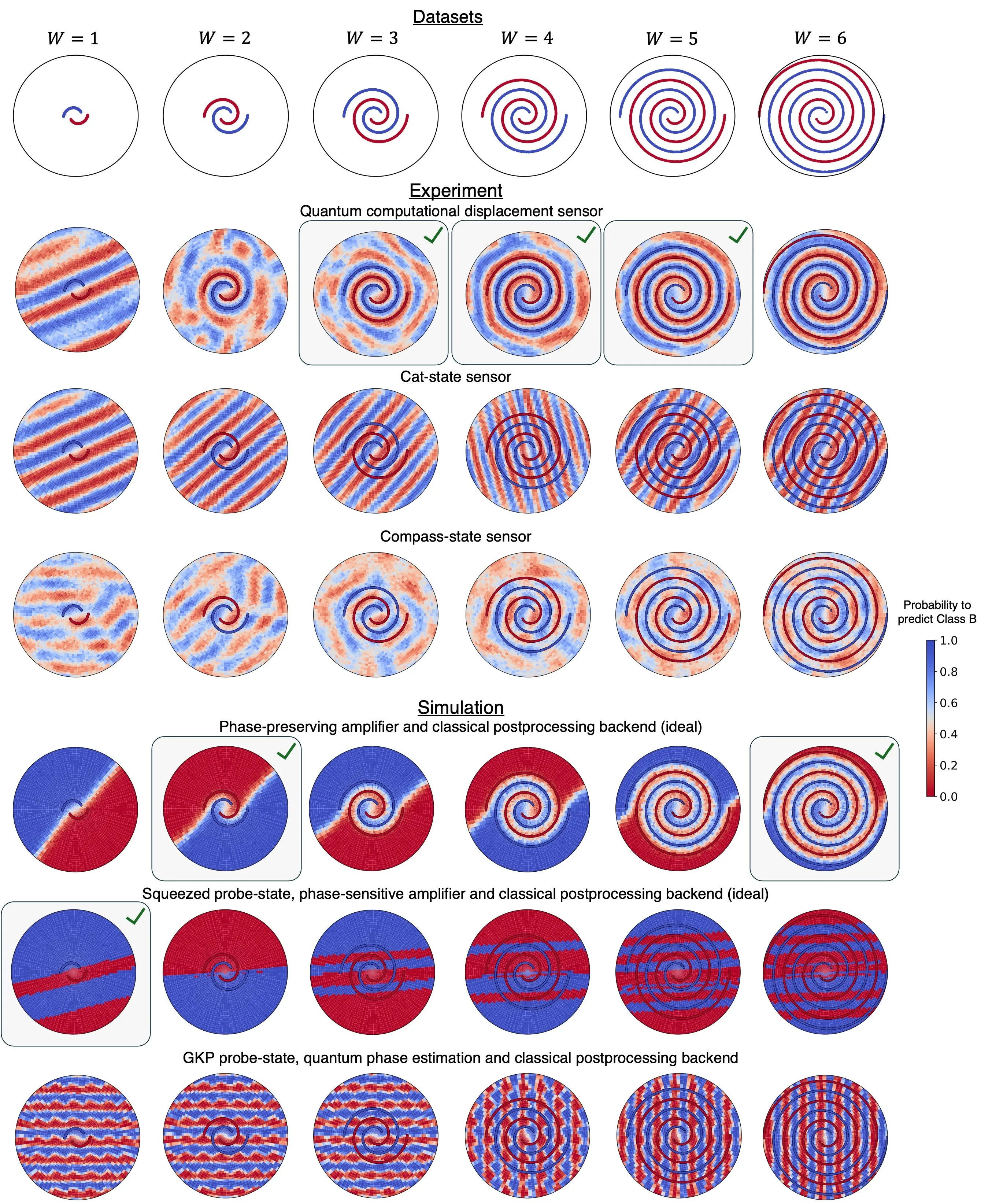
Судья заходит в зал, но не смотрит на улики — он сразу выносит приговор. Так работает новый квантовый датчик: он не измеряет сигнал, а сразу решает, к какому классу тот относится.
В обычном квантовом зондировании всё как в детективе: сначала собирают улики (измеряют сигнал), потом анализируют. Но учёные предложили иной путь — объединить квантовое измерение и квантовые вычисления в одной схеме. Схема из сверхпроводящего кубита (квантового бита) и осциллятора (резонатора) настраивается так, чтобы после одного измерения кубита сразу выдать ответ: «да» или «нет».
Эксперимент показал: чем больше слоёв в схеме, тем точнее классификация. На отдельных задачах квантовый подход обогнал классическую альтернативу на 15 процентных пунктов. Это как если бы судья, минуя изучение улик, сразу угадывал виновного с большей точностью, чем следователь после долгого анализа.
Квантовый судья пока работает на простых задачах с шумным оборудованием, но уже ясно: иногда не нужно знать всё, чтобы принять верное решение.
Оригинальная аннотация
как её написали авторы, на английском arXiv:2604.13177
Quantum computational sensing (QCS) combines quantum sensing with quantum computing to extract task-relevant information from the physical world. QCS can in principle achieve an accuracy advantage for specific tasks versus the alternative of raw-signal estimation using conventional quantum sensing followed by task-specific classical postprocessing. Here we report the experimental demonstration of quantum computational displacement sensing (QCDS) with a superconducting circuit comprising a qubit coupled to an oscillator. We consider binary classification sensing tasks, where the goal is to predict the class label of a single complex-valued displacement sensed once by the oscillator. Rather than estimating the displacement, our computational-sensing protocol -- using parameterized quantum circuits before and after sensing -- attempts to determine the binary class label using quantum processing and map it onto the ground or excited state of the qubit. A single measurement of the qubit directly outputs the prediction. We implemented circuits with up to 24 entangling gates and 38 free parameters, which were trained in silico. We show that increasing the circuit depth systematically improves expressivity and classification accuracy. We experimentally obtained an accuracy advantage over a suite of protocols that first use conventional quantum sensing to estimate the displacement before using classical postprocessing to perform prediction. For certain tasks, our protocol achieves a 15-percentage-points higher classification accuracy than the best conventional approach considered. Our results establish the feasibility of quantum computational sensing with noisy superconducting hardware and illustrate how integrating quantum computation with quantum sensing can enhance performance when the goal is to estimate a property or function of a signal rather than to estimate the signal.
Схема обучалась на компьютере (in silico), а затем переносилась на реальное сверхпроводящее устройство — как пилот отрабатывает манёвры на симуляторе перед полётом.
В сериале «Пространство» детектив Миллер использует интуицию, чтобы найти пропавшую девушку, не имея прямых улик — похоже на то, как квантовый датчик выносит вердикт без полного измерения сигнала.