Горячие точки из крошечных чёрных дыр экспресс
Крошечная чёрная дыра пролетает сквозь облако газа. Она не поглощает его, а наоборот — греет, как утюг, оставленный на мокрой ткани. От неё исходит излучение, и вокруг возникает горячее пятно — область, где температура в сотни раз выше, чем в окружающем космосе.
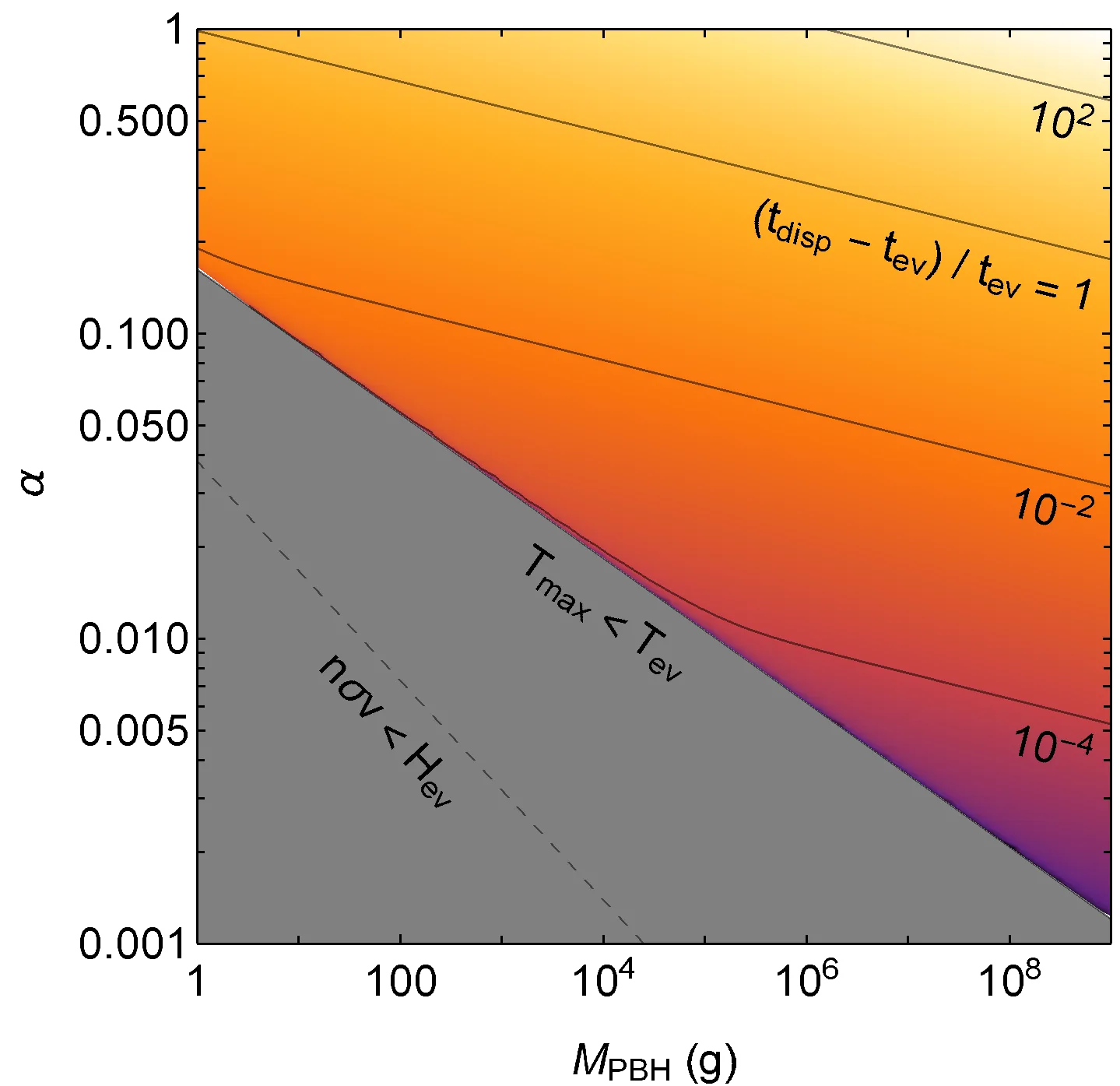
Раньше считалось, что такие пятна живут почти вечно, остывая медленно и по одному и тому же закону. Но в новой работе учли, что Вселенная расширяется. Расширение работает как вентилятор: оно уносит тепло быстрее, чем оно расползается само. Горячая точка сначала резко теряет температуру, а потом остывает по более крутому закону — не так, как в статичном мире.
В итоге все горячие точки исчезают за конечное время. Это важный вывод: если такие точки действительно существовали в ранней Вселенной, их следы могли бы сохраниться до наших дней только при особых условиях. Теперь понятно, что искать их нужно иначе — не как вечные маяки, а как короткие вспышки, которые давно погасли.
Оригинальная аннотация
как её написали авторы, на английском arXiv:2605.08336
Light primordial black holes heat the surrounding plasma via Hawking radiation, forming localized hotspots whose temperature may far exceed that of the cosmological background. Previous studies of hotspot formation and cooling have treated the subsequent energy transport in flat spacetime, thereby neglecting the expansion of the Universe. We formulate the diffusion equation governing the hotspot evolution, in an expanding universe, and clarify the regime in which the formalism is valid. We find that hotspot formation is robust against cosmological expansion. We show that the critical distance scale, where Hubble expansion overtakes diffusion, coincides with the decoupling radius introduced in earlier work, and the temperature profile $$T\propto r^{-7/11}$$ essentially remains unchanged. However, the cooling stage is substantially modified. We find that the plateau temperature of a cooling hotspot initially undergoes a rapid drop and then follows $$T_{\rm plt} \propto t^{-11/15}$$, steeper than the flat-spacetime scaling $$t^{-7/15}$$. This scaling cannot be obtained by simply redshifting the flat-spacetime solution, because expansion also suppresses diffusive transport. As a consequence, all hotspots disappear within a finite time, as opposed to the flat-spacetime prediction of everlasting hotspots in part of the parameter space.
Температура горячей точки может в тысячи раз превышать температуру окружающего газа — как если бы в ледяной воде вдруг оказался кипяток.