Почему даже тяжёлый прибор дрожит экспресс
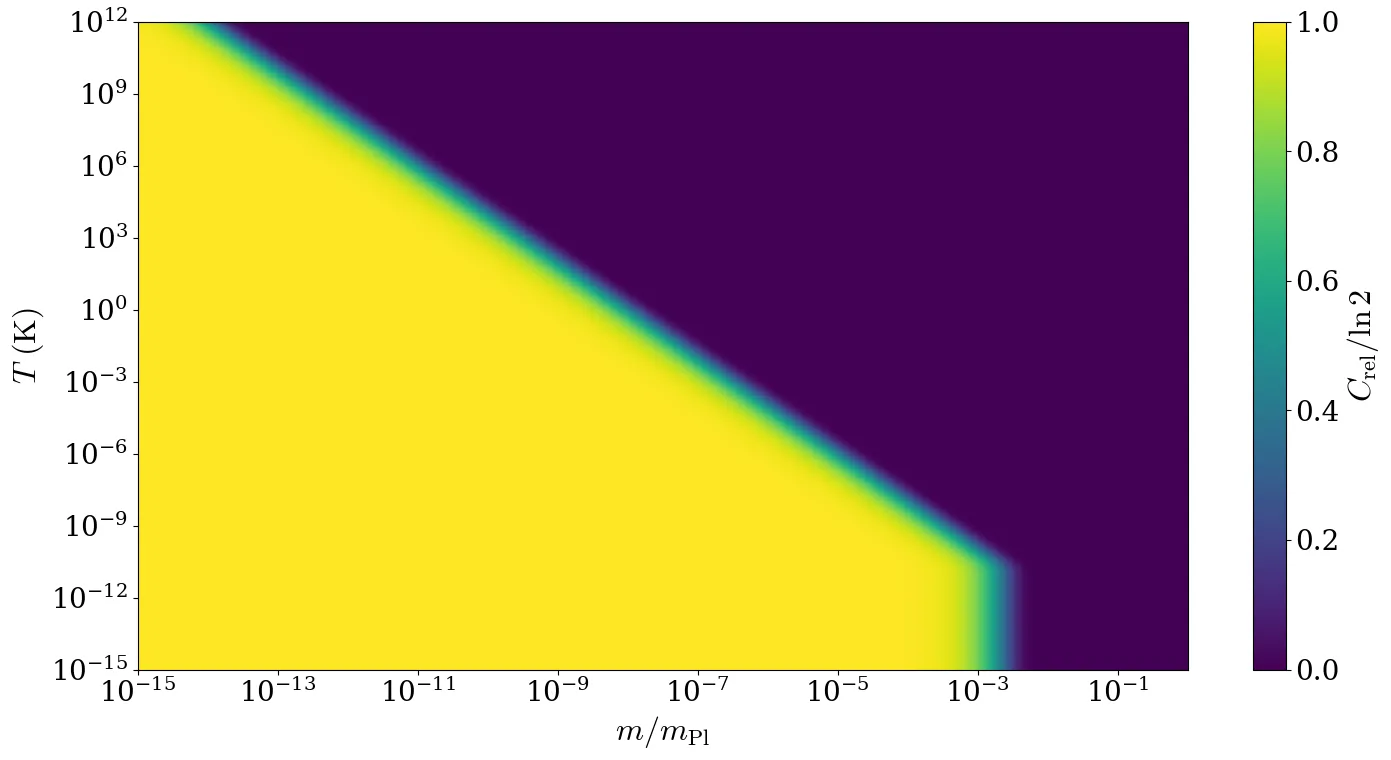
Квантовый мир любит баланс. Когда массивную частицу заставляют раздвоиться — пойти сразу двумя путями, — что-то должно качнуться в ответ. Этим «чем-то» оказывается сам прибор, который частицу разделил.
Тяжёлая платформа стоит на мягких пружинах. Вы резко толкаете от неё тележку в одну сторону — платформа чуть отъезжает в другую. Так и здесь: прибор, создающий суперпозицию, получает микроскопическую отдачу. Его центр масс смещается. Если этот сдвиг больше, чем размытость положения самого прибора в квантовом смысле, частица и прибор запутываются. Квантовая согласованность частицы теряется — не из-за шума или тепла, а из-за самой геометрии опыта.
Авторы вывели простое правило: чтобы сохранить суперпозицию частицы с размахом $d$, прибор массы $M$ должен быть либо очень холодным, либо очень жёстко прикручен к столу. Иначе его дрожь смажет картину. Любопытно, что ограничение действует даже для частиц намного легче планковской массы и для весьма массивных приборов. Скажем, в опытах по гравитационному запутыванию двух частиц отдача зеркал или ловушек может стать решающей помехой.
Это не приговор, а ориентир. Зная предел, можно заранее рассчитать, какой стол, какое охлаждение и какая жёсткость нужны, чтобы квантовый танец состоялся.
Оригинальная аннотация
как её написали авторы, на английском arXiv:2607.08819
Preparing massive particles in coherent spatial superpositions is a central objective of modern quantum science, motivated by applications ranging from fundamental tests of quantum mechanics and gravity to quantum-enhanced sensing. The experimental difficulty of realizing such superpositions is usually attributed to environmental decoherence mechanisms whose impact depends on the details of the experimental implementation. Here we identify a universal constraint arising from momentum conservation and the quantum nature of the preparation apparatus. Any protocol that places a particle of mass $$m$$ in a spatial superposition with separation $$d$$ necessarily entangles the particle with the center-of-mass degree of freedom of the apparatus responsible for the splitting. The resulting recoil displacement, fixed by conservation of the mass dipole moment, reduces the coherence of the particle when the apparatus is not included as part of the quantum system. For an apparatus of mass $$M$$, preserving coherence requires the recoil displacement to remain smaller than the coherence length of the apparatus center-of-mass state, leading to a quantitative bound expressible as a constraint on its temperature and on how rigidly the apparatus is anchored to the laboratory frame. We analyze the implications of this bound for current matter-wave interferometry experiments, proposals for gravitationally mediated entanglement, and tests of quantum mechanics near the Planck scale. Our main result, which may seem counterintuitive, is that the recoil of even heavy macroscopic apparatuses can pose a surprisingly strong constraint on the coherence of spatial superpositions of particles with masses well below the Planck mass. Finally, we discuss why the resulting limitation should be regarded as a conservative estimate and under which conditions it can be interpreted as an instance of false decoherence.
Планковская масса — примерно 22 микрограмма, это масса крупинки соли. Вся «тяжёлая» квантовая механика пока работает с массами в миллиарды раз меньше.