Как стареют звёзды: ключ в скорости вращения экспресс
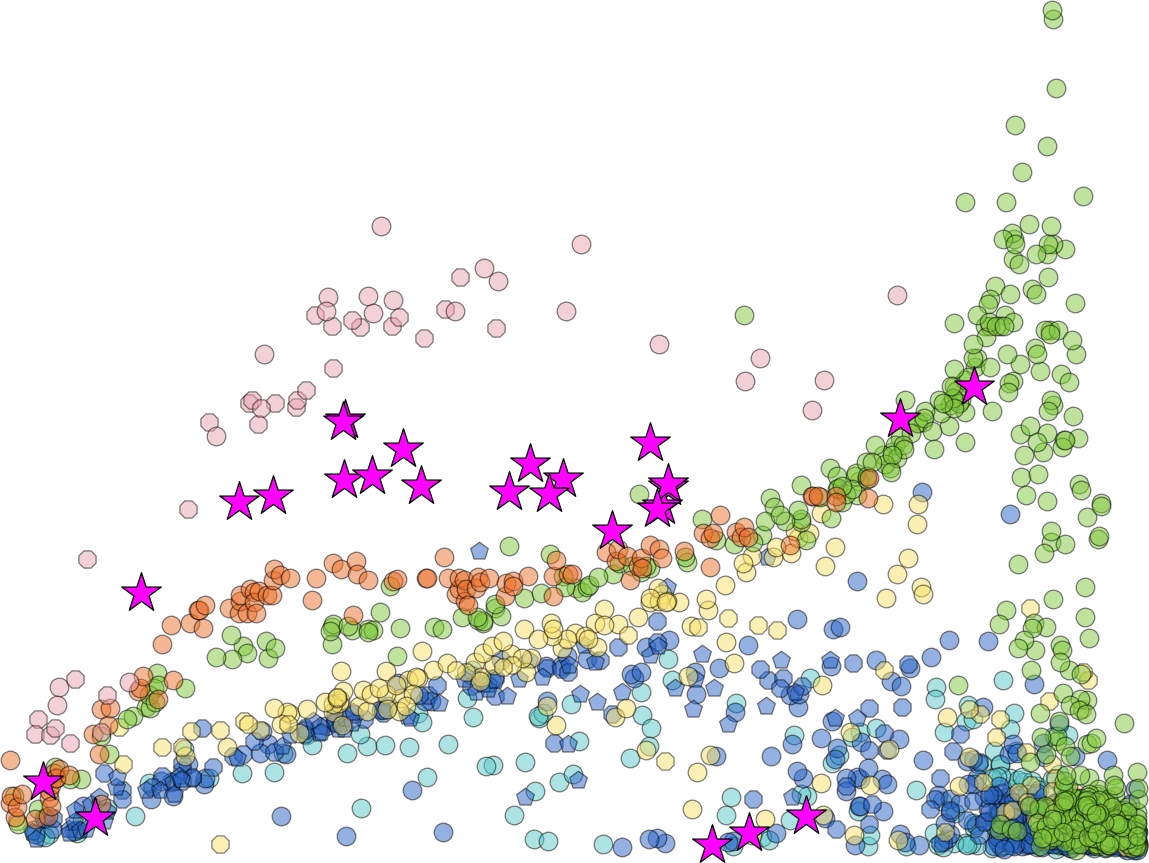
Звёзды похожи на волчки: рождаются быстрыми, а со временем замедляются. Этот процесс — как песочные часы: чем медленнее вращается звезда, тем она старше. Астрономы используют эту закономерность, чтобы определять возраст звёзд, но для этого нужны эталонные группы звёзд с известным возрастом.
Рассеянное скопление NGC 752 — это такая группа звёзд, родившихся вместе около 1,3 миллиарда лет назад. Оно заполняет пробел между более молодым скоплением NGC 6811 (1 миллиард лет) и более старым NGC 6819 (2,5 миллиарда лет). Раньше для NGC 752 не удавалось измерить скорости вращения нужных звёзд, поэтому калибровка «возраст–вращение» была неточной.
Сравнение с моделями показало: существующие методы завышают возраст многих звёзд на 20–50%. Причина — отсутствие данных для промежуточных возрастов. NGC 752 теперь служит надёжным якорем для улучшения оценок возраста. Это особенно важно, потому что будущие космические миссии, такие как Gaia DR4, Roman и PLATO, измерят периоды вращения десятков миллионов звёзд, и точность калибровки станет главным ограничением.
Оригинальная аннотация
как её написали авторы, на английском arXiv:2608.10077v1
Empirical gyrochronology relies on co-eval stellar associations to map stellar rotation as a function of mass and age. The accuracy of its age predictions is therefore limited by the number and quality of benchmark rotation sequences. The well-characterized clusters NGC-6811 (t ~ 1 Gyr) and NGC-6819 (t ~ 2.5 Gyr) bracket an intermediate-age interval in which stellar spin-down remains poorly constrained due to lack of available rotation data. At t ~ 1.3 Gyr, NGC-752 provides a critical benchmark within this gap, but previous measurements could not define the G- and K-dwarf rotation sequence needed for calibration. Here, we combine Gaia-based NGC-752 membership lists with literature rotation periods to map NGC-752's slow-rotator sequence for the first time. We identify a well-defined sequence intermediate between those of NGC-6811 and NGC-6819. Stars near Teff ~ 4500 K rotate more slowly than their counterparts in NGC-6811, indicating that stars experiencing stalled spin-down at ~1 Gyr have resumed appreciable spin-down by the age of NGC-752. Adopting an age of 1.3 Gyr for NGC-752, we further show that existing empirical gyrochronology models overestimate the ages of many G and early-K dwarfs by 20--50% because they lack intermediate-age calibration data, although uncertainty in the absolute age of NGC-752 may account for part of this offset. NGC-752 therefore provides a necessary anchor for improving rotational age estimates. This calibration is especially timely because Gaia DR4, Roman, and PLATO are expected to yield rotation periods for tens of millions of stars, making the age coverage of benchmark sequences a principal limitation on large-scale gyrochronology.
Скопление NGC 752 видно даже в бинокль в созвездии Андромеды, и оно старше, чем горы на Земле, но моложе, чем самые древние окаменелости.