أمواج الخلط في الرياح الشمسية: كيف تسخن الهالة سريع
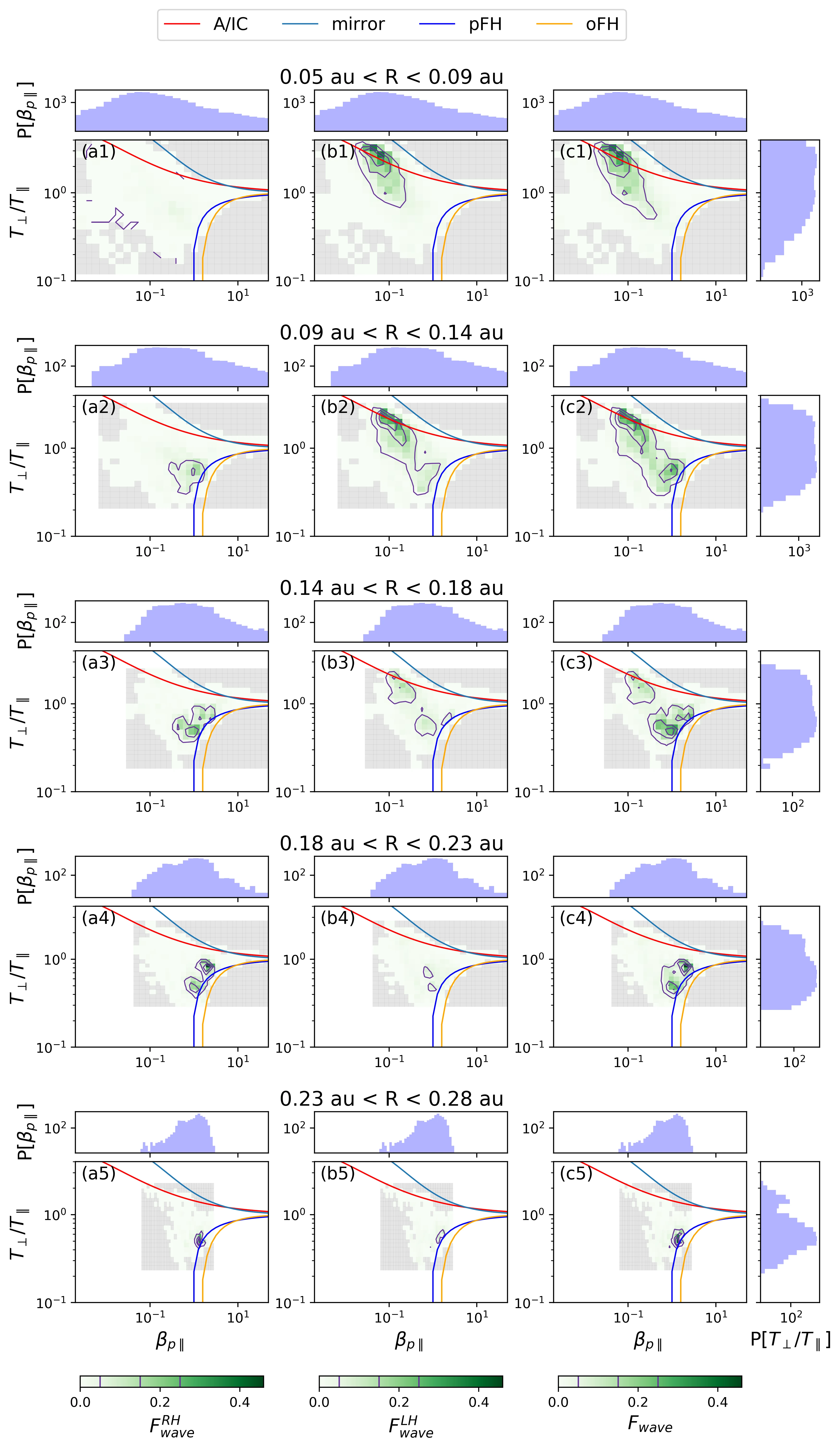
الرياح الشمسية ليست جدولًا هادئًا، بل حساءً فقاعيًا من الجسيمات المشحونة. مسبار باركر، الذي غاص إلى الشمس نفسها، التقط نوعين من موجات الخلط. الموجات الملتفة يسارًا، مثل مخفقة في يد طبّاخ، تخفق المادة عندما تختلف درجة الحرارة على طول الحركة وعبرها. تعصف هذه الموجات قرابة ثلث الوقت قرب النجم، مما يزيد نسبة أسرع الجسيمات - تمامًا كخلاط يدفع الرغوة إلى السطح.
الموجات الملتفة يمينًا
التحليل الدقيق للضوء (المطيافية) والتعلم الآلي سمحا بالتقاط اللحظة التي تولد فيها النفاثات الحرارية الموجات اليمنى. من المفارقة أن هذا التموج الخفي، وليس المقذوفات العظيمة، هو المسؤول عن تسخين الهالة العملاقة - التي تبلغ حرارتها مئات المرات أعلى من سطح الشمس. على إيقاع هذه الموجات يعتمد الطقس الفضائي عند الأرض.
الملخص الأصلي
كما كتبه المؤلفون، بالإنجليزية arXiv:2512.11182
Parker Solar Probe (PSP) observes abundant circularly polarized ion-scale waves throughout the inner heliosphere. These waves are a signature of the interplay between plasma microinstabilities and turbulent dissipation. We perform a mission-wide statistical survey of ion-scale waves observed by PSP, investigating if the waves correspond to specific free energy sources in the measured proton velocity distributions. We find that left-handed waves (LHWs) are frequently observed, with the fraction of time they are observed increasing closer to the Sun, reaching $$\sim$$30\%. Right-handed waves (RHWs) are less frequently observed, with the associated time fraction decreasing closer to the Sun. The observed LHWs are generally consistent with parallel propagating ion cyclotron wave (ICW) storms that occur continuously for extended periods of time. Turbulent energy spectra are consistently steeper when LHW storms are observed; these wave storms mediate the spatial transport of the free energy associated with temperature anisotropy. The observed RHWs are generally consistent with oblique and parallel fast magnetosonic waves (FMWs), and their observation is well correlated with enhanced proton parallel heat flux, which quantifies the presence of secondary proton populations. Using observations and the SAVIC machine learning instability identification algorithm, we identify a threshold on the proton heat flux beyond which FMWs are likely to be driven unstable by the proton beams. We are thus able to associate trends in the observed ion-scale waves with known sources of free energy for Encounters 3 through 24 of the PSP's prime science phase.
تفقد الرياح الشمسية كتلة تعادل جبل إفرست تقريبًا كل دقيقة.