ومضات صغيرة على الشمس سريع
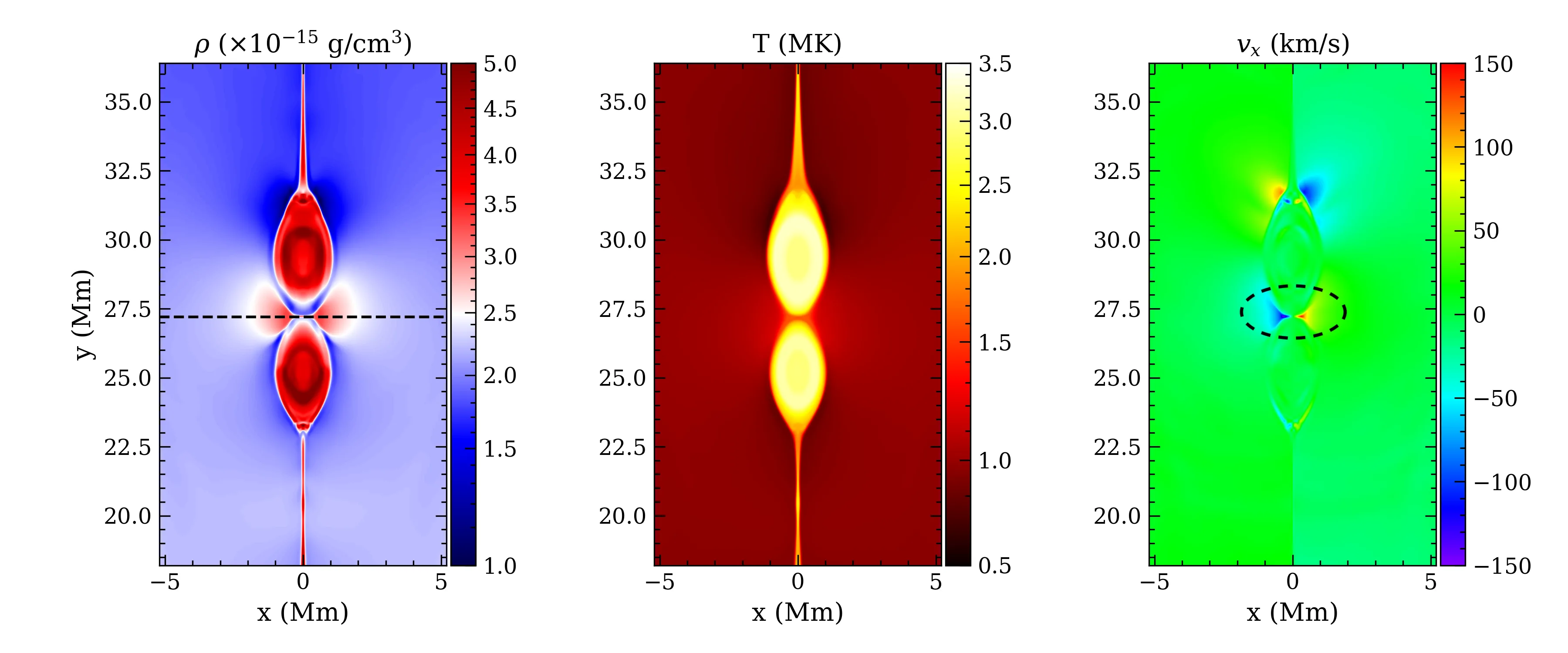
تحدث على الشمس بين الحين والآخر قذفات بلازما قصيرة تُعرف بالنفاثات النانوية. حجمها بحجم مدينة صغيرة، وتنطلق بسرعة مئات الكيلومترات في الثانية، وتختفي في أقل من نصف دقيقة. كل ومضة من هذه الومضات تشبه انفجارًا صغيرًا يقذف غازًا ساخنًا إلى الأعلى.
يشتبه علماء الفيزياء الفلكية في أن هذه النفاثات النانوية هي التي تُسخّن الهالة الشمسية إلى ملايين الدرجات، رغم أن سطح الشمس أبرد بمئات المرات. لكن رصدها مباشرة أمر صعب: فهي صغيرة وسريعة جدًا. لذلك بنى العلماء نموذجًا حاسوبيًا يندمج فيه حبلان مغناطيسيان داخل حلقة شمسية ليكوّنا نفاثة نانوية — تمامًا كشريطين مطاطيين ملتويين، عندما ينفكّ التواءهما يقذفان إلى الأعلى.
أظهر النموذج كيف ينبغي أن تبدو هذه الومضة في الضوء فوق البنفسجي الذي تلتقطه التلسكوبات الحديثة. واتضح أن آثار النفاثات النانوية يمكن تمييزها من خلال السطوع، والانزياح الدوبلري (تغير لون الضوء بسبب الحركة)، واتساع الخطوط الطيفية. وهذا يعني أن الأدوات المستقبلية، مثل مهمة MUSE، ستتمكن من العثور على النفاثات النانوية والتحقق مما إذا كانت تُسخّن الهالة فعلًا.
وهكذا يصبح النموذج الحاسوبي جسرًا بين النظرية والرصد: الآن يعرف الفلكيون ما الذي يبحثون عنه في البيانات لالتقاط النفاثات النانوية المراوغة.
الملخص الأصلي
كما كتبه المؤلفون، بالإنجليزية arXiv:2601.03354
Detection and characterization of small-scale energetic events such as nanoflares and nanojets remain challenging owing to their short lifetimes, small spatial extent, and relatively low energy release, despite their potential role in coronal heating. Recent observations have identified nanojets as small-scale (length $$\lesssim 6.6$$~Mm, width $$\lesssim 1$$~Mm), fast ($$\sim$$~few 100 km s$$^{-1}$$), and short-lived ($$\lesssim 30$$~s) ejections associated with nanoflare-scale energies, providing evidence of magnetic reconnection at small spatial scales. However, the lack of synthetic diagnostics has limited the connection between magnetohydrodynamic (MHD) models and observations. In this Letter, we present synthetic observations of the coalescence of two flux ropes, leading to nanojet-like signatures from a numerical model obtained with the \texttt{MPI-AMRVAC} code. We report synthetic observables in Extreme-ultraviolet lines compatible with existing instruments such as SDO/AIA, and upcoming MUSE mission, and compare the synthetic observables with an existing observation of nanojets. The synthetic diagnostics of the emissivity maps, Doppler velocity, thermal, and non-thermal line broadening produce key observational properties, suggesting a plausible 3D scenario for nanojet generation where tiny flux ropes reconnect within loops. Our results provide predictions for the detectability of nanojets with current and future spectroscopic facilities, and establish a bridge between MHD modeling and observations.
تُطلق النفاثة النانوية في 30 ثانية طاقة تكفي لتشغيل مصباح عادي لمليار سنة، لكن بمقاييس الشمس هي ومضة صغيرة.