ثوانٍ تُغيّر كل شيء سريع
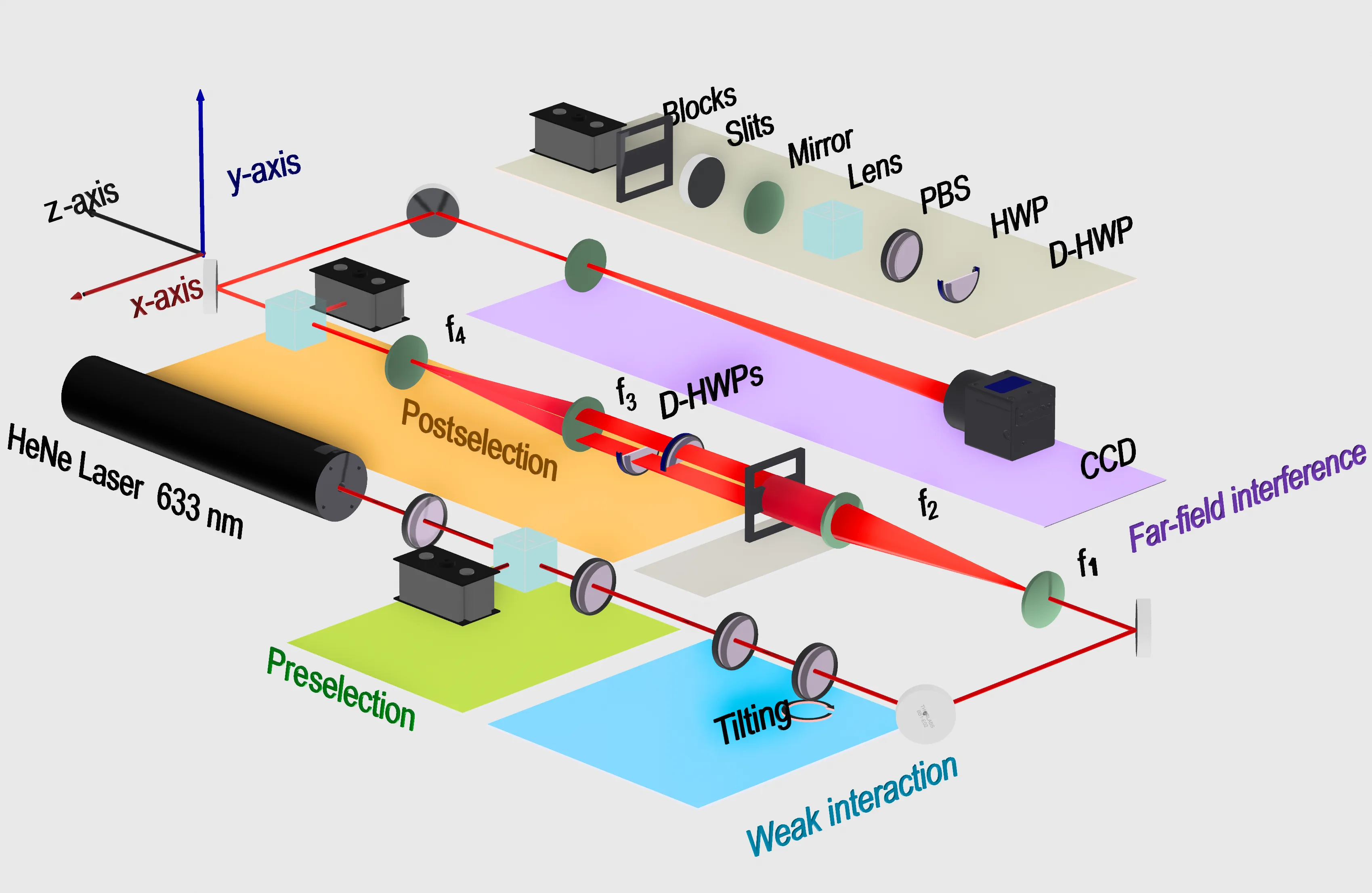
الضوء الذي يمر عبر شقوق ضيقة يمكن أن يكشف عن تأخيرات غير مرئية للعين. في تجربة جديدة، جعل الفيزيائيون شعاع ليزر يمر عبر شقّين في وقت واحد، وقاسوا مقدار تأخر جزء من الموجة عن الآخر. بلغ التأخير عدة أتوثانية — وهي جزء من مليار من مليار جزء من الثانية. لفهم المقياس: في أتوثانية واحدة، يقطع الضوء مسافة أصغر بثلاث مرات من قطر ذرة الهيدروجين.
الطرق التقليدية لقياس مثل هذا الإزاحة الضئيلة تغرق في الضوضاء — تذبذبات عشوائية تحجب الإشارة. هنا طُبّقت تقنية تُسمى التضخيم الضعيف: تُضعف الإشارة أولاً، ثم تُقاس بطريقة تبرز الجزء المفيد على خلفية الضوضاء. ونتيجة لذلك، زادت الدقة مئة ضعف مقارنة بالتجارب السابقة. الاستنتاج الأساسي: تقل الضوضاء تماماً بقدر ما يزداد عدد الفوتونات الملتقطة — جسيمات الضوء. هذا يعني أن الطريقة تعمل عند الحد الذي تسمح به الطبيعة نفسها.
هذه الدقة ليست مطلوبة فقط لتحطيم الأرقام القياسية. كاشفات الموجات الثقالية — تموجات المكان نفسه — تلتقط إشارات تتغير في أجزاء من الثانية. كلما قلّت الضوضاء، أمكن رصد موجات أضعف. ربما تساعد هذه الطريقة في سماع اصطدامات الثقوب السوداء في أقصى الكون.
الملخص الأصلي
كما كتبه المؤلفون، بالإنجليزية arXiv:2602.17035
We report a quantitative evaluation of weak-value amplification (WVA) for longitudinal phase measurements using Allan variance analysis. Building on a recent double-slit interferometry experiment with real weak values [Phys. Rev. Lett. 134, 080802 (2025)], our Allan variance analysis demonstrates measurement of a few attosecond time delay approaching the shot noise limit at short averaging intervals of $$T$$ = $$0.01-0.1$$ s, representing two orders of magnitude variance reduction compared to the $$T=300$$ s operating point in prior implementations. We demonstrate that the Allan-variance noise floor scales with the inverse of the detected photon number $$1/N_r$$, confirming shot-noise-limited operation with WVA. Furthermore, this $$1/N_r$$ scaling experimentally validates that WVA can outperform conventional measurement under fixed detected photon number and detector saturation, in the presence of technical noise, as theoretically predicted [Phys. Rev. Lett. 118, 070802 (2017)]. Our results provide rigorous, quantitative evidence of the near-optimal noise performance achievable with WVA, establishing a new benchmark for precision optical metrology. This advancement is particularly relevant to applications such as gravitational-wave detection, where signals predominantly occupy the high-frequency regime ($$>10$$ Hz).
الأتوثانية قصيرة جداً لدرجة أن الضوء يقطع في أتوثانية واحدة مسافة أصغر من حجم الذرة.