ضوء المجرات البعيدة: كيف نميّز الهادئة منها عن المضطربة سريع
المجرة ليست مجرد حشد من النجوم. ففي مركز الكثير منها يتوهج شيء أشد سطوعًا من مليارات الشموس: غاز محمّى يتساقط نحو ثقب أسود. ومن لون هذا التوهج يمكننا أن نفهم أي حياة تعيشها المجرة — هل تولّد النجوم بهدوء أم تلتهم المادة بعنف.
في السابق، كان علماء الفلك يزيلون ضوء النجوم يدويًا ويفصلون الخطوط المتقاربة في الطيف، مثل طاهٍ دقيق يفصل صفار البيضة عن بياضها. وهذا يستغرق وقتًا طويلًا وقد يؤدي أحيانًا إلى أخطاء. الأداة الجديدة تعمل بشكل مختلف: فهي تنظر فقط إلى بضع "شرائط ملونة" ساطعة — خطوط الهيدروجين والأكسجين — وتصدر حكمها فورًا.
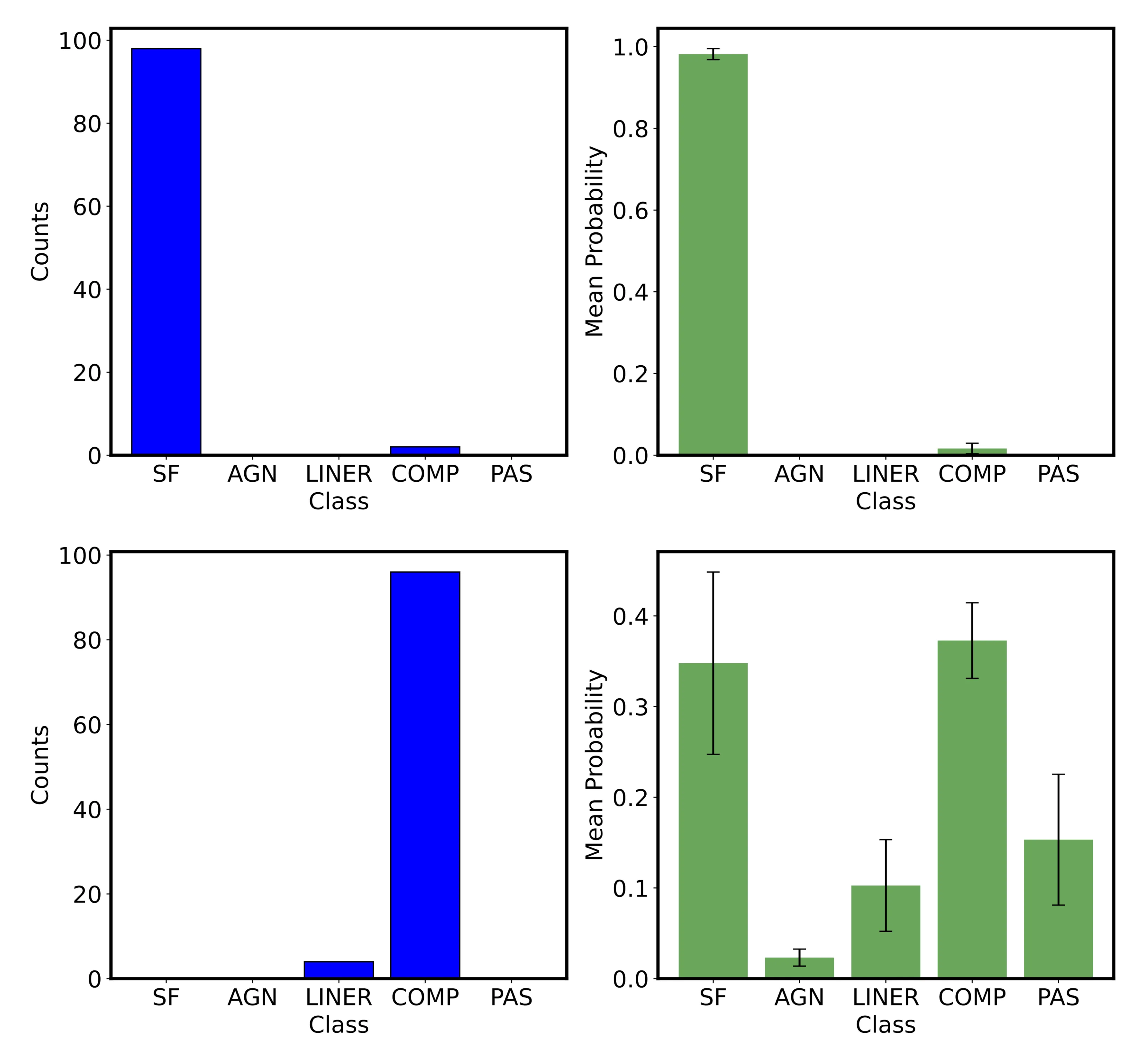
الدقة تبلغ 83%، وبالنسبة للمجرات الهادئة تصل إلى 96%. والأداة لا تحتاج إلى معرفة المسافة إلى المجرة أو معايرة السطوع. يكفي جزء ضيق من الطيف، لذا تصلح الطريقة حتى لأبعد الأجرام التي تظهر كنقاط خافتة.
بهذه الطريقة، سيتمكن الفلكيون من فرز آلاف المجرات بسرعة والعثور بينها على النوى النشطة النادرة — مثل فارز يحدد بنظرة واحدة إلى لون التفاحة ما إذا كانت ناضجة أم لا.
الملخص الأصلي
كما كتبه المؤلفون، بالإنجليزية arXiv:2602.20343
Reliable, versatile galaxy activity diagnostics are essential for understanding galaxy evolution. Traditional methods frequently necessitate extensive preprocessing, such as starlight subtraction and emission line deblending (e.g., H{\alpha} and [N II]), which can introduce substantial biases and uncertainties due to their model-dependent nature. In this work we developed an automated, diagnostic tool capable of distinguishing between star-forming (SF), active galactic nuclei (AGN), low-ionization nuclear emission-line regions (LINERs), composite, and passive galaxies. We developed a diagnostic tool based on a support vector machine trained on data from optical emission-line ratios and color selection criteria. From literature studies and exploring combinations of discriminatory feature schemes, we found that the equivalent widths of H{\beta}, [O III]{\lambda}5007, and H{\alpha}+[N II]{\lambda}6548,84 as key diagnostic features. Additionally, galaxies classified as AGN can be distinguished into broad- and narrow-line AGN by measuring the full quarter at the half-maximum of H{\alpha} and [N II] complex. We have developed a diagnostic tool that encompasses all activities of galaxies while achieving high performance scores across all of them. Our diagnostic achieves overall accuracy of 83% and recall of 79% for SF, 94% for AGN, 85% for LINER, 77% for composite, and 96% for passive galaxies. Our diagnostic tool significantly improves upon existing diagnostics as it eliminates the need for preprocessing (i.e., starlight subtraction or flux calibration) and spectral line fitting, includes all activity classes under one scheme, and distinguishes the two main AGN types. In addition, omitting starlight subtraction does not significantly reduce performance. Furthermore, Its narrow wavelength requirement enables use across a wide redshift range, making it ideal for high-z studies.
الطريقة تعمل دون طرح ضوء النجوم — فقد تحقق الفلكيون من أن الدقة لا تنخفض تقريبًا إذا تم تخطي هذه الخطوة. وهذا يوفر ساعات من العمل اليدوي.