زجاج يتفتت وفق قانون واحد سريع
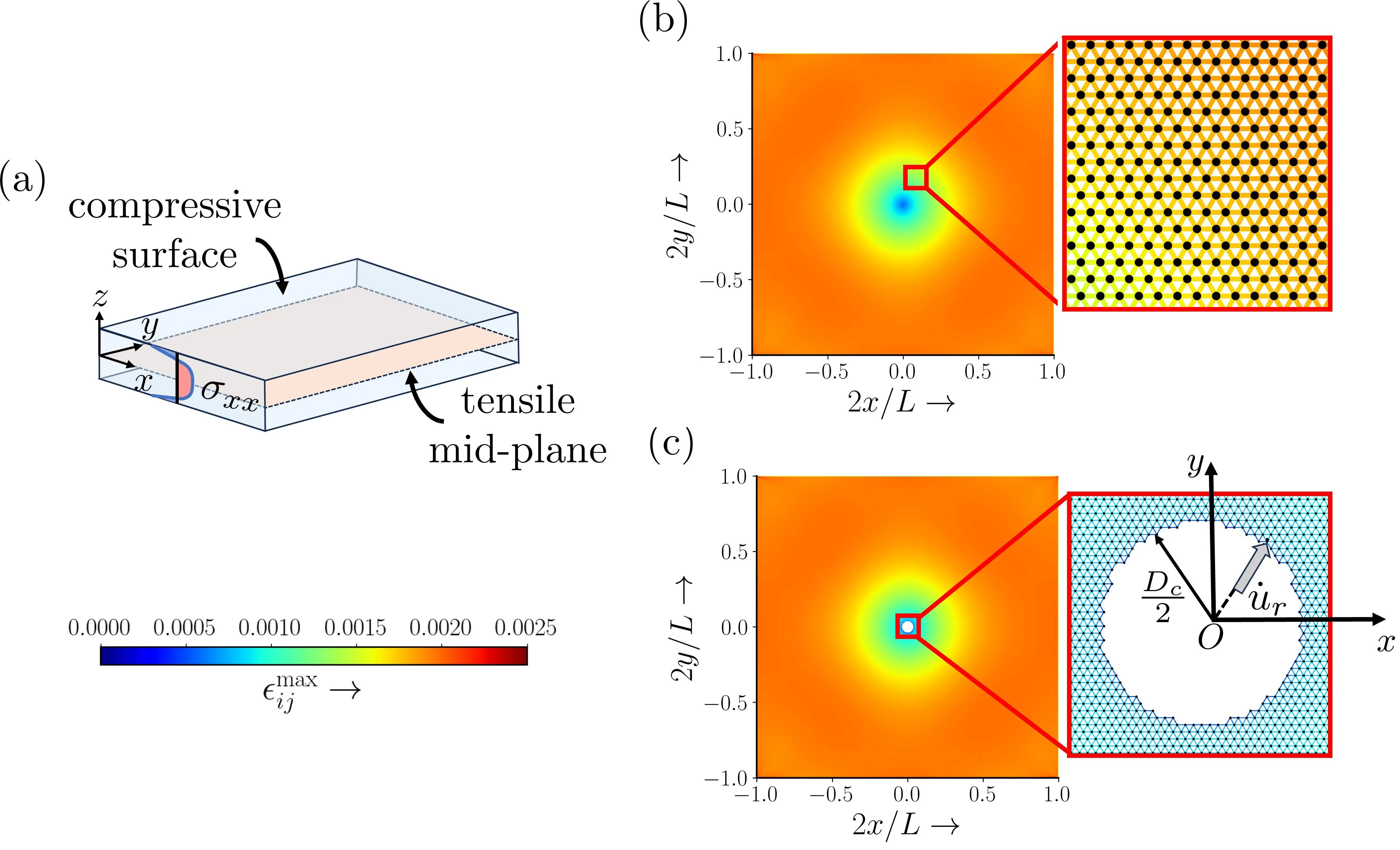
الزجاج مادة ذات طابع خاص. يبدو هشًا، لكن داخله قد تسكن قوى خفية هائلة. في الزجاج المقوّى كيميائيًا، يكون السطح مضغوطًا كشريط مطاطي مشدود، بينما يكون العمق، على العكس، ممدودًا. عندما يصطدم جسم سريع بهذا الزجاج، يتمزق ذلك الشريط في أماكن كثيرة دفعة واحدة.
أطلق العلماء مقذوفات على الزجاج وراقبوا كيف يتفتت. ثم بنوا نموذجًا حاسوبيًا حيث مُثّل الزجاج بشبكة من النوابض، وتم ضبط الإجهادات الداخلية كما لو كانت تشوهًا «متجمدًا». أعاد النموذج إنتاج صورة الكسر بدقة.
المفاجأة الكبرى: عند الضربة الضعيفة تكون الشظايا كبيرة، وعند الضربة القوية تكون صغيرة، لكن إذا رُسم رسم بياني «كم عدد الشظايا من كل حجم»، تندمج جميع المنحنيات في منحنى واحد. يكفي قسمة مساحة كل شظية على متوسط المساحة — فيكون القانون واحدًا لجميع الضربات وجميع توزيعات الإجهاد.
على المستوى المجهري أمكن رؤية أمر غير عادي: أمام الشق الرئيسي تنكسر روابط منفردة، ولفترة قصيرة يجري الشق أسرع من الصوت في هذا الزجاج. ثم يتوقف، تاركًا على سطح الكسر «ألسنة» ومناطق بدرجات صغيرة — تلك الآثار التي تُرى تحت المجهر.
هكذا يروي الزجاج المكسور في المختبر قصة كيفية تفتت ليس فقط النوافذ، بل أيضًا شاشات الهواتف والزجاج الأمامي للسيارات والألواح الواقية.
الملخص الأصلي
كما كتبه المؤلفون، بالإنجليزية arXiv:2602.20443
The dynamic fragmentation of residually stressed solids involves a complex interplay between stored elastic energy, stress wave propagation, and crack instabilities. In this work, we investigate the fracture mechanics of chemically toughened glass through high-velocity projectile impact experiments and a novel micromechanical network model. We rigorously incorporate residual stress into the discrete lattice framework via a prescribed inelastic strain (eigenstrain) distribution, formulated as equivalent body and surface forces to ensure mesh-independent fracture paths. Our experiments and simulations demonstrate that while the fracture topology shifts from coarse to fine with increasing impact energy, the cumulative fragment size distribution consistently follows an exponential decay. Crucially, we reveal a universal scaling law: fragment size distributions from diverse loading conditions and stress profiles collapse onto a single master curve when normalized by the mean fragment area. Furthermore, the model elucidates the determinants of fragmentation, showing that the resulting fragment size is governed not only by the magnitude of residual stress but also by the steepness of the stress gradient. At the microscopic scale, we identify a mechanism for dynamic instability where non-sequential bond breaking ahead of the crack tip leads to apparent local crack speeds exceeding the Rayleigh wave speed ($$c_r$$). These arrested micro-branches, analogous to the Burridge-Andrews mechanism, provide a physical explanation for the "tongue-like" features and hackle zones observed in post-mortem fractography.
سرعة الصوت في الزجاج حوالي 5–6 كيلومترات في الثانية. الشقوق الدقيقة في التجربة تجاوزتها لفترة قصيرة، رغم أن هذا مستحيل في الظروف العادية.