المعدن الخفي داخل الموصلات الفائقة سريع
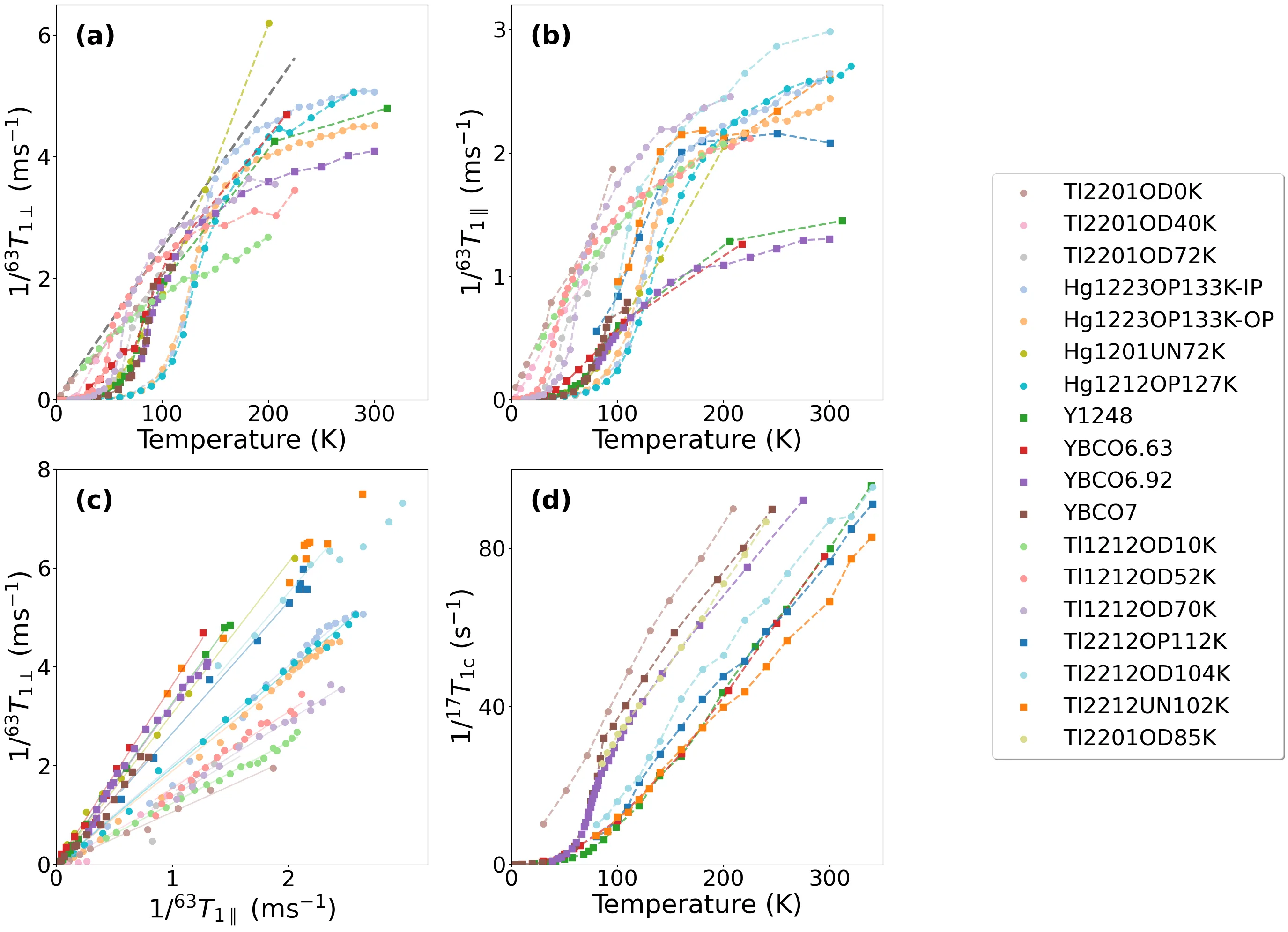
داخل الموصلات الفائقة النحاسية — وهي مواد توصل التيار بدون فقدان عند درجات حرارة مرتفعة بشكل غير متوقع — توجد طور خفي. يتصرف هذا الطور كمعدن عادي، لكنه لا يظهر في القياسات القياسية. جمع العلماء بيانات من جميع أنحاء العالم عن جميع الموصلات الفائقة النحاسية المعروفة ووجدوا أنه تحت درجة حرارة معينة (خط الفجوة الزائفة) تنتقل المادة دائمًا إلى هذه الحالة المعدنية الخفية.
من هذا المعدن الخفي، يتكثف الموصل الفائق إلى حالة التوصيل الفائق، مثلما يتحول البخار إلى قطرات ماء. سرعة تضاؤل الإشارات المغناطيسية (الاسترخاء النووي) تصبح متطابقة لجميع العينات — كما لو كانت جميع الطرق في المدينة بنفس سرعة الحركة. هذه القاعدة العامة تساعد على فهم لماذا التوصيل الفائق في هذه المواد قوي جدًا.
هذا التباين (الانيزوتروبيا) مرتبط ارتباطًا وثيقًا بأقصى درجة حرارة للانتقال الفائق. كلما زادت درجة حرارة الانتقال، زاد الفرق بين الاتجاهين. يبدو أن في المعدن الخفي تتعايش مكونان شبه مستقلين للسبين، وتفاعلهما يحدد خصائص الموصل الفائق. هذا النهج يعطي أساسًا جديدًا لفهم هذه المواد الغامضة.
الملخص الأصلي
كما كتبه المؤلفون، بالإنجليزية arXiv:2604.10133
Nuclear relaxation is a very robust probe of electronic excitations in superconducting materials, above and below the critical temperature of superconductivity, $$T_\mathrm{c}$$. Here, a phenomenology of it in cuprate superconductors is established based on essentially all cuprate data available in the literature from the CuO$$_2$$ plane. A universal 'hidden metal' with $$1/T_1 T = const$$ reigns below the pseudogap line, and, similar to usual superconducting metals, all cuprates condense at $$T_\mathrm{c}$$ out of this metal and relaxation ceases rapidly. There is no Hebel-Slichter peak. Above the hidden metal, a renormalized two-component metal is found. Therefore, the hidden metal is identified as the pseudogap matter, which has other important properties. It predominantly lacks a uniform response, unlike the normal metal above $$T^*$$, and it does not significantly relax planar O. However, for planar Cu it exhibits a special relaxation anisotropy. With the field in the plane, it causes a relaxation rate that is very similar for all cuprates, $$1/{^{63}T}_{1\perp}T\approx 25/$$Ks, while with the field parallel to the $$c$$-axis, $$1/{^{63}T}_{1\parallel}T$$, the proportional rate (in the pseudogap range) changes as a function of doping and material. This relaxation anisotropy is strictly correlated with the maximum critical temperature, $$T_\mathrm{c,max}$$, of all cuprates. It is stipulated that two partially independent spin components are needed to understand this behavior. The new phenomenology will be discussed and should give a better foundation for the understanding of the cuprates
الاسترخاء النووي يشبه تضاؤل الصدى: بعد الإثارة بنبضة مغناطيسية، تعود النوى الذرية إلى حالتها الأصلية، وسرعة هذا العودة تخبرنا عن خصائص الإلكترونات المحيطة.