حدود الحبيبات: كيف تغيّر اللحامات داخل المعدن طابعه المغناطيسي سريع
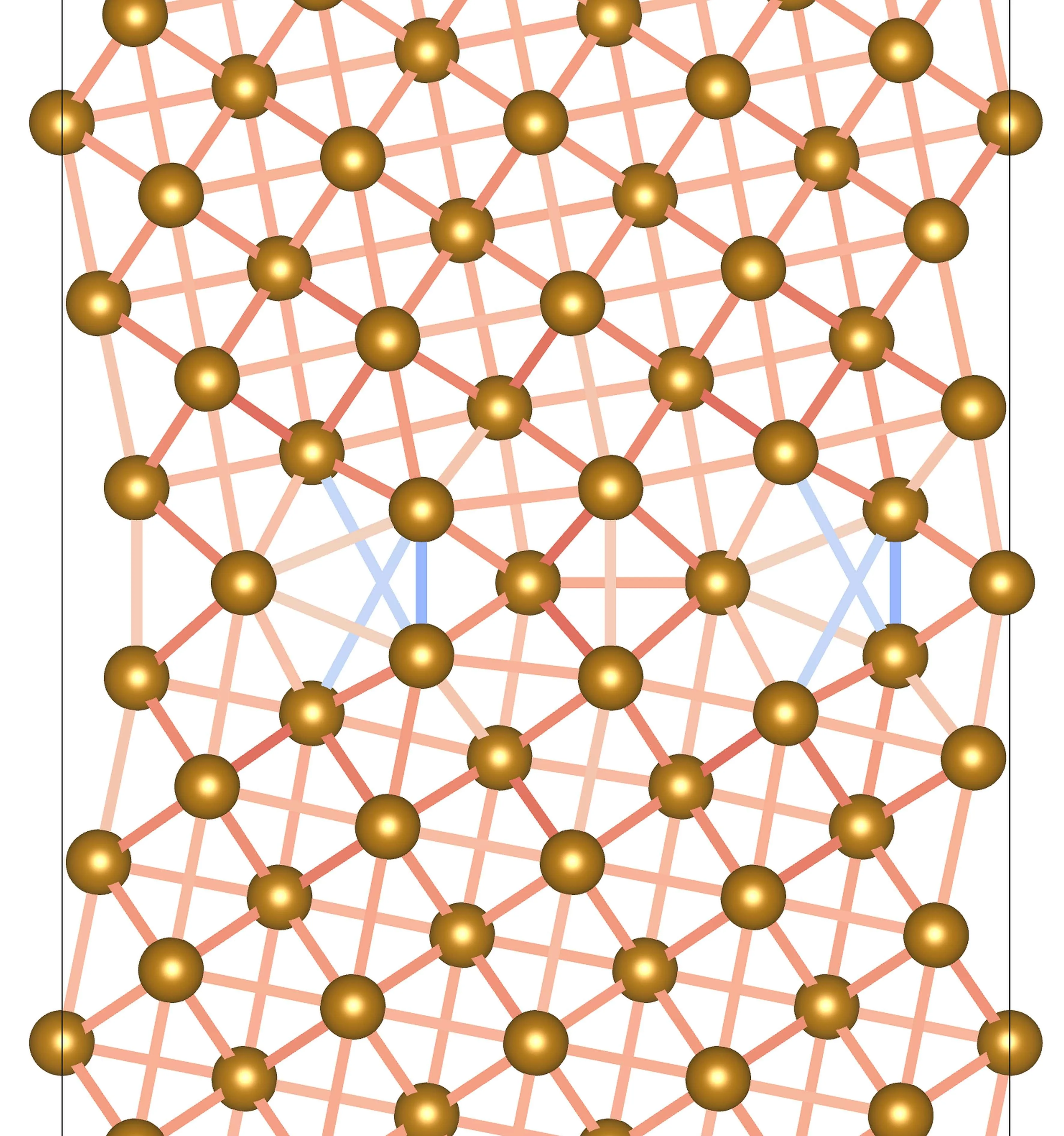
بلورة الحديد تشبه فسيفساء من حبيبات متراصة بإحكام. حيث تلتقي حبيبة بأخرى، ينشأ حد — خط رفيع مضطرب النظام. وفي هذه اللحامات تحديدًا تختبئ مفاجآت للمغناطيسية.
حسب العلماء كيف تتفاعل ذرات الحديد مع بعضها عند ثلاثة أنواع من هذه الحدود. واتضح أن الارتباطات المغناطيسية عند الخط نفسه يمكن أن تنقلب: فبدلًا من أن تصطف في اتجاه واحد، تبدأ مغازل الذرات المتجاورة في التوجه نحو اتجاهين متعاكسين. هذا يشبه ما يحدث في حشد من الناس حيث يسير الجميع عادة في اتجاه واحد، لكن في ممر ضيق يستدير أحدهم ويعيق الحركة العامة.
عندما تدخل ذرات الفوسفور إلى هذا الخط، فإنها تغيّر الصورة المغناطيسية أكثر. يعمل الفوسفور مثل حصاة في ترس: فهو يثبط الارتباطات المنقلبة ويعيد توزيع التفاعلات حوله.
ولكن ما مدى أهمية ذلك للقطعة كاملة من الحديد؟ أجرى الباحثون محاكاة حاسوبية ورأوا: حتى مع وجود عدد ملحوظ من الحدود، فإن درجة حرارة كوري — النقطة التي يفقد عندها الحديد مغنطته — تنخفض قليلًا جدًا. الجزء الأكبر من المعدن يبقى غير متأثر، وهو الذي يحدد الطابع المغناطيسي العام.
إذن، اللحامات في فسيفساء الحديد تؤثر فعلًا على المغناطيسية، لكن بشكل موضعي فقط. لكي نُضعف المغناطيس بشكل ملحوظ، كان علينا أن نجعل الحدود في كل مكان تقريبًا بشكل مصطنع — وهذا لا يحدث في المواد الحقيقية.
الملخص الأصلي
كما كتبه المؤلفون، بالإنجليزية arXiv:2604.10489
This work investigates how grain boundaries (GBs) modify magnetic exchange interactions in bcc iron, with particular focus on the effect of phosphorus segregation. Using density-functional theory combined with the Liechtenstein-Katsnelson-Antropov-Gubanov Green's-function approach, we calculate Heisenberg exchange parameters for three symmetric tilt GBs, $$\Sigma5(310)$$, $$\Sigma13(510)$$, and $$\Sigma13(320)$$, and use these parameters in Monte Carlo simulations to evaluate finite-temperature magnetic behavior. All clean GBs exhibit strong local deviations from bulk exchange interactions, including antiferromagnetic coupling across the boundary plane. These negative exchange interactions are not governed by interatomic distance alone, but arise primarily from the altered local coordination and symmetry breaking at the GB. Phosphorus segregation, modeled in both substitutional and interstitial configurations at the $$\Sigma5(310)$$ GB, suppresses the antiferromagnetic couplings and significantly redistributes the local exchange landscape through chemical and electronic effects. Monte Carlo results show that, despite pronounced local perturbations, realistic GB densities cause only a small reduction in the Curie temperature because bulk-like regions dominate the global magnetic transition. A substantial decrease in Curie temperature appears only when the GB volume fraction is artificially increased. The results demonstrate that GBs strongly influence local magnetic interactions while having a limited effect on global magnetic ordering, and they establish a general framework for linking atomistic interfacial structure and chemistry to mesoscale magnetic behavior in Fe-based materials.
درجة حرارة كوري للحديد النقي تبلغ حوالي 770 درجة مئوية. هذا أسخن من أي فرن منزلي.