الطبقات تنزلق من تلقاء نفسها: حركة دافئة في بلورات ثنائية الأبعاد سريع
ورقتان من الورق موضوعتان معًا تبدأان بالانزلاق البطيء فوق بعضهما عند التسخين. هذا تقريبًا ما تفعله طبقات ثنائي كبريتيد الموليبدينوم، وهي مادة بسماكة ذرة واحدة. في درجة حرارة الغرفة، تنزلق تلقائيًا بسرعة تقارب مترًا في الثانية.
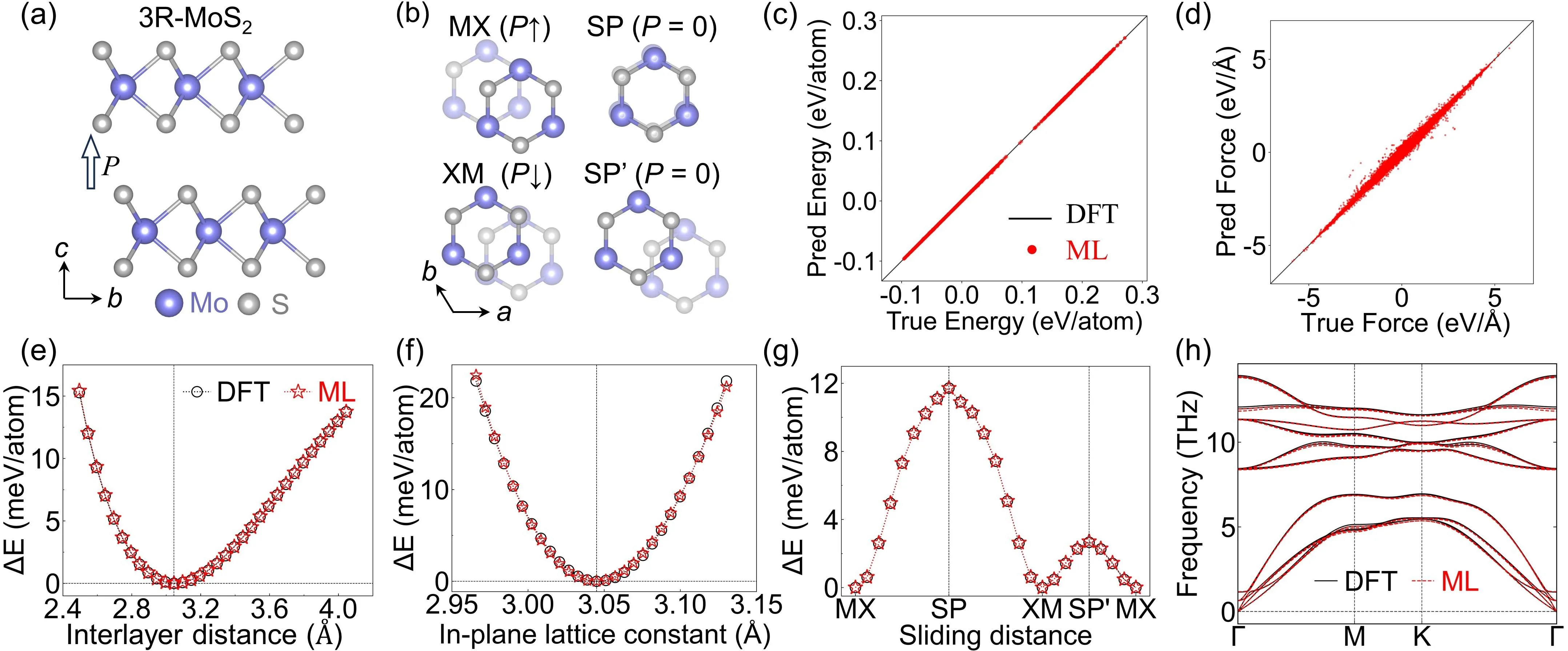
كان يُعتقد سابقًا أن تحريك الطبقات يتطلب تجاوز حاجز، كما لو كنت تسحب صندوقًا ثقيلًا فوق عتبة الباب. لكن الحسابات على المستوى الذري أظهرت أن الحاجز شبه معدوم. الحركة لا تتم كانزياح الورقة كاملة، بل كموجة إعادة ترتيب على الحدود بين المناطق ذات الاتجاهات المختلفة. هذا يشبه كيفية انتقال ثنية في السجادة دون تحريك السجادة نفسها.
هذا السلوك يفتح الطريق أمام أجهزة ذاكرة تُكتب فيها المعلومات عن طريق إزاحة الطبقات بتكلفة طاقة شبه معدومة.
الملخص الأصلي
كما كتبه المؤلفون، بالإنجليزية arXiv:2604.20277
Sliding ferroelectrics built from stacked nonpolar monolayers enable out-of-plane polarization and unconventional switching via interlayer sliding, yet the microscopic sliding dynamics remain unclear. Using machine-learning molecular dynamics, we reveal spontaneous thermally driven interlayer sliding in ferroelectric MoS2 moir\'e superlattices, with relative velocities on the order of 1 m/s at 300 K. Instead of rigid translation of the entire bilayer, the motion appears as a global drift of the moir\'e pattern. Such thermally driven sliding is inconsistent with the meV/atom-scale rigid-sliding barrier. In contrast, when constrained relaxation is allowed, the sliding proceeds along an almost barrierless pathway that directly reproduces the global drift of the moir\'e pattern. Furthermore, sulfur vacancies trigger a sliding-to-pinning transition, with about 0.1% S vacancies already sufficient to convert the long-range sliding into localized oscillations. Notably, these phenomena are not restricted to small twist angles, but arise generically in twisting-induced multidomain structures. These results reveal that the sliding process is governed by a domain-wall-mediated collective reconstruction pathway with an ultralow barrier, rather than rigid layer translation, deepening the understanding of microscopic dynamics in moir\'e superlattices and sliding ferroelectrics.
سرعة الانزلاق التلقائي للطبقات في درجة حرارة الغرفة تبلغ حوالي 1 م/ث، أي ما يعادل سرعة مشي شخص هادئ.