المادة المظلمة حول الثقوب السوداء: كيف نسمع غير المرئي سريع
الكون مليء بمادة غير مرئية تتحكم في حركة المجرات. في سبعينيات القرن الماضي، أظهرت عالمة الفلك فيرا روبين أنه بدون المادة المظلمة، لكانت النجوم في أطراف المجرات قد تفرقت منذ زمن بعيد. لكن مما تتكون هذه المادة، لا يزال مجهولاً.
تقترح إحدى الفرضيات أن المادة المظلمة هي سحب من جسيمات فائقة الخفة، تغلف الثقوب السوداء. تشبه هذه السحابة ضباباً ممتصاً للصوت. عندما يسقط ثقب أسود أصغر على ثقب أسود أكبر، يرتجف الفضاء ويصدر «طنيناً» - إنها الموجات الثقالية. يغير هذا الضباب من المادة المظلمة هذا الصوت، فيخففه ويشوهه. وسيسمع كاشف ليزا، الذي سيبدأ العمل في ثلاثينيات القرن الحادي والعشرين، هذه التغيرات وكأنه أذن حساسة. وعبر «الرنين» المشوه، سيحدد العلماء كتلة الجسيمات وخصائصها، حتى لو كانت تتجنب التفاعلات مع جسيمات النموذج القياسي - المجموعة الكاملة للجسيمات المعروفة لدينا.
حقيقة غير متوقعة: قد تكون هذه الجسيمات أخف من الإلكترون بمليارات المرات، لكن ضغطها الجماعي في السحابة قادر على تغيير مدار ثقب أسود بأكمله.
الملخص الأصلي
كما كتبه المؤلفون، بالإنجليزية arXiv:2605.17589
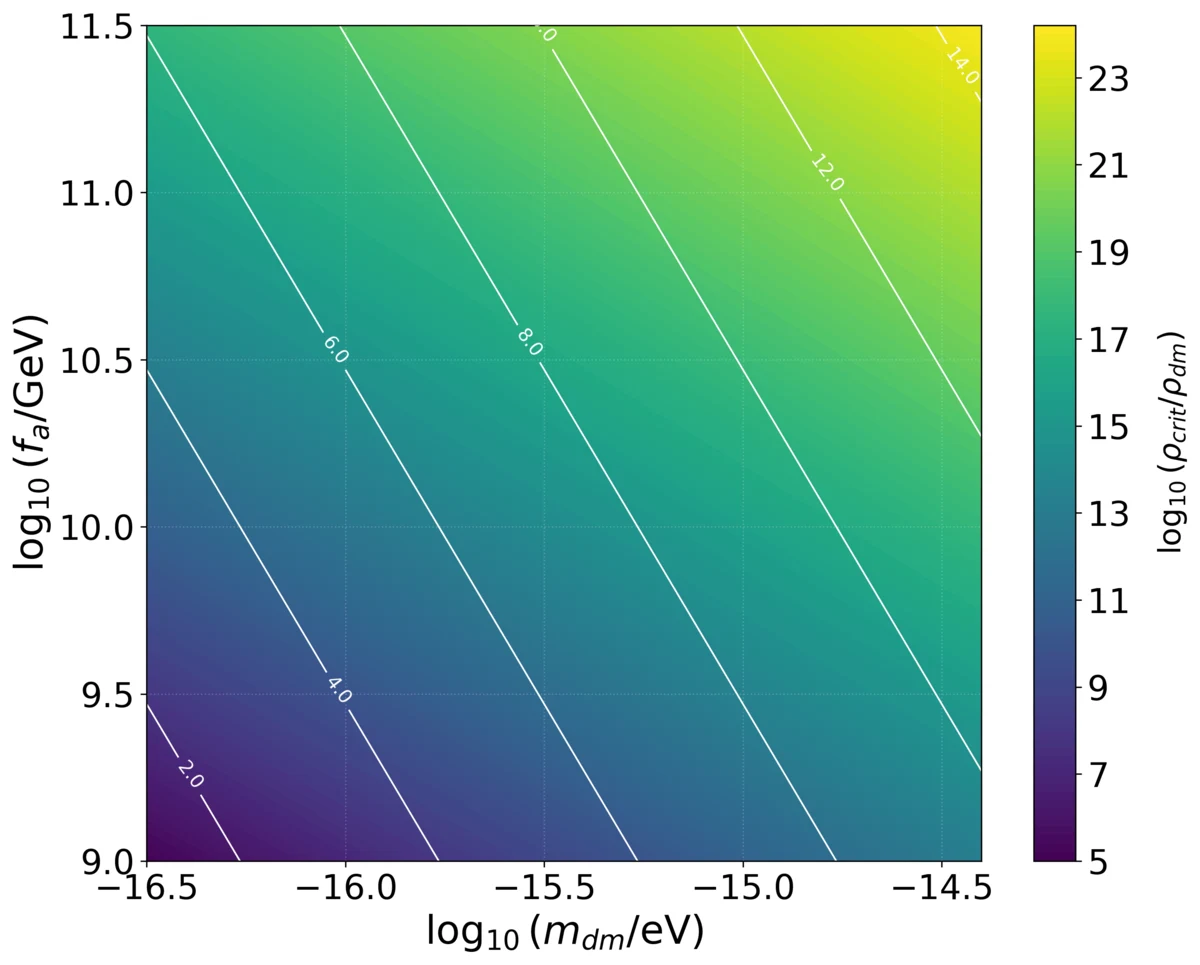
Ultralight bosons with self-interactions, such as axion-like particles, can form astrophysical Bose--Einstein condensates around stars or compact objects, often referred to as gravitational atoms. In this work, we adopt a recently proposed dynamical formation mechanism for these halos and estimate their impact on extreme- and intermediate-mass-ratio inspirals when present around the primary black hole. We show that, for signal-to-noise ratios $$\lesssim 100$$, LISA can distinguish gravitational waveforms from binaries embedded in such halo overdensities. Our analysis indicates that LISA can probe boson masses $$m_\mathrm{dm}\sim10^{-17}$$--$$10^{-15}\,\mathrm{eV}$$ and decay constants $$f_a\sim3 \times 10^{10}$$--$$6 \times 10^{12}\,\mathrm{GeV}$$ using binaries with total masses $$M\sim10^4$$--$$10^5\,M_\odot$$, assuming conservative DM densities consistent with the central values of Navarro--Frenk--White profiles. Allowing for higher background densities and different extreme-mass-ratio configurations further extends the accessible parameter space. Moreover, we find that for a binary configuration with $$M\sim10^4M_{\odot}$$, $$\rho_{\rm dm} = 10^4\,\mathrm{GeV/cm^3}$$, and signal to noise ratio $$\text{SNR} \sim 20$$, a particle mass of $$m_{dm} = 3.2 \cdot 10^{-15}$$ eV and decay constant of $$f_a = 1.6 \cdot 10^{11}$$ GeV maximize the dephasing due to dynamical friction, enabling the recovery of the particle parameters at the percent level. These results demonstrate that LISA can place constraints on axion-like particle masses and self-interactions without requiring additional couplings to Standard Model fields.
قد تكون جسيمات المادة المظلمة في هذه السحب أخف من الإلكترون بمليارات المرات، لكن ضغطها الجماعي قادر على تغيير مسار ثقب أسود كامل.