كيف تشعل الإلكترونات الثقيلة شمسًا اصطناعية سريع
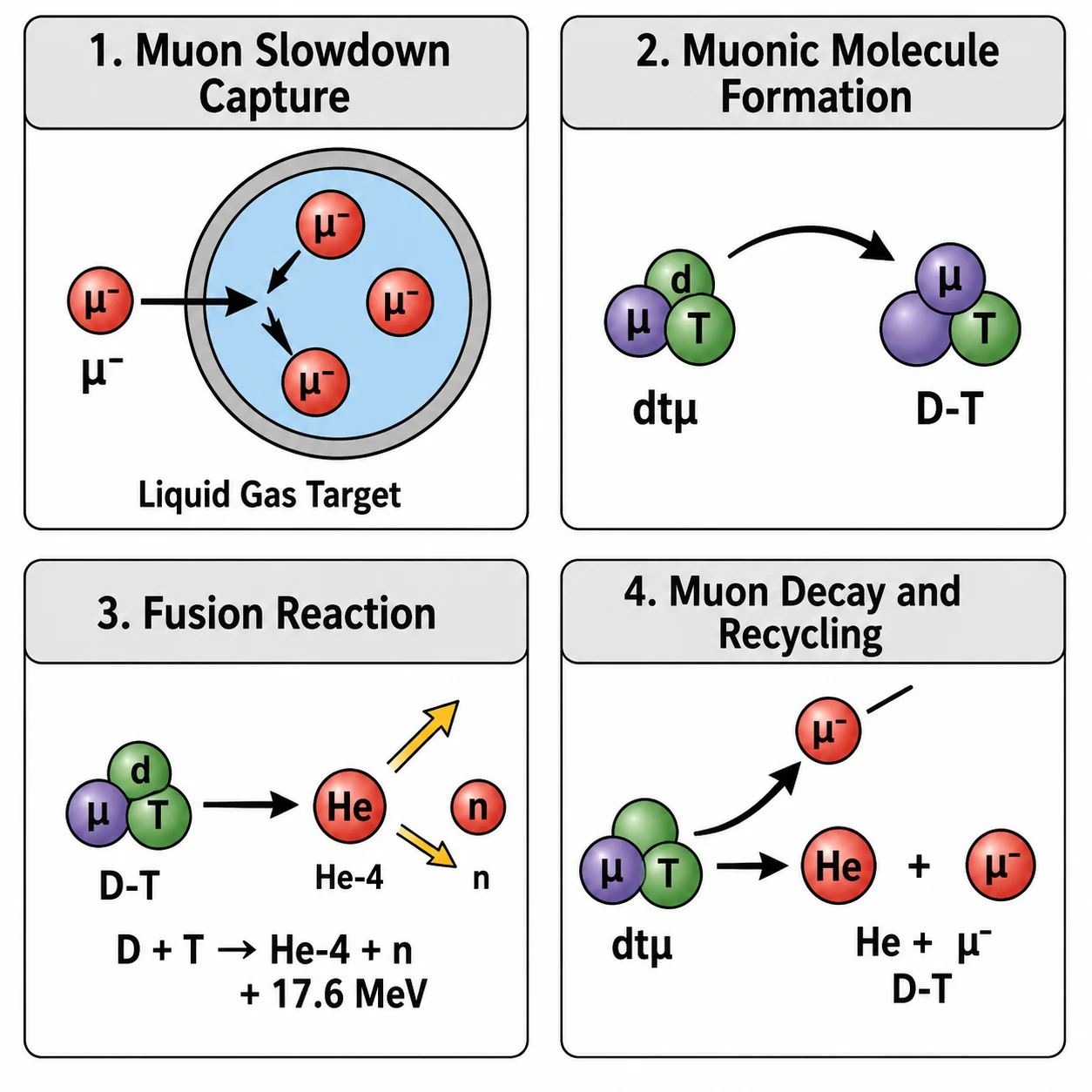
أنوية الذرات مغطاة بأغلفة رقيقة من الإلكترونات — في مثل هذه الأغلفة لا يمكن التحامها. لكن استبدل الغلاف الخفيف بآخر ثقيل: الميون، وهو جسيم من النموذج المعياري، يضغط السحابة الإلكترونية بحوالي 200 مرة. عندها تندمج أنوية الهيدروجين (الديوتيريوم والتريتيوم) تلقائيًا في درجة حرارة الغرفة، مولدةً الهيليوم وطاقة هائلة.
المشكلة أنه بعد الاندماج، يلتصق الغلاف الثقيل أحيانًا بالهيليوم بشكل دائم، ويخرج الميون من اللعبة. حاليًا، يُشغّل ميون واحد حوالي 150 تفاعلًا فقط. لكن الحقول الكهربائية والظروف الخاصة تجعله ينزلق، مطيلة سلسلة التفاعلات إلى 500 اندماج. وهذا يعطي طاقة أكبر مما أُنفق على إنتاج الميون.
يمكن أن تصبح هذه المنشآت مفاعلات هجينة: يحول تيار النيوترونات من الاندماج المصغر اليورانيوم-238 العادي إلى بلوتونيوم-239 — وقود للمحطات النووية التقليدية.
الملخص الأصلي
كما كتبه المؤلفون، بالإنجليزية arXiv:2605.26432
Muon-catalyzed nuclear fusion (\mucf) replaces atomic electrons with negative muons, compressing atomic orbitals by about two orders of magnitude and enabling deuterium--tritium (D--T) fusion under near-room-temperature conditions. This paper reviews the physical principles of \mucf{} and formulates its essential dynamics as a four-step cycle: muonic-atom formation, muon transfer, resonant \dtmu{} molecular formation, and D--T fusion with muon release and recycling. A kinetic model is used to quantify the number of catalysis cycles per muon and the corresponding energy gain. We focus on the central limitation of catalytic efficiency, namely the alpha-sticking effect, and discuss possible breakthrough routes including nuclear-spin and muon dual polarization, in-flight muon-catalyzed fusion, and heavy-ion-driven magneto-inertial fusion. Within the idealized assumptions of the present model, a four-dimensional synergistic scheme combining dual polarization, high-density confinement, electric-field-assisted muon recovery, and resonant enhancement may increase the number of catalysis cycles per muon from the present experimental record of about 150 to more than 500, potentially enabling an energy gain \(Q>2\). On this basis, we propose a conceptual fusion--fission fuel-breeding hybrid reactor, denoted as \mucf-FBR, which exploits the 14.1-MeV neutron yield of \mucf{} to breed \({}^{239}\mathrm{Pu}\) from a \({}^{238}\mathrm{U}\) blanket in a decoupled fusion--fission operating mode. This concept may offer advantages in engineering robustness, radiation-damage tolerance, and natural-uranium utilization.
تُستخدم الخلفية الطبيعية للميونات لمسح الأهرامات والبحث عن فراغات مخفية في المنشآت.