كيف تفرز موجات المد الكواكب سريع
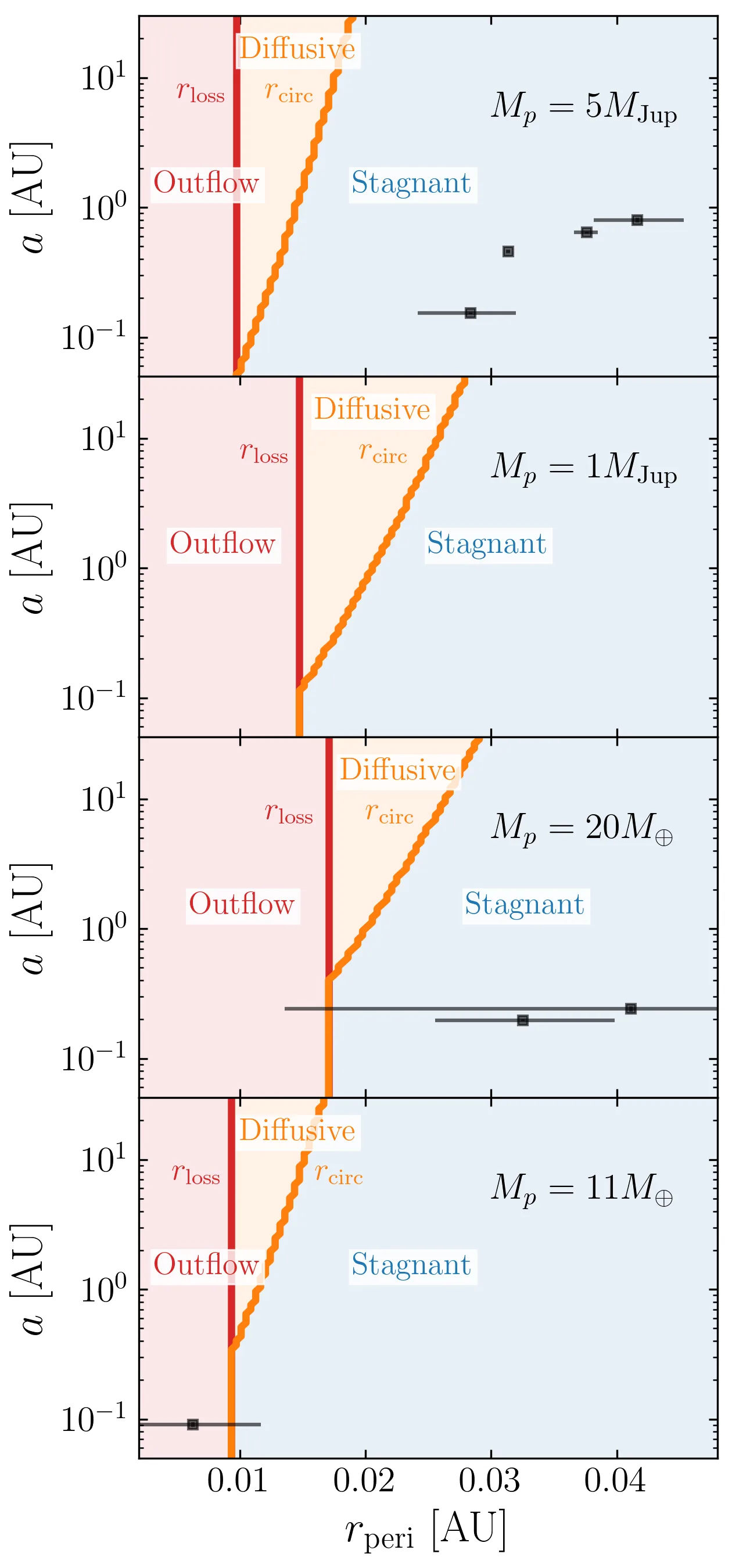
إذا هززت قدرًا فيه حساء يغلي بقوة، فستتموج السوائل وتضرب الأمواج الجدران. تقريبًا نفس الشيء يحدث داخل كوكب غازي عندما يمر بالقرب من نجمه في مدار إهليلجي. جاذبية النجم تثير موجات داخلية قوية في الكوكب — تُسمى الموجات الثقالية الأساسية. هذه الموجات يمكن أن تغير مصير الكوكب تمامًا.
لفترة طويلة، كان لغزًا أين تذهب طاقة هذه الموجات. مؤلفو الدراسة الجديدة، باستخدام محاكاة هيدروديناميكية، أظهروا لأول مرة سيناريوهين. إذا اخترقت الموجة بعمق ضحل، تتبدد طاقتها عبر الإشعاع والتسخين — فيهدأ الكوكب تدريجيًا، ويصبح مداره دائريًا، وينضم إلى "كومة" المشتريات الحارة في مدارات تتراوح بين 5 إلى 6 أيام. ولكن إذا اقترب الكوكب كثيرًا من النجم، تتسارع الموجات إلى سرعات فوق صوتية وتتحول إلى موجات صادمة. إنها حرفيًا تجرد الغلاف الغازي، تاركة نواة عارية — هكذا تنشأ "صحراء نبتون" في مدارات أقصر من ثلاثة أيام.
هذه العملية تفسر أيضًا شذوذًا آخر. الكواكب التي نجت من تجريد الغلاف يجب أن تحتفظ بذكرى الكارثة: سيكون محور دورانها مائلًا بشدة بالنسبة لمدارها، وقد تكون العملية مصحوبة بومضات ساطعة. هكذا تصبح النوى الصخرية المنعزلة في "الصحراء" ليست لغزًا، بل نتيجة طبيعية لشباب عاصف. ومصير كل كوكب، مثل الحساء في القدر المهتز، يعتمد على مدى شدة هزة النجم القريب.
الملخص الأصلي
كما كتبه المؤلفون، بالإنجليزية arXiv:2606.20789
The period distribution of hot gaseous exoplanets depends strongly on mass. Clustering between the orbital periods of $$\sim$$3 to $$\sim$$5-6 days is seen for sub-Saturns ("Neptune ridge") and Jovians ("hot Jupiter pile-up"), contrasting with a sharp deficit interior to 3 days for sub-Saturns, not seen for Jovians ("Neptune desert"). During high-eccentricity migration, tidally-excited fundamental-modes (f-modes) act as a reservoir for orbital energy, and can take gaseous planets formed beyond several AU and place them at short separations. However, how f-modes relinquish their energy into the planet interior is unknown. Here, we show how f-modes can not only circularize orbits -- causing clustering near the Neptune ridge and hot-Jupiter pile-up -- but can also shock and unbind mass, leaving sub-Saturn cores in the Neptune desert. Our hydrodynamical simulations demonstrate that close approaches tidally excite f-modes, whose super-sonic velocities shock gaseous envelopes. Atmospheres cool by radiative diffusion or winds when shocks penetrate shallow versus deep depths. Planetary structural and orbital evolution is followed over many periastron passages using an iterative map: shocks that diffusively cool circularize and bunch orbits near the hot Jupiter pile-up and Neptune ridge, while shocks that drive outflows unbind envelopes and place gas giant cores in the Neptune desert. Sub-Saturns that dwell in the desert are predicted to arrive with large spin-orbit misalignments after producing luminous flares.
الموجات الصادمة في باطن الكوكب يمكن أن تسرع المادة إلى سرعات مماثلة لسرعة الصوت في الهيدروجين — حوالي 10 كيلومترات في الثانية. وهذا أسرع من سرعة الرصاصة.