Morgan MacLeod

4 articles · 21 co-authors · latest: 2026-06-18
2,173 citations · h-index 29 · 78 papersData: Semantic Scholar

We have retold 4 papers by this author. most often about: binary star, spectroscopy, stellar evolution. 21 co-authors across our retellings.

Links in the knowledge graph
Stellar2026-01-011 minarXiv:2601.00470express
Giant Star Betelgeuse Gains a Companion
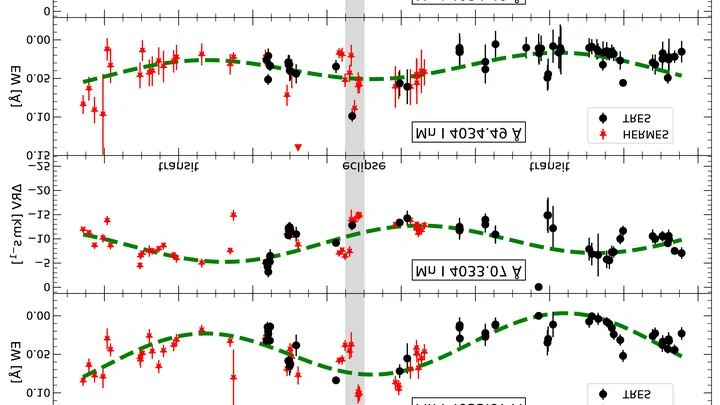
Betelgeuse is a giant star ready to explode as a supernova. But it may not be alone: a small companion star, Sivarkha, circles in a tight orbit. Every 2000 days, it plunges through Betelgeuse’s outer layers, like a boat cutting through water, leaving waves of superheated gas.

Stellar2026-01-091 minarXiv:2601.05774express
The Quiet Death of a Star
In 2014, astronomers spotted a massive yellow star in the Andromeda galaxy. By 2022, it had vanished without a trace — without the usual blinding explosion of a supernova. It was as if someone simply switched off the light.
Stellar2026-04-102 minarXiv:2604.09767express
The Mystery of Long Cycles in Red Giants
A lighthouse blinks every few seconds, but then begins to slowly brighten and dim over the course of a year. That is exactly what about a third of red giants do — huge stars in the late stages of life. Their normal pulsations take days or weeks, but on top of that, long secondary periods are visible: months and years.
Exoplanets2026-06-182 minarXiv:2606.20789express
How Tidal Waves Sort Planets
A pot of boiling soup is shaken hard — the liquid sloshes, waves crash against the walls. Something similar happens inside a gas planet when it swings past its star on an elongated orbit. The star's gravity excites powerful internal waves in the planet, known as tidal fundamental modes. These waves can completely change the planet's fate.