قبة الموصلية الفائقة: لماذا يساعد الضغط أولاً ثم يعيق؟ سريع
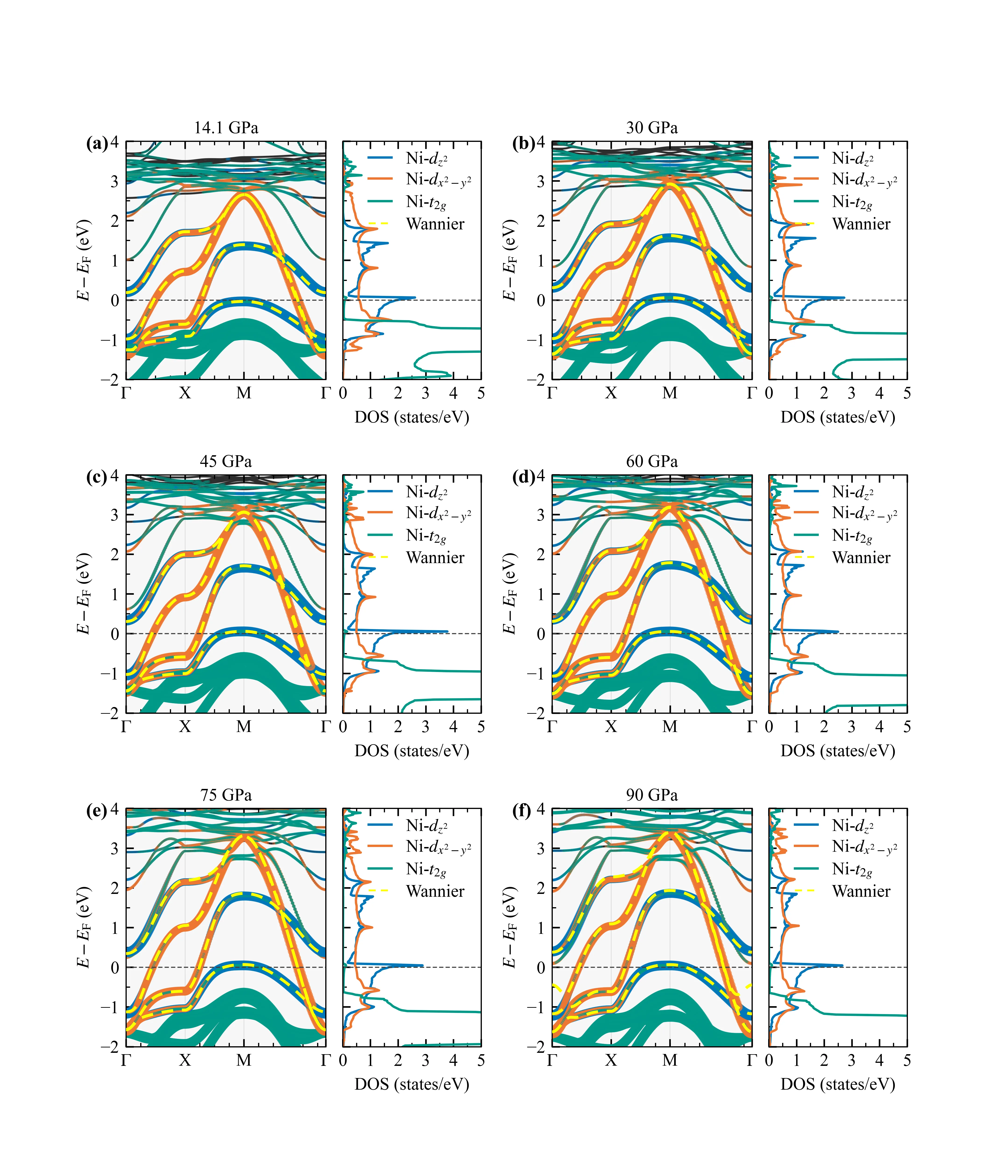
تتصرف البلورة الطبقية La₃Ni₂O₇ تحت الضغط مثل أوركسترا يغير فيها قائد الفرقة مستوى صوت مجموعات الآلات المختلفة. عند الضغط، تزداد قفزات الإلكترونات بين الطبقات — ويبدو أن هذا يجب أن يعزز الموصلية الفائقة. لكن في الوقت نفسه، يصبح جزء من الإلكترونات شديد الحركة.
المفارقة الرئيسية تكمن في نوعين من مدارات النيكل. الإلكترونات في dx²-y² تشبه بشكل متزايد مسافرين أحرارًا، بينما جيرانها في dz² يظلون ملتزمين بأماكنهم. عندما يكثر المسافرون، يبدأون في حجب العزوم المغناطيسية للمقيمين — يظهر تأثير يشبه تأثير كوندو (ظاهرة تخمد فيها سحابة من الإلكترونات الحرة المجال المغناطيسي للشوائب). يضعف التفاعل المغناطيسي الذي كان بمثابة الغراء لأزواج الإلكترونات.
هكذا تولد القبة على مخطط الطور: تتعزز الموصلية الفائقة أولاً ثم تخمد بنفس الضغط الذي أنشأها. الثنائي المداري ينظم مصيره بنفسه — مثل أوركسترا تتفاجأ فيها المجموعة المنفردة بإغراق الآخرين.
الملخص الأصلي
كما كتبه المؤلفون، بالإنجليزية arXiv:2608.02261v1
The recent discovery of high-temperature superconductivity in pressurized bilayer La3Ni2O7 has sparked intense research interest, yet the microscopic mechanism governing its pressure-dependent superconducting transition temperature (Tc) remains elusive. In this work, we investigate the electronic and magnetic correlations of La3Ni2O7 under high pressure using a combination of density-functional theory (DFT), constrained random phase approximation (cRPA), and dynamical mean-field theory (DMFT). We find that while hydrostatic pressure enhances the interlayer hopping and the bare superexchange energy scale (4t2/U), it simultaneously drives the system toward a more itinerant regime by reducing the relative correlation strength (U/W). Crucially, our results reveal a distinct orbital-selective evolution: the Ni dx2-y2 states become increasingly itinerant, whereas the Ni dz2 orbitals retain a more localized character. This pressure-induced itinerancy significantly enhances the hybridization between the two, leading to a dramatic amplification of the Kondo-like screening of the local dz2 moments by the itinerant dx2-y2 electrons. Consequently, the effective magnetic exchange coupling (Jeff), which serves as the pairing glue, is suppressed in the high-pressure regime. Our findings suggest that the monotonic decrease of Tc at high pressures is driven by the dominance of Kondo screening over superexchange interactions, providing a coherent microscopic explanation for the dome-shaped superconducting phase diagram in La3Ni2O7.
كلمة «كوندو» في الفيزياء تأتي من اسم العالم الياباني جون كوندو، الذي شرح في عام 1964 الزيادة الغامضة في المقاومة في المعادن التي تحتوي على شوائب مغناطيسية عند درجات حرارة منخفضة.