أمواج الشمس الملتوية: كيف نراها من الأرض سريع
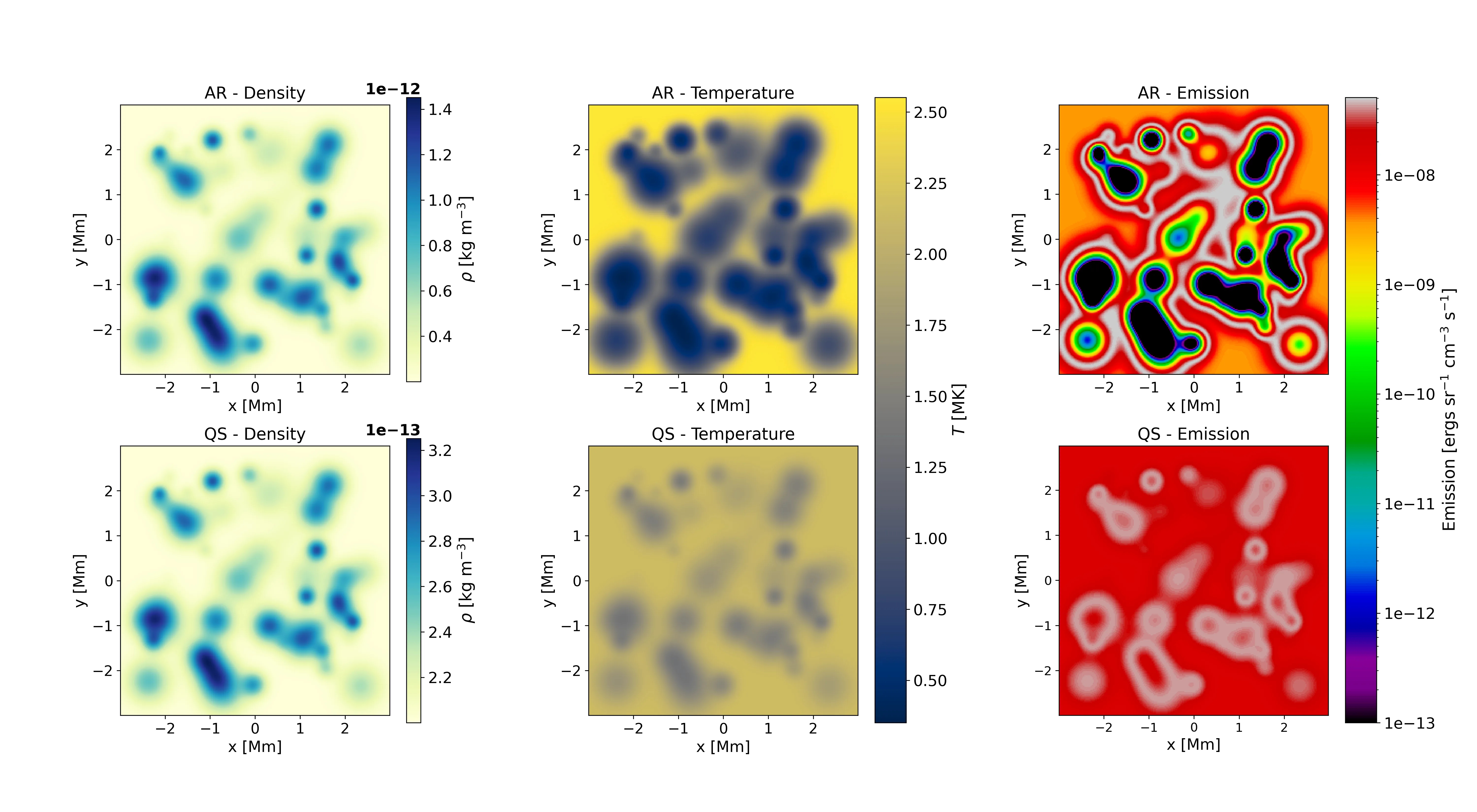
الهالة الشمسية هي الغلاف الجوي الخارجي للشمس، وتبلغ حرارتها ملايين الدرجات. كيف تسخن؟ لا يزال الأمر غير واضح تمامًا. أحد المرشحين هو الأمواج الالتوائية: فهي تلوي خطوط المجال المغناطيسي كما لو كنت تفتل حبلًا مطاطيًا. وقد رُصدت هذه الأمواج مؤخرًا بواسطة التلسكوب الشمسي الجديد "دانيال إينوي".
لكن التلسكوب لا يرى الأمواج نفسها، بل يرى الضوء الصادر عن أيونات الحديد، والذي يصل إلينا على طول خط الرؤية. داخل خط الرؤية توجد طبقات عديدة مختلفة، وإشاراتها تختلط معًا. قام العلماء بمحاكاة ذلك على الحاسوب: أخذوا عدة أنابيب مغناطيسية في الهالة، وأطلقوا عليها أمواجًا، ثم حسبوا الضوء الذي سيراه التلسكوب.
في المناطق الهادئة من الشمس، تظهر إشارة الأمواج الالتوائية لكنها أضعف مما هي عليه في الواقع — بسبب الاختلاط على طول خط الرؤية. أما في المناطق النشطة، حيث تكون البلازما أكثر كثافة وأقل تجانسًا، فتظهر إشارة مشابهة حتى بدون أمواج التواء. تُنشئها دوامات قوية بين الأنابيب، حيث يكون الضوء أكثر سطوعًا.
إذن، في المناطق الهادئة يمكن تمييز الأمواج الالتوائية، أما في المناطق النشطة فمن السهل الخطأ. هذا مهم للرصدات المستقبلية: يجب أولًا فهم مدى عدم تجانس الوسط، ثم استخلاص النتائج حول الأمواج.
الملخص الأصلي
كما كتبه المؤلفون، بالإنجليزية arXiv:2608.08812v1
Torsional Alfv\'{e}n waves are a promising mechanism for transporting energy through the solar atmosphere, with implications for coronal heating and solar wind acceleration. Recently, signatures of torsional Alfv\'{e}n waves have been observed with the Daniel K. Inouye Solar Telescope. We aim to investigate the effects of line of sight integration and plasma conditions on the observable properties of the torsional mode. Here we present three-dimensional magnetohydrodynamic simulations of multiple coronal waveguides, driven by a combination of transverse kink and torsional wave drivers, considering two plasma regimes representative of active region (AR) and quiet Sun (QS) conditions. Synthetic observables of the Fe~\textsc{xiii}~1074.7~nm coronal emission line are produced using the pyCELP forward-modelling framework to enable direct comparison with spectroscopic observations. In the QS regime, red-blue Doppler asymmetries are associated with the driven torsional waves, though their observed amplitudes are substantially reduced by line-of-sight integration. In contrast, the AR regime exhibits red-blue Doppler asymmetries even in the absence of an imposed torsional driver, which may be misidentified as the $$m=0$$ torsional Alfv\'{e}n mode. In the AR setup, the red-blue Doppler asymmetries arise from strong phase mixing, generating shear flows and localised vorticity between waveguides where emission is strongest. The differences between the two regimes are governed by the location of peak emission, which is determined by the degree of density inhomogeneity. Our results support the identification of torsional Alfv\'{e}n wave signatures in the quiet Sun (a weakly inhomogeneous environment), but caution should be exercised when interpreting spectroscopic observations in strongly inhomogeneous environments such as active regions.
درجة حرارة الهالة الشمسية أعلى من درجة حرارة سطح الشمس: ملايين الدرجات مقابل حوالي 5500 درجة مئوية. الأمر أشبه بأن الهواء حول النار يكون أسخن من اللهب نفسه.