بلازما في مصيدة: كيف تنفخ النحاس فقاعة في الهيليوم سريع
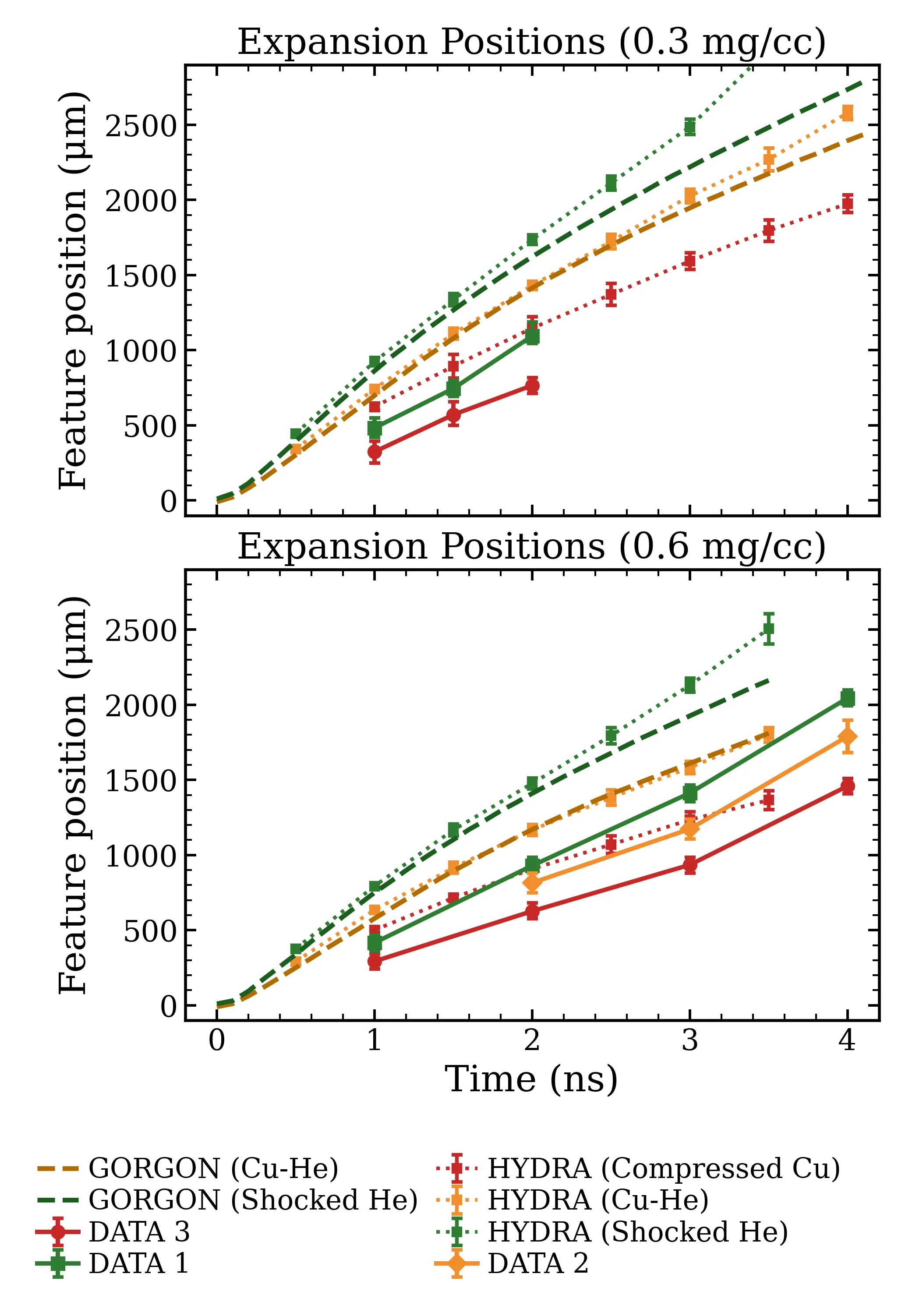
صفيحة نحاسية بحجم عملة معدنية تتبخر تحت وطأة الليزر خلال أجزاء من مليار من الثانية. سحابة النحاس الساخنة تندفع في الهيليوم البارد، مثل نفث بخار في هواء متجمد. في الصور تظهر فقاعة واضحة المعالم بخيوط رفيعة على أطرافها — البلازما لا تتمدد بشكل منتظم، بل تتفكك إلى ألياف بسماكة شعرة إنسان.
البلازما هي غاز انفصلت فيه الإلكترونات عن الذرات. وهي توصل التيار الكهربائي وتستجيب للمجالات المغناطيسية. في التجربة، تدفع الفقاعة النحاسية الهيليوم، وعند الحدود تنشأ دوامات. أظهر التصوير الإشعاعي البروتوني وجود مجالات مغناطيسية داخل الفقاعة لا تراها الكاميرا العادية.
تظهر مثل هذه الفقاعات داخل أهداف الاندماج النووي، حيث تتبخر جدران الحجرة وتعيق انضغاط الوقود. فهم كيفية تمدد البلازما في الغاز سيساعد في ضبط الليزر بدقة أكبر لمحطات الطاقة المستقبلية.
الملخص الأصلي
كما كتبه المؤلفون، بالإنجليزية arXiv:2608.11664v1
Experiments at the OMEGA EP laser facility were designed and executed to study plasma expansion into hohlraum-relevant gas fills (0.3-0.6 mg/cc of helium), providing a surrogate platform for investigating hohlraum wall blow-off, non-local transport, and magnetized plasma effects. We observe well-defined density features and filamentary structures as laser-driven copper plasma expands into a low-Z background gas. Shadowgraphy resolves sharp density features over time and reveals fine-scale filamentation in the laser spot region with characteristic transverse scales of 10-100 microns near the foil surface. Proton radiography provides sensitivity to path-integrated magnetic fields and density modulations throughout the bubble volume. We extract the bubble expansion as a function of time for two gas pressures, 350 psi (producing 0.3 mg/cc equivalent conditions) and 700 psi (0.6 mg/cc equivalent conditions), and compare the measured propagation to magnetohydrodynamic simulations performed with Gorgon and HYDRA. While the large-scale shape of the bubble is well reproduced by both codes, the time-dependent expansion rate shows significant discrepancies (20-50% faster) compared to experimental observations between 1 and 3 ns. This leads to increasingly larger differences in bubble sizes at later times. The optical measurements of bubble expansion and evolution of small-scale structures point to additional constraints required for Biermann-battery field generation, thermal transport, and instability growth in hohlraum-relevant plasmas, to ensure accurate, predictive modeling of gas-filled hohlraums.
وصلت درجة حرارة بلازما النحاس في التجربة إلى مئات الآلاف من الدرجات — أي أعلى بعشرات المرات من حرارة سطح الشمس.