المادة الدافئة الكثيفة: كيف تضغط الليزرات المادة حتى 25 غرامًا لكل سنتيمتر مكعب سريع
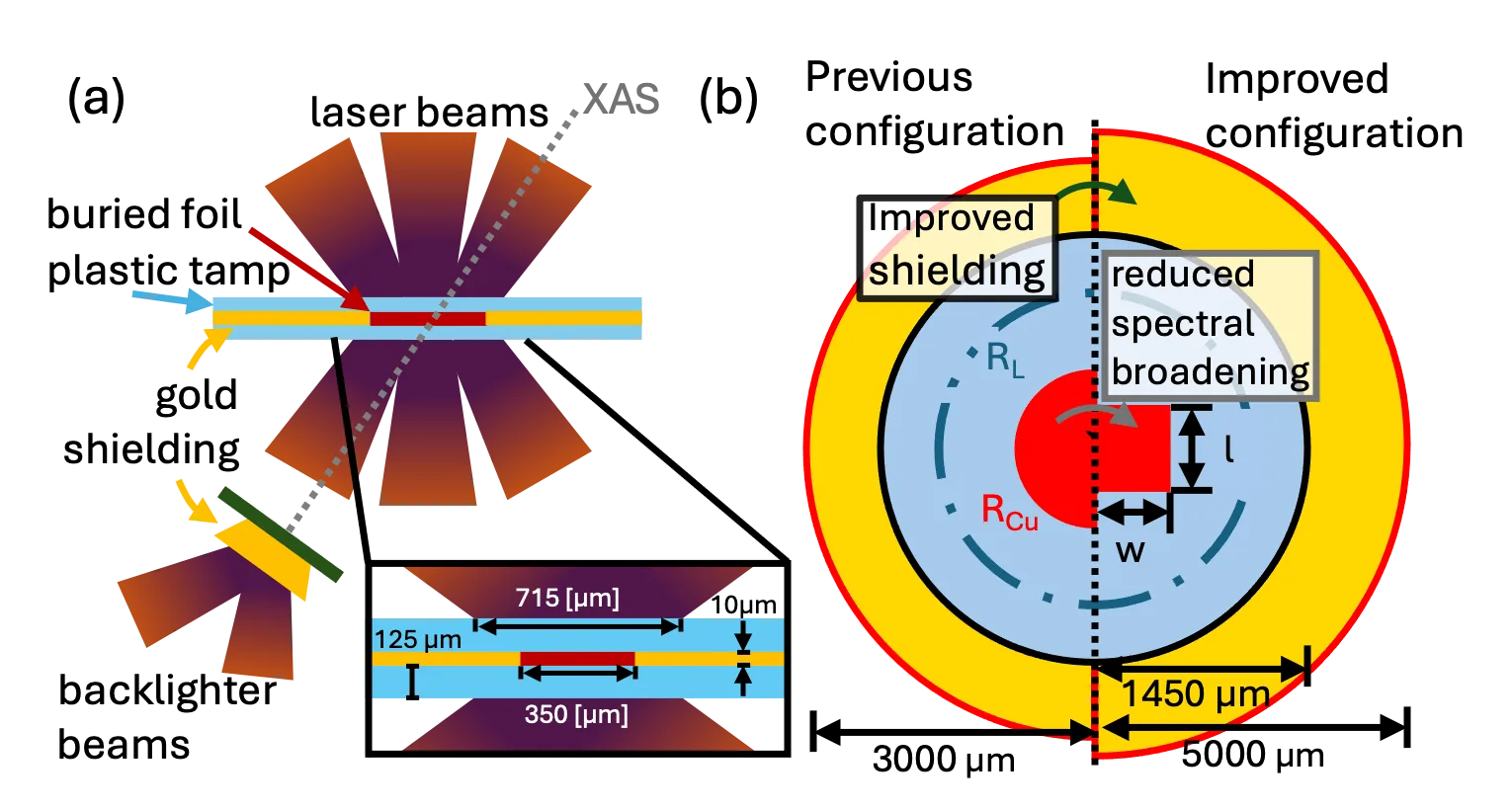
شعاع ليزر يضرب هدفًا رقيقًا مخبأً داخل طبقات من مادة أخرى. خلال أجزاء من مليار من الثانية، تنضغط المادة إلى كثافة 25 غرامًا لكل سنتيمتر مكعب — وكأن قطعة من الرصاص أصبحت أثقل بأكثر من الضعفين وهي في مكانها. تقفز درجة الحرارة إلى 20 إلكترون فولت، أي أكثر سخونة بحوالي 230 ألف مرة من درجة حرارة الغرفة. هذه الحالة تُسمى المادة الدافئة الكثيفة: ليست صلبة ولا غازًا، بل شيء بينهما، حيث تكون الإلكترونات قد انفصلت عن الذرات لكنها لم تتشتت تمامًا بعد.
للنظر إلى داخل هذه الحالة، سلّط العلماء أشعة سينية على البلازما. ذرات الحديد في الهدف تمتص الأشعة السينية عند طاقات محددة، ومن شكل هذه الانخفاضات في الطيف يمكن تحديد عدد الإلكترونات التي فقدتها كل ذرة ومدى سخونة الوسط. اتضح أن النماذج البسيطة التي تأخذ في الاعتبار تصادمات الجسيمات وتضيف تأثيرات الكثافة بشكل تقريبي لا تطابق القياسات. بينما الحساب الأكثر تعقيدًا، القائم على ميكانيكا الكم للعديد من الجسيمات، يعيد إنتاج الشكل العام للطيف بشكل أفضل، وإن لم يكن مثاليًا أيضًا.
الفرق بين النماذج يُظهر أن الإلكترونات في البلازما الكثيفة الساخنة تؤثر على بعضها البعض بقوة أكبر مما كان مفترضًا. هذا مهم ليس فقط للتجارب المخبرية، بل أيضًا لفهم بنية باطن المشتري أو العمليات في الاندماج النووي الحراري بالليزر. حتى الآن، لا توجد نظرية تصف كل التفاصيل، لكن الطريق نحو وصف أفضل أصبح واضحًا.
الملخص الأصلي
كما كتبه المؤلفون، بالإنجليزية arXiv:2608.19382v1
Warm dense matter remains a challenging regime to characterize experimentally and to model with predictive accuracy. Recent experimental platforms have been developed to generate, characterize, and diagnose uniform warm dense matter, enabling detailed comparisons with models. Here, we present experiments conducted at the OMEGA laser facility that compress and heat a buried layer target to warm dense matter conditions, where the targets are heated to temperatures of approximately 20 eV and compressed to densities of 25 g/cm^3. We probe the warm dense plasma using x-ray absorption spectroscopy, using the K-edge and bound-bound absorption features to constrain the temperature and charge state distribution of the plasma. We compare these measurements with two types of models: collisional-radiative models with detailed electronic structure and ad-hoc density effects, and a multi-ion model based on density functional theory in combination with excited-state projector augmented-wave potentials. Neither approach fully reproduces the observed data, We show that the broad structure and position of the K-edge region can be modeled using density functional theory in combination with excited-state projector augmented-wave potentials. The density functional theory results are contrasted with a collisional-radiative model approach that incorporates ad-hoc density effects, which show incomplete agreement with the experimental observations, highlighting a need for improved density-dependent atomic modeling in warm dense plasmas.
عند كثافة 25 غ/سم³، كان مكعب من المادة بحجم حجر النرد يزن نحو 400 غرام — مثل قطعة زبدة جيدة، لكنه أصلب بعشرات المرات من الفولاذ.