Death and Rebirth of Quantum Echo: A Hierarchy of Temporal Correlations in a Qubit ✦
Original: "Observation of Full Hierarchy of Temporal Quantum Correlations with a Superconducting Qubit"
An experiment on an IBM quantum processor showed that a qubit's past splits into three echoes, each fading and reviving according to its own laws.
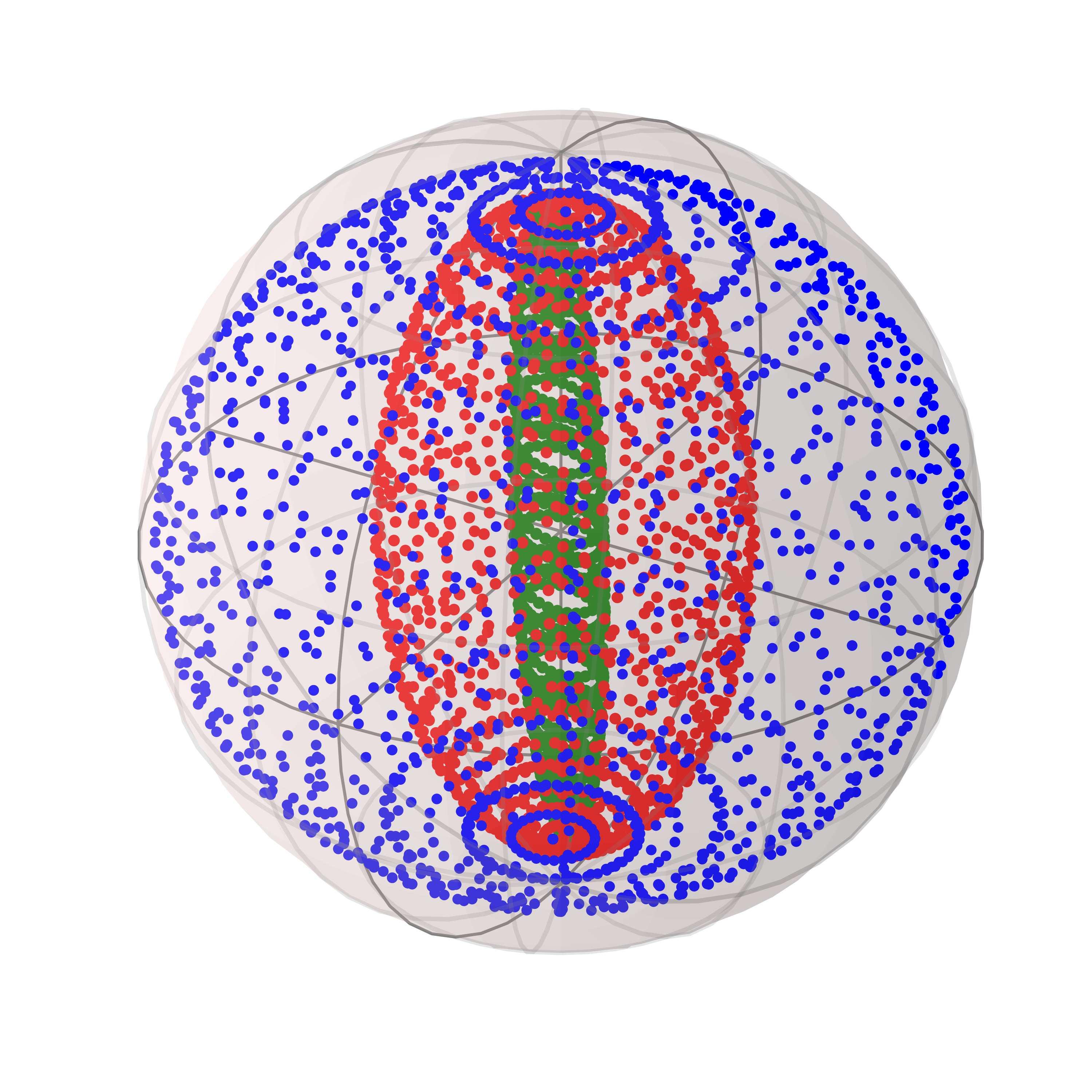
Links in the knowledge graph 1
Quantum echo stratifies. First, the loudest voice of non-macrorealism goes silent. Then temporal steering quiets down. And when all seems hushed, a new echo is born from the noise—the environment for a moment remembered the qubit's past and gave it back. This hierarchy of deaths and resurrections opens the way to quantum memory detectors that can hear the invisible dynamics of open systems. Perhaps this is how we'll teach quantum computers not to lose themselves in time.
🎯 In 2007, physicists were stunned to first witness the 'sudden death' of entanglement: two particles instantly lost their nonlocal connection. Now the mirror effect has been discovered in time—a qubit can abruptly sever its connection with its past self.
B_{\max} = \max\left\{0, \frac{C_{ab} + C_{a'b} + C_{ab'} - C_{a'b'} - 2}{2\sqrt{2} - 2}\right\}
Bmax = 1 for maximal violation of macrorealism, 0 — the qubit behaves as a classical system without temporal coherences.
f = \|R\|_{\mathrm{tr}} - 1
f > 0 means the pseudo-density matrix R cannot be decomposed into a product of states for different time moments, i.e. the qubit's past and present are entangled.
Scientists
Erwin SchrödingerHugh Everett IIINiels BohrPascual JordanWerner HeisenbergWolfgang Pauliquantum information
quantum computer
superconductivity
quantum decoherence
quantum measurement
superposition
quantum entanglementLaws
Schrödinger equationHeisenberg uncertainty principlePauli exclusion principleHawking radiationsuperposition principleBell's theorem