Popular

Erwin Schrödinger

1887-1961 · quantum mechanics, theoretical physics
Erwin Schrödinger is an Austrian theoretical physicist, one of the founders of quantum mechanics. His famous wave equation describes the evolution of quantum systems and allowed the explanation of the hydrogen atom spectrum. He also introduced the term 'quantum entanglement' and proposed a paradoxical thought experiment with a cat, demonstrating the complexities of quantum interpretation.

Biography

Born in Vienna. Studied at the University of Vienna. Taught at the University of Zurich, then took Max Planck's chair at the University of Berlin. After the Nazis came to power, he left Germany and worked at Oxford and the Dublin Institute for Advanced Studies. In 1926, in a series of papers, he developed wave mechanics and the Schrödinger equation. Laureate of the Nobel Prize in Physics in 1933 jointly with Paul Dirac.

Key discoveries

💡 It is believed that the idea of the wave equation came to Schrödinger during the Christmas holidays of 1925, spent at an Alpine resort with a mysterious companion. His cat paradox was conceived as sarcastic criticism of the Copenhagen interpretation but became one of the most recognizable images in science.
Quote: "The number of fundamental facts that remain uncovered is becoming fewer; a new fact can almost certainly be foreseen, and the more precisely it is foreseen, the more precise the convergence."
Links in the knowledge graph 1
Related tags
quantum entanglementhydrogenspectroscopy
Related laws
Schrödinger equationPauli exclusion principlede Broglie formulasuperposition principleKlein-Gordon equation
Related scientists
Robert HookeJohann Jakob BalmerJocelyn Bell BurnellArno PenziasCharles TownesJames Clerk MaxwellAlain AspectCecilia Payne-Gaposchkin

Related articles

Symphony of Imaginary Frequencies: Quantum Decay of the Inverted Well

A classical particle rolls off a hilltop, nudged by gravity; its quantum twin is pushed down by the uncertainty principle itself. A new work provides a rigorous solution for the inverted potential well: energy becomes purely imaginary, E = iℏω(n+½), and states decay exponentially. Yet in coherent su
arXiv:2505.00475v2 · 2025-05-01

Quantum Measurement as a Deformation of Perception: The Bloch Sphere and the Birth of Categories

A deep connection between quantum measurement and categorical perception: how a continuous spectrum turns into discrete concepts. On the Bloch sphere, wave function collapse deforms distances—pure states 'fall' into mixed ones, distances within a category shrink, and those between categories stretch
arXiv:2505.00777v1 · 2025-05-01

Dance of the Octopus Electron: What Quantum Tunneling Says About the Nature of Reality

Quantum tunneling is not just a trick that lets electrons seep through impassable barriers. It’s a window into the deepest mysteries of reality. It turns out that an electron behaves not as a point, but as a distributed entity—something like an octopus squeezing its tentacles through a crack. This v
arXiv:2505.00872v4 · 2025-05-01

Maximum Quantum Entanglement: Hidden Symmetry and the Mirror Universe

Researchers found that if Higgs particle collisions are required to always produce maximally entangled states, the Higgs potential automatically extends its global symmetry. This leads to an exact symmetry U(2)×U(2), spontaneously broken to U(1)×U(1), giving rise to six massless Goldstone bosons. A
arXiv:2505.00873v1 · 2025-05-01

Quantum Symphony from Noise: How Spontaneous Emission Gives Birth to Entanglement

Contrary to the entrenched view of spontaneous emission as an incoherent process that destroys quantum entanglement, a team of physicists has theoretically demonstrated the possibility of generating near-perfect bipartite entanglement between two bright light fields. The scheme is based on a four-le
arXiv:2505.00919v1 · 2025-05-01

The Rydberg Waltz: How a Dance of Losses Amplifies Quantum Sensitivity

Quantum sensors based on Rydberg atoms can detect minuscule electromagnetic fields, but optical readout usually destroys almost all signal photons. Physicists from Warsaw went against the grain and deliberately enhanced nonlinear losses through dipole-dipole collisions of excitations. This paradoxic
arXiv:2505.01506v2 · 2025-05-02

Radical Dance, Frozen by Chirality: How Birds See the Magnetic Field

The work shows how chirality—the property of a molecule not coinciding with its mirror image—turns a weak magnetic signal into a reliable compass. Chirality does not merely create quantum coherence, but induces spin polarization, forcing the system to endlessly 'freeze' in one state. This amplificat
arXiv:2505.01519v1 · 2025-05-02

Quantum Boomerang: Fugue in a Detuned Orchestra

Disordered quantum systems usually stifle any transport, but new simulations have revealed a quantum boomerang: in a discrete walk, the wave packet returns, only not to the starting point, but to the opposite end. The internal state of the coin particle creates an asymmetry without external force—li
arXiv:2505.01532v1 · 2025-05-02

Quantum Wallet: Energy Teleportation Between Five Qubits

Imagine a shared wallet: one person deposits their paycheck, and the others take turns withdrawing, with the first grabbing the largest bill. In the quantum world, this is how energy teleportation works in a W state — a special kind of multipartite entanglement. Experiment on the IBM Lagos processor
arXiv:2505.01863v1 · 2025-05-03

The Electron's Heel: What Dirac Knew and Pauli Missed

The simplified description of electrons in magnets misses a built-in curvature. Dirac's equation shows that every electron inherently has a property that slightly bends its path. This explains the anomalous Hall effect without extra assumptions. The discovery changes the foundations of magnet physic
arXiv:2506.01292v2 · 2025-06-02

When Quantum Meets Gravity, Weirdness Fades

Mixing quantum theory and gravity often requires bending the rules into nonlinear forms. A fresh study uncovers a stunning side effect: this bending kills contextuality—the hallmark of quantum strangeness where a particle’s properties depend on how you look. If real, these models would make the worl
arXiv:2506.04298v1 · 2025-06-04

The Key to Quantum Gravity Lies in a Single Atom

Physicists have found a workaround: instead of complex experiments to entangle massive objects, you can track the motion of a single atom. If its quantum dance obeys the Schrödinger equation, two atoms automatically become entangled through gravity. This brings us closer to answering the question ab
arXiv:2508.03052 · 2025-08-05

Mechanical Schrödinger's Cat

Instead of complex setups — just one qubit (an artificial atom) and a resonator. A signal at double the frequency swings the string in two opposite directions at once, like the legendary cat, only mechanical. This simplifies experiments and paves the way for ultra-precise sensors and error-proof qua
arXiv:2508.10500 · 2025-08-14

Quantum Duet: How Two Pendulums Catch a Shared Rhythm

Classical synchronization is familiar from pendulum clocks that align their ticks via a common support. Scientists have now brought this effect into the quantum realm for the first time: two ions, cooled nearly to absolute zero, swung in unison thanks to finely tuned energy losses. The catch? You ca
arXiv:2509.18423 · 2025-09-22

Quantum Record: 120 Entangled Qubits

A record entangled state of 120 qubits helps test quantum computers. Scientists used a clever scheme with temporary 'disentanglement' and error catching to bypass the fragility of connections. The achieved accuracy of 56% is an important step toward reliable computing and testing fundamental theorie
arXiv:2510.09520 · 2025-10-10

Disorder as an Ally: Quantum Memory

Scientists found that crystal imperfections help store quantum information longer. Experiments on diamond showed: chaos creates isolated pockets where fragile states live hundreds of times longer. This opens the way to reliable quantum storage media.
arXiv:2511.07785 · 2025-11-11

Quantum Secrets Inside Viruses

Ordinary computer calculations miss quantum phenomena that are crucial at the nanoscale. Inside the cramped viral shell, the DNA thread behaves like a wave. By applying the mathematics of the microworld to the Paracoto virus, researchers discovered that quantum effects here are not a minor detail bu
arXiv:2511.13768 · 2025-11-14

A Quantum Accelerator for Drug Design

A hybrid method combines classical and quantum computers to assess the binding strength of a drug molecule to a protein in minutes. It is 20 times faster than classical approaches without sacrificing accuracy, filtering out weak binders before synthesis.
arXiv:2512.06141 · 2025-12-05

Gravity vs. Superposition: Why the World Isn't Blurred

Scientists discovered that an object's own gravity destabilizes quantum superposition: the object quickly loses its fuzziness and ends up in one place. The collapse time is inversely proportional to mass—for heavy bodies it's almost instantaneous. The effect works even in free fall, explaining why l
arXiv:2512.15393 · 2025-12-17

Universal AI Key to Light States

Scientists have created an AI model that learns from simple quantum states of light and then instantly adapts to complex ones—multi-beam and 'squeezed'—to check their quality. This will accelerate the development of quantum computers and secure communication channels.
arXiv:2512.18801 · 2025-12-21

Quantum Camera Reveals Invisible Particle Bonds

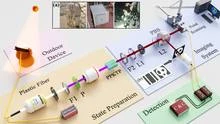
Scientists used an ordinary camera to capture the quantum connection of photon pairs. Bright light and a simple algorithm replaced complex detectors that work in total darkness. The new approach speeds up imaging by tens of thousands of times and makes quantum technologies more accessible.
arXiv:2512.24878 · 2025-12-31

Particles Play Shy in an Expanding Universe

The stretching cosmos can conjure particles from nothing. But new simulations find that if those particles tug on each other, they slam the door on further creation—challenging the idea that more expansion means more particles. The early universe may have been far less crowded than we thought.
arXiv:2601.02331v2 · 2026-01-05

A Diamond Speck in Two Places at Once

A setup with magnetic microchips suspends a tiny diamond grain with a special defect that glows like a beacon. The particle enters a state of superposition, existing in two places at once. The goal: entangle two such grains via gravity—if successful, it would prove that attraction itself obeys quant
arXiv:2601.06608 · 2026-01-10

Entanglement Born in Collisions

Molecular collisions weave their states into quantum knots. Physicists have learned to measure this entanglement and control it with a magnetic field. This will allow control over quantum processes in chemistry and ultracold gases.
arXiv:2601.17144 · 2026-01-23

Billiards and Quanta: One Equation for All

A single equation covers both billiards and quanta: the parameter κ acts like a speed knob, switching reality between two modes.
arXiv:2601.22697 · 2026-01-30

Quantum Magic of Heavy Particles

In an experiment at the Large Hadron Collider, the CMS collaboration has for the first time measured quantum discord and steerability in top quarks. The main discovery is 'quantum magic,' a special state that cannot be reduced to ordinary correlations. This sheds light on the fundamental laws of the
arXiv:2602.15115 · 2026-02-16

Why can't large objects be in two places at once?

The mass of a large object warps space so much that any attempt to be in two places creates a deep energy well into which the object immediately falls. This explains why tables and rocks don't follow quantum laws, linking gravity to quantum physics and homing in on the measurement puzzle.
arXiv:2603.01811 · 2026-03-02

How a Quantum Computer Distinguished Past from Future

An experiment on a 10-qubit diamond processor proved that machine learning can capture the direction of time in quantum processes. The neural network identified the flow of heat with 92% accuracy, helping to understand how an irreversible world emerges from symmetric laws.
arXiv:2603.10344 · 2026-03-11

How a Beam of Light Turns into Schrödinger's Cat

When doubling the frequency of a laser beam inside a crystal, the light spontaneously morphs into something like Schrödinger’s cat—a blend of two states. Vacuum jitters disrupt the rhythm of the wave, and the photon stream splits in two. This lets us generate macroscopic quantum states without bulky
arXiv:2603.24067 · 2026-03-25

A Quantum Recipe for Free Will

The 'Agent Choice via Quantum Flux' model reconciles free choice with physics: one decision is embodied by many quantum states—like soup made by different chefs. This leaves room for genuine choice where only predetermination was seen before.
arXiv:2604.06450 · 2026-04-07

Gravitational Duet: How Entangled Masses Listen to the Whisper of Other Dimensions

Extra dimensions have long evaded detection due to electromagnetic noise. The protocol of quantum-induced entanglement of masses turns two microscopic bodies in superposition into gravitational tuning forks, accumulating a phase shift exquisitely sensitive to deviations from Newton's law. Analysis o
arXiv:2605.00749v1 · 2026-05-01

Gravitational Shadows: How Mass Splits Reality

Matter interferometry creates a Schrödinger's cat for macroscopic masses, opening the path to quantum gravity. A mass in superposition generates two clouds of coherent gravitons — gravitational shadows. Their contrast drops exponentially with increasing mass, signaling the growing entanglement betwe
arXiv:2605.05153v1 · 2026-05-06

When Gravity Knits Quantum Lace: Lessons from the Schrödinger–Newton Model

The hybrid Schrödinger–Newton equation for the first time analytically disentangled two faces of gravity: self-interaction and mutual attraction. It turns out that self-gravity does not alter the Schmidt spectrum, and hence the measure of quantum entanglement; however, the pairwise potential activel
arXiv:2605.06577v1 · 2026-05-07

Pendulum Swinging Nonstop for Five Days

Physicists built a microscopic pendulum that loses energy so slowly it swings for nearly five days. Superconductivity and cooling to ultralow temperatures eliminate friction. The device already detects tiny nudges from impurities in superfluid helium, and in the future it will test quantum gravity h
arXiv:2605.09632 · 2026-05-10

How Internal Noise Destroys Quantum Magic

For a long time, it remained a mystery why large objects don't exhibit quantum weirdness like the Schrödinger's cat superposition. It's all about internal noise: countless microscopic details, acting like interference, cause the superposition to collapse rapidly. Thus, Born's rule is derived from qu
arXiv:2605.16148 · 2026-05-15

A Tiny Magnet Sneaks Through an Invisible Wall

A tiny magnet levitates in a trap, unable to rotate freely. Scientists have found a way to protect its quantum 'leakage' through an energy barrier from residual gas interference: just make the magnet almost perfectly round. This discovery promises a breakthrough in creating ultra-sensitive sensors a
arXiv:2605.19125 · 2026-05-18

Quantum Mpemba: Strong Entanglement Melts Faster

Physicists have discovered that under environmental influence, a strong quantum bond between particles breaks down faster than a weak one. The reason is excess energy in highly entangled states. This counterintuitive effect helps manage fragile quantum systems.
arXiv:2605.23197 · 2026-05-22

Quantum Generator: Images Without Training

The quantum approach eliminates training. An energy landscape is constructed, where the lowest point is the finished image. Quantum effects stitch together possibilities into a sharp, coherent visual. Fast, transparent, and without thousands of examples.
arXiv:2605.25986 · 2026-05-25

Quantum Cat Made of 120 Photons

Physicists created a quantum state of light in which 120 photons act like a spinning coin—heads and tails are seen at once. The new method combines a quantum switch with a precise mathematical trick, achieving 96% accuracy even with noise. This pushes forward the test of the boundary between the qua
arXiv:2606.03293 · 2026-06-02

Quantum Drones Scan Ruins with Magnetic Vision

After earthquakes or explosions, every hour counts. New research proposes using drones with incredibly sensitive quantum magnetometers to peer beneath rubble. Scientists simulated the collapse of a concrete parking structure and showed that weak magnetic fields from steel rebar can reveal where void
arXiv:2606.25957 · 2026-06-24

Vortices in the Quantum World

Scientists have reformulated the Schrödinger equation, representing particles as a flowing medium. Points where the probability of finding a particle is zero become vortices. Their integer count naturally yields precise energy levels, explains the eternal jitter even of a particle at rest, and links
arXiv:2606.28640 · 2026-06-26

The Universe's Dance Floor: When Dark Matter Breaks into a Quantum Rhythm

Scientists have constructed a rigorous quantum-kinetic theory of gravitational instability for the fuzzy dark matter model—ultralight bosons with a mass on the order of 10⁻²² eV. By applying the Wigner equation and the Landau method, they derived a dispersion relation that revealed a sharp crossover
arXiv:2607.04893v1 · 2026-07-06

The Quantum Wave That Gives Birth to the Universe

A physicist found that interpreting a motionless quantum wave as a probability distribution for a particle’s internal clock naturally yields the math of an expanding universe. Gravity becomes unnecessary—spacetime bends purely from statistical chances. This offers a route to merging quantum physics
arXiv:2607.05020 · 2026-07-06

Classical Gravity Distorts Quantum Snapshots

Scientists have proposed a way to test the nature of gravity by observing the oscillations of microscopic mirrors. If gravity is classical, the reconstructed quantum picture violates fundamental constraints—opening a path to lab tests.
arXiv:2607.06967 · 2026-07-08