Popular

Quantum Physics quant-ph

448 articles

Foundations of quantum mechanics, quantum information and computation, quantum optics, entanglement, and related experiments.

articles

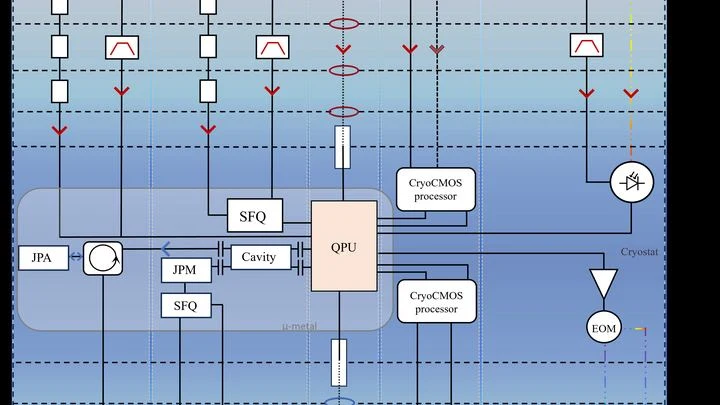
Why It's So Hard to Simulate a Quantum Computer

Accurate simulation of quantum computers runs into mind-boggling memory demands. Scientists get creative—building approximate models that let them develop quantum algorithms without real hardware.
arXiv:2410.12660 · 2024-10-16

Quantum Batteries: How to Plug the Leak at the Quantum Level

Next-generation batteries could last longer, but their energy leaks away like water from a sieve. The solution: weak measurements, which act like a perfect patch, stopping losses without expending energy. The method works for systems of any size and promises stable storage for quantum computers.
arXiv:2411.16633 · 2024-11-25

Donut Beam Locks Mirrors with Subatomic Precision

Scientists stabilized a pair of micromirrors using a donut-shaped laser beam. The beam’s dark center lands right on the detector, letting the camera capture the glow of single atoms without interference. This will boost the reliability of quantum devices.
arXiv:2412.00271 · 2024-11-29

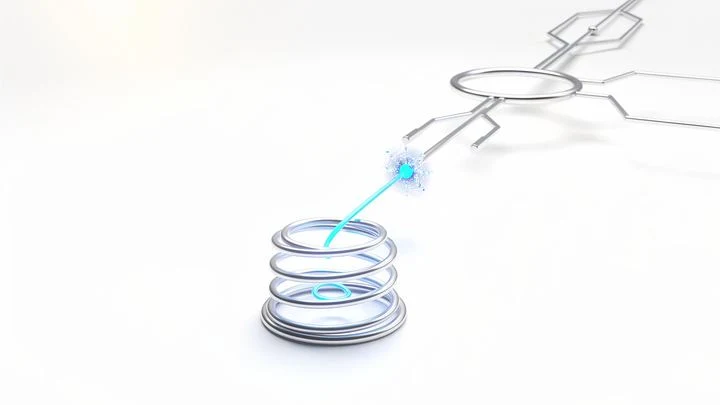
The Kick That Stops Molecules: A New Cold Record

Scientists used a precise laser pulse—a delta-kick—to cool molecules almost to a standstill. The molecules' internal vibrations don't mess with their motion, so they stay intact. Supercold molecules will open the door to ultra-precise tests of gravity.
arXiv:2502.09437 · 2025-02-13

Gravitational Waves to Test the Quantum Graininess of Space

The Generalized Uncertainty Principle (GUP) posits that space is made of quantum 'pixels.' This feature acted as dark energy in the early universe, and today it influences galaxy formation and leaves a trace in gravitational waves. New observatories will be able to measure this effect.
arXiv:2502.10043 · 2025-02-14

Quantum Measurements: Hidden Paths of Evolution

Weak continuous measurement of quantum systems usually causes random walks of their properties. However, new research has shown that these walks are secretly constrained by simple 'rails' — curves with few parameters. This unexpected discovery simplifies control over quantum objects and promises pro
arXiv:2503.08296 · 2025-03-11

Engineering Trick Makes Quantum Computers More Accurate

Quantum computers suffer from imprecise signals, like an orchestra without a conductor. The engineering approach iLQR, which lands rockets, now calculates smooth pulses for qubits. This reduces noise and paves the way for practical quantum computing.
arXiv:2504.10938 · 2025-04-15

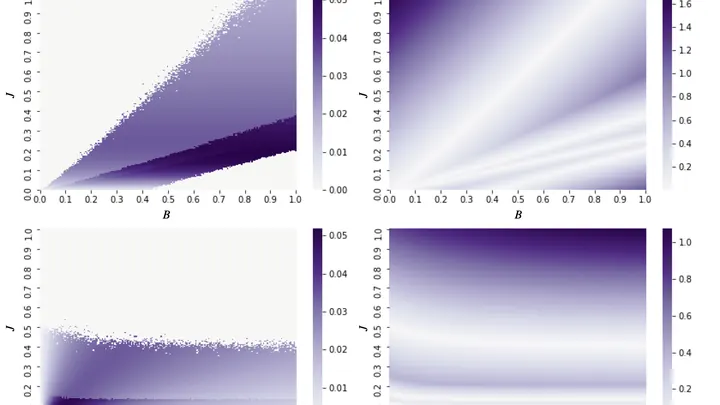
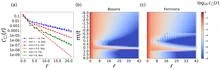
Dance of Bosons: From Chaos to a Checkerboard Pattern

Traditional models of fundamental forces rely on fermions—particles that avoid their neighbors. An experiment with bosons, which, on the contrary, are drawn to each other, unexpectedly revealed a structure with perfectly alternating vortices. This discovery reduces computational costs and brings the
arXiv:2504.17000 · 2025-04-23

Quantum Dispatcher for the Power Grid

A hybrid algorithm involving a quantum computer quickly finds an economical schedule for power plants. Tests on 26 generators showed near-ideal results. This will reduce fuel consumption and electricity bills.
arXiv:2505.00145 · 2025-04-30

The Skyrmion Dance: How a Magnetic Vortex Conducts the Quantum Orchestra

A hybrid quantum system has been proposed, combining long-lived spin memory, a fast superconducting processor, and a topologically protected mediator — a magnetic skyrmion. Its oscillations bridge the atomic world of defects with macroscopic circuits, overcoming the scale chasm. Calculations promise
arXiv:2505.00266v1 · 2025-05-01

Quantum Debts: When a Photon Has Negative Presence

For the first time, physicists operationally measured how a single photon physically distributes between two paths of an interferometer. It turned out that in the port with destructive interference, 'superlocalization' occurs: the probability of presence in one arm exceeds unity, while in the other
arXiv:2505.00336v2 · 2025-05-01

Symphony of Imaginary Frequencies: Quantum Decay of the Inverted Well

A classical particle rolls off a hilltop, nudged by gravity; its quantum twin is pushed down by the uncertainty principle itself. A new work provides a rigorous solution for the inverted potential well: energy becomes purely imaginary, E = iℏω(n+½), and states decay exponentially. Yet in coherent su
arXiv:2505.00475v2 · 2025-05-01

Cosmic Tango: How Spins Dance with Dark Matter

Armed with a quantum magnetometer that reads nuclear spins with incredible precision, scientists hunted for exotic forces that break mirror symmetry. A tandem of rotating lead masses and a cloud of neon atoms improved previous constraints by a thousandfold. The setup works like a miniature gravitati
arXiv:2505.00483v1 · 2025-05-01

Light in a Cryostat: How Imperfect Converters Build Quantum Bridges

Superconducting quantum computers hit a cooling wall: a single cryostat can't hold millions of qubits. The solution is optical channels, but they need microwave-to-optical converters, which are still far from perfect. The authors showed that with feedback protocols, parallel attempts, and quantum di
arXiv:2505.00542v1 · 2025-05-01

Quantum Measurement as a Deformation of Perception: The Bloch Sphere and the Birth of Categories

A deep connection between quantum measurement and categorical perception: how a continuous spectrum turns into discrete concepts. On the Bloch sphere, wave function collapse deforms distances—pure states 'fall' into mixed ones, distances within a category shrink, and those between categories stretch
arXiv:2505.00777v1 · 2025-05-01

Dance of the Octopus Electron: What Quantum Tunneling Says About the Nature of Reality

Quantum tunneling is not just a trick that lets electrons seep through impassable barriers. It’s a window into the deepest mysteries of reality. It turns out that an electron behaves not as a point, but as a distributed entity—something like an octopus squeezing its tentacles through a crack. This v
arXiv:2505.00872v4 · 2025-05-01

Maximum Quantum Entanglement: Hidden Symmetry and the Mirror Universe

Researchers found that if Higgs particle collisions are required to always produce maximally entangled states, the Higgs potential automatically extends its global symmetry. This leads to an exact symmetry U(2)×U(2), spontaneously broken to U(1)×U(1), giving rise to six massless Goldstone bosons. A
arXiv:2505.00873v1 · 2025-05-01

Quantum Symphony from Noise: How Spontaneous Emission Gives Birth to Entanglement

Contrary to the entrenched view of spontaneous emission as an incoherent process that destroys quantum entanglement, a team of physicists has theoretically demonstrated the possibility of generating near-perfect bipartite entanglement between two bright light fields. The scheme is based on a four-le
arXiv:2505.00919v1 · 2025-05-01

Quantum Tuning Fork: Noise Speeds Up the Search for Single Emitters

Brute-force photon counting from a single emitter gets bogged down in noise, like digging a tunnel with a shovel. But introduce a coherent reference beam and let quantum interference kick in — and the picture changes dramatically: the noisier the environment, the faster the verdict. The extended Hon
arXiv:2505.00950v2 · 2025-05-02

Death and Rebirth of Quantum Echo: A Hierarchy of Temporal Correlations in a Qubit

Physicists made a superconducting qubit forget its past—and saw how three types of temporal correlations (non-macrorealism, temporal steering, temporal non-separability) arrange themselves into a logical ladder. These echoes die at different noise levels and can resurrect when the environment briefl
arXiv:2505.01379v1 · 2025-05-02

The Rydberg Waltz: How a Dance of Losses Amplifies Quantum Sensitivity

Quantum sensors based on Rydberg atoms can detect minuscule electromagnetic fields, but optical readout usually destroys almost all signal photons. Physicists from Warsaw went against the grain and deliberately enhanced nonlinear losses through dipole-dipole collisions of excitations. This paradoxic
arXiv:2505.01506v2 · 2025-05-02

Radical Dance, Frozen by Chirality: How Birds See the Magnetic Field

The work shows how chirality—the property of a molecule not coinciding with its mirror image—turns a weak magnetic signal into a reliable compass. Chirality does not merely create quantum coherence, but induces spin polarization, forcing the system to endlessly 'freeze' in one state. This amplificat
arXiv:2505.01519v1 · 2025-05-02

Quantum Boomerang: Fugue in a Detuned Orchestra

Disordered quantum systems usually stifle any transport, but new simulations have revealed a quantum boomerang: in a discrete walk, the wave packet returns, only not to the starting point, but to the opposite end. The internal state of the coin particle creates an asymmetry without external force—li
arXiv:2505.01532v1 · 2025-05-02

A Glass Loom for Light: 99.7% Fidelity Across 24 Quantum Threads

Researchers from Ephos and the Polytechnic University of Milan inscribed a 24-mode universal photonic processor into glass, using femtosecond lasers like a sewing machine needle. Operating at 925 nm—ideal for quantum-dot single-photon sources—the device is controlled by microheaters and uses less po
arXiv:2505.01609v2 · 2025-05-02

Seven Lives of a Photon: Exceptional Points Control Spontaneous Emission

By combining lithium niobate and gallium arsenide, scientists created a chip. In it, quantum dots interact with microresonator modes, and electro-optic tuning of the feedback phase drives the system to an exceptional point. At this singularity, two modes coalesce, and the spectral density of states
arXiv:2505.05490v1 · 2025-05-02

Quantum Wallet: Energy Teleportation Between Five Qubits

Imagine a shared wallet: one person deposits their paycheck, and the others take turns withdrawing, with the first grabbing the largest bill. In the quantum world, this is how energy teleportation works in a W state — a special kind of multipartite entanglement. Experiment on the IBM Lagos processor
arXiv:2505.01863v1 · 2025-05-03

Quantum Ghosts in the Hall of Mirrors

Usually, nonclassical states of motion require clever tricks. But new research reveals that the intrinsic nonlinearity of an optical trap itself sculpts quantum 'ghosts' from mechanical vibrations — states with a negative Wigner function. No probabilistic schemes needed, even in unresolved sidebands
arXiv:2505.01942v2 · 2025-05-03

Conductor of Heat Death: The Charge Palette of a Quantum Bath

The Mpemba effect, familiar from the paradoxical behavior of water, gains a quantum dimension: in isolated systems, a more non-equilibrium state sometimes relaxes faster. New research reveals the mechanism — the key lies in the symmetry structure of the thermostat's initial state. The wider the ener
arXiv:2505.02040v2 · 2025-05-04

Quantum Internet: How Entanglement Became a Data Packet

Superconducting qubits and optical photons are separated by a five-order-of-magnitude frequency gap. Direct qubit translation is an engineering dead end, but an architectural trick inspired by packet switching turns weak transducers into entanglement generators. Thus the quantum internet transforms
arXiv:2505.02057v4 · 2025-05-04

Catching Light on the Rebound: The 'Pitch-and-Catch' Method

Typically, light traps lose some photons upon capture. The 'pitch-and-catch' method uses reflected light for a second attempt, catching the pulse without loss. This will improve the accuracy of quantum networks, bringing us closer to reliable quantum internet.
arXiv:2506.01127v2 · 2025-06-01

One-Way Door: How Quantum Magnets Reconcile Order with Chaos

The study reveals an unusual transition in one-dimensional magnetic chains, where ordered and disordered states coexist. The key was nonreciprocal symmetries—rules with no reverse path, like a door that only opens one way. This allowed them to not only describe a single critical point but also gener
arXiv:2506.01131v1 · 2025-06-01

Energy Teleportation Without Particle Transfer

A new protocol exchanges secrets using teleported energy, without moving particles. The method is noise-resistant and detects cheating, paving the way for absolutely secure networks.
arXiv:2506.02054v2 · 2025-06-01

The Electron's Heel: What Dirac Knew and Pauli Missed

The simplified description of electrons in magnets misses a built-in curvature. Dirac's equation shows that every electron inherently has a property that slightly bends its path. This explains the anomalous Hall effect without extra assumptions. The discovery changes the foundations of magnet physic
arXiv:2506.01292v2 · 2025-06-02

Secret Symmetry in Particle Collisions

Particle collisions are usually chaotic due to their internal entanglements. But if you remove these entanglements, an elegant symmetry emerges, simplifying the description of the microworld. The discovery builds on ideas from quantum information science.
arXiv:2506.01314v2 · 2025-06-02

Disorder is Inevitable: The Secret Lies in Information

A new proof shows that the growth of disorder in the universe is caused by erasing information about order. The system forgets its initial state, and it cannot be restored. This discovery links quantum mechanics with everyday phenomena and could help create energy-efficient nanotechnology.
arXiv:2506.01351v5 · 2025-06-02

Edge with a Twist: The Möbius Strip in the Quantum World

Some materials conduct electricity only along their edges. Laser irradiation causes these edge paths to twist into a quantum Möbius strip—a noise-resistant foundation for future quantum computers.
arXiv:2506.01401v2 · 2025-06-02

Eternal Acceleration: Quantum Ball vs. Classical

Scientists studied a model where an imaginary ball bounces between moving walls. It turned out: in ordinary physics, the ball usually returns without going far. In quantum physics, it gains energy without stopping. A way was also found to find rare exceptions — classical runaway trajectories. The wo
arXiv:2506.01684v2 · 2025-06-02

Quantum Chaos Accelerates Beyond the Limit

In some quantum systems, information spreads not gradually but like an avalanche. Additional symmetries act as 'super-spreaders' of rumors. This overturns previous ideas about the maximum speed of chaos and promises a breakthrough in quantum technologies.
arXiv:2506.01957v3 · 2025-06-02

The Void That Dresses Matter

Vacuum is not emptiness, but an invisible fabric of fleeting particles of light. By placing a material inside a microresonator, we 'wrap' it in this fabric, and its properties change without external influence. This is the path to new electronics and energy technology running on emptiness.
arXiv:2506.02170v1 · 2025-06-02

Laser Lasso for Stable Molecules

Aluminum fluoride molecules resemble microscopic dumbbells—incredibly sturdy. Until now, traps only captured fragile objects. Now physicists have thrown a lasso of laser light and magnetic field over AlF, cooling them to a near standstill. The leap in measurement precision is akin to the jump from p
arXiv:2506.02266v2 · 2025-06-02

Pilot droplets: a new look at quantum reality

Physicists have long debated whether quantum particles have hidden 'pilots'. Bell's theorem seemed to put an end to that idea. But experiments with bouncing droplets showed that a classical system can bypass the bans if its parameters depend on context. Scientists propose testing this trick on real
arXiv:2506.02637v2 · 2025-06-03

Quantum Hearing Without Noise

Scientists have developed a method to detect ultra-weak signals, bypassing the fundamental noise threshold of the quantum world. Using a special amplifier crystal and analyzing two 'echoes' of the signal, the useful signal becomes louder, but the noise does not. This paves the way for more sensitive
arXiv:2506.02717v1 · 2025-06-03

Quantum gas unlocks the secrets of the universe's birth

Scientists used a Bose–Einstein condensate (Bose and Einstein) — a state where atoms move as a single wave — to simulate the first moments after the Big Bang. By tuning interactions, they made it mimic the behavior of spacetime at the tiniest scales. This allowed them to observe “Planckian damping”
arXiv:2506.02719v3 · 2025-06-03

Quantum Data Centers: The Future of the Internet

By uniting finicky quantum computers into orchestras through invisible synchronization, scientists are creating error-free computing centers—a stepping stone to a quantum internet that will speed up drug discovery and precise climate predictions.
arXiv:2506.02920v3 · 2025-06-03

A Mousetrap in the Atomic Nucleus: Reading Thorium with Ejected Electrons

By detecting electrons hurled from thorium-229's nucleus, researchers bypass light-blocking materials, enabling faster readout and bringing ultra-precise nuclear clocks within reach.
arXiv:2506.03018v1 · 2025-06-03

Quantum Bicycle: The Code That Squeezes Out Errors

A new type of quantum architecture, the 'bicycle', corrects errors using special codes. With the same number of qubits, it performs ten times more complex calculations than previous methods. This is a step toward truly useful quantum computers.
arXiv:2506.03094v1 · 2025-06-03

Quantum Stopwatch: Photons Measure Time

Scientists broke the coherence barrier by teaching detectors to recognize photon frequencies. This allows measuring delays with 10-picosecond precision, even when photons don’t arrive simultaneously. The discovery promises a breakthrough in quantum metrology.
arXiv:2506.03098v2 · 2025-06-03

How Closed Space Breaks the Quantum Rules of Rotation

In a closed space, like the surface of a donut, orbital rotation loses its discreteness. Its values become continuous—from fractional to irrational—and the effect persists on the scale of the entire Universe. Scientists suggest searching for its traces in the cosmic microwave background.
arXiv:2506.03254v1 · 2025-06-03

Particle Dance on Curved Spacetime

Researchers examined how tiny bumps in spacetime affect the quantum link between particles. It turns out that altered rules for energy exchange give rise to an interaction that protects this link from breaking. Even as spacetime loses track of the particles, it helps them stay in sync. This discover
arXiv:2506.03282v2 · 2025-06-03

There Are No Easy Paths in Quantum Computing

In quantum computing, every step is reversible, like a dance. Irreversible processes, where a step cannot be undone, are like a dancer vanishing. If such processes were easily accessible, the computer would gain fantastic power. But that very power hints that nature imposes a hard barrier.
arXiv:2506.03435v2 · 2025-06-03

Teaching a Tiny Mirror to Remember: Lessons from a Laser Teacher

Scientists have shown that systems where light pushes a microscopic mirror can serve as memory. Laser pulses change the mirror's state, making it remember past signals. To gauge memory, they devised a simple metric—a number close to one for good memory. The technology is compatible with current chip
arXiv:2506.03455v1 · 2025-06-03

Atom Cloud Gives Light a New Color

Physicists shifted light from visible red to infrared—the color that glides through glass cables—using a cloud of cold rubidium atoms. Achieving 80% efficiency, the method marks a leap toward a quantum internet where signals travel without fading.
arXiv:2506.03957v1 · 2025-06-04

Quantum Vortices: How a Chip Recreates the Dance of Fluids

Scientists created a model that allows a quantum chip to simulate vortex flows. They rewrote fluid motion equations into rules for qubits and tested them on an eight-qubit superconducting processor. Virtual vortices behaved like real ones. Thus, quantum computers bring us closer to solving the ancie
arXiv:2506.04023v1 · 2025-06-04

When Quantum Meets Gravity, Weirdness Fades

Mixing quantum theory and gravity often requires bending the rules into nonlinear forms. A fresh study uncovers a stunning side effect: this bending kills contextuality—the hallmark of quantum strangeness where a particle’s properties depend on how you look. If real, these models would make the worl
arXiv:2506.04298v1 · 2025-06-04

Anti-qubit: Reverse Time for a Quantum Sensor

Physicists have created an 'anti-qubit' — a quantum bit that evolves backward, like a film in reverse. Paired with an ordinary qubit, it becomes a gold standard sensor that even picks up the hidden direction of weak fields.
arXiv:2506.04315v1 · 2025-06-04

How Noise Turns Order into Chaos on a Quantum Chip

Physicists ran two programs on a superconducting chip: an orderly one and a chaotic one. By measuring the distances between energy levels, they found that in chaos, these levels keep a respectful distance, like people in a crowded room forming a circle. On a graph, this looks like a 'donut'—an empty
arXiv:2506.04325v1 · 2025-06-04

Gravitational Lens from Spins

Scientists have theoretically shown that in materials with a specific pattern of electron spins, an effect similar to gravitational lensing arises. Electrons are deflected and focused without a magnetic field. This opens the possibility of studying cosmic phenomena in miniature and creating new type
arXiv:2506.04335v2 · 2025-06-04

Why Flat Mirrors Baffle Physicists

The idea that light between mirrors behaves like a pair of tuning forks fails for flat systems. A new theory accounts for any shape and accurately predicts how light will bounce around inside. This paves the way for sensitive sensors and more powerful lasers.
arXiv:2506.04413v1 · 2025-06-04

How Diamonds and Light Measure Immense Pressure

In a diamond anvil cell that compresses matter to pressures of the Earth's core, scientists placed diamond dust specks, which lit up under a laser like miniature sensor-bulbs. Analyzing their glow allowed them to build a detailed stress map, revealing dangerous 'hot spots.' The method paves the way
arXiv:2506.09058v2 · 2025-06-04

How to Strike Light from the Void

Scientists have built a laser trap where rapid frequency shifts force the void to spawn photon pairs. An unexpected twist: the stronger the shaking, the harder it is for new particles to appear—space itself seems to resist. This paradox yields light with suppressed noise, perfect for quantum sensors
arXiv:2508.00353 · 2025-08-01

A Dust Particle Suspended in Light Hunts for Dark Matter

Physicists have turned a dust grain levitating in a vacuum into a detector capable of feeling the faint bump from a passing dark matter particle. The hunt for this mysterious substance that binds galaxies together has reached a new level: they've set record limits on its interaction with ordinary ma
arXiv:2508.00815 · 2025-08-01

Quantum Bridge of Light

Quantum processors are isolated in ultra-cold chambers. Their microwave signals were converted into light, which ran through an optical fiber, and back in another chamber—without losing the quantum essence. The first step toward a quantum internet.
arXiv:2508.02444 · 2025-08-04

The Key to Quantum Gravity Lies in a Single Atom

Physicists have found a workaround: instead of complex experiments to entangle massive objects, you can track the motion of a single atom. If its quantum dance obeys the Schrödinger equation, two atoms automatically become entangled through gravity. This brings us closer to answering the question ab
arXiv:2508.03052 · 2025-08-05

Light Makes Two Magnetic Strings Sing in Unison

Inside a mirror trap, light binds two magnetic nanoscale strings into a single quantum object. The pressure of light synchronizes their vibrations, creating entanglement that doesn't break even at a surprisingly high temperature — a few thousandths of a degree above absolute zero. This is an order o
arXiv:2508.03450 · 2025-08-05

Quantum Switch Breaks the Usual Flow of Time

In everyday life, everything happens in order: cause, then effect. But quantum particles can exist in two temporal orders at once — as if time for them can flow both forward and backward simultaneously. Scientists tested this with a quantum switch and confirmed it by looking only at the final statis
arXiv:2508.04643 · 2025-08-06

Switchable Ion Crystals

Physicists held six charged barium atoms in a vacuum trap, creating a flat crystal. By changing the electric field, they made the ions rearrange between two stable configurations, just like isomers. They estimated the temperature from the frequency of random switches. Now this platform can be used t
arXiv:2508.05902 · 2025-08-07

Taming Quantum Chaos through Learning

To control many quantum particles, scientists used trial and error: a computer agent, seeing only part of what's happening, learned to limit the growth of connections between particles. Normally, these connections (entanglement) quickly fill all space, like chaos. But the agent places 'bottlenecks'
arXiv:2508.06612 · 2025-08-08

The Quantum Mpemba Mystery: When Greater Chaos Speeds Up Order

Hot water freezes faster than cold—that's the Mpemba effect. In the quantum world, its counterpart is a system with a highly broken symmetry restoring order faster. Scientists controlled this on a superconducting chip, turning an accelerated 'tightening' of disorder on and off. This could help quant
arXiv:2508.07707 · 2025-08-11

Photonic Quantum Computer Sets a Speed Record

The new photonic computer Jiuzhang 4.0 pushes photons through a network of microchannels and uses photometry—precise counting of light flashes—to record the final pattern. This pattern is beyond any ordinary computer: it would require sifting through more possibilities than atoms in the universe. Th
arXiv:2508.09092 · 2025-08-12

Mechanical Schrödinger's Cat

Instead of complex setups — just one qubit (an artificial atom) and a resonator. A signal at double the frequency swings the string in two opposite directions at once, like the legendary cat, only mechanical. This simplifies experiments and paves the way for ultra-precise sensors and error-proof qua
arXiv:2508.10500 · 2025-08-14

Atoms in a Row: A New Way to Control Light

By cooling atoms to near absolute zero and arranging them with laser tweezers, scientists created a ruler that directs light into a narrow beam. The more atoms in the row, the sharper the beam. An effect previously known only in crystals made of billions of atoms emerged for the first time in just a
arXiv:2508.10748 · 2025-08-14

Sunlight replaces lasers: quantum imaging without complex optics

Sunlight is passed through a crystal that splits each photon into two entangled halves. Their invisible link allows imaging where ordinary optics are blind: in fog, under murky water, in near-total darkness. Previously, only lasers could do this—bulky and expensive. Now, daylight can be the source,
arXiv:2508.11207 · 2025-08-15

Why Dark Molecular States Promise Better Solar Cells

Many organic molecules have a built-in charge imbalance that changes upon light absorption. In pairs of such molecules, this opens hidden channels between bright and dark states. The discovered dark states barely respond to thermal noise, promising more efficient carbon-based solar cells.
arXiv:2508.11445 · 2025-08-15

Speed Outsmarts the Laws of Heat Engines

A heat engine made of quantum particles, flying almost as fast as light, perceives temperature in a whole new way. Einstein’s effects make the hot even hotter and the cold even colder, boosting useful work and bypassing the classical barrier. Speed becomes a thermodynamic trump card.
arXiv:2508.11554 · 2025-08-15

Diamond DNA Chip: A Revolution in Rapid Diagnostics

A diamond plate with 49 DNA sensors catches disease marker molecules. When the target is caught, the magnetic noise quiets, and the sensor gives a signal—fast, with no reagents or bulky equipment.
arXiv:2508.13193 · 2025-08-15

Motion as Fuel: Quantum Engines at Near-Light Speeds

Researchers have shown that if the heat and cold sources in a quantum maser (microwave amplifier) race along at nearly the speed of light, this engine circumvents the classical efficiency limit. Moreover, it can operate even without a temperature difference—the motion itself serves as fuel.
arXiv:2508.14183 · 2025-08-19

Tiny chip tames quantum entanglement

The device generates pairs of entangled photons at a record rate—45 billion per second—consuming just milliwatts of power. The purity of the quantum connection exceeds 96%. Its tiny size and efficiency bring quantum internet, secure satellite links, and ultra-precise sensors closer to reality.
arXiv:2508.14566 · 2025-08-20

Entangled Photons vs. Murky Media

A new method uses pairs of entangled photons to transmit sharp images through murky media—places where ordinary light is helpless. The medium remains opaque to everyone except the quantum duo, opening the door to ultra-secure communication and improved medical and astronomical imaging.
arXiv:2508.14616 · 2025-08-20

Microwave Teleportation Withstands the Heat

Connecting superconducting quantum computers is hindered by lethal heat. The solution is teleportation via entangled signals. In an experiment, the channel was heated to 4 K, yet fidelity remained above the classical limit. Now, distributed quantum networks can be built without cooling everything do
arXiv:2508.14691 · 2025-08-20

Fast Quantum Links: Delivered Before They Melt

Quantum entanglement is the fragile foundation of the future internet. It melts from noise like ice cream in the heat. Waiting for all parts only accelerates the melting. A new scheme processes each link immediately, leaving a minimal core. This nearly halves errors, paving the way for quantum netwo
arXiv:2508.14737 · 2025-08-20

Time Crystals Boost Batteries and Sensors

A chain of tiny magnets, where coupling strength drops sharply with distance, under rhythmic kicks transitions into a discrete time crystal state. Energy accumulates avalanche-like, and sensitivity to rhythm disruptions surpasses all known limits.
arXiv:2508.14847 · 2025-08-20

Heat that Entangles: Diamond Defects

Physicists have found a way to entangle two microscopic defects in diamond simply by heating them. Usually heat destroys everything, but here it establishes quantum order instead. The secret is to make the environment behave like a crowd with uneven rules, which synchronizes the defects. This method
arXiv:2508.18131 · 2025-08-20

Heat capacity catches quantum entanglement in time

Temperature lag during heating isn't just physics—it's a manifestation of temporal quantum entanglement. That's when events at different times influence each other, as if past and present were sharing information. Researchers proved: if thermal inertia is large, then such an unusual link exists with
arXiv:2508.15728 · 2025-08-21

Precise tuning of quantum gates without compromising readout

A new tuning technique made it possible to combine ultra-precise single-qubit and two-qubit operations with high-quality readout. Previously, one harmed the other, but now a balance has been found. This is an important step toward computers that can correct their own errors.
arXiv:2508.16437 · 2025-08-22

How Information Gives Birth to Particles from Nothing

Physicists have derived formulas proving: when quantum ties are broken, the vacuum responds by birthing matter. The calculations hold for acceleration, black holes, and radioactive decay. Information is no longer a shadow of reality — it's its architect.
arXiv:2508.17067 · 2025-08-23

Scandium-45: The Key to Clocks More Precise Than Atomic Ones

Physicists excited scandium-45 nuclei with an X-ray laser and saw that in a solid crystal, vibrations hinder ideal precision. But the transition's natural purity promises nuclear clocks with an error of less than a second over the age of the universe. This opens the door to ultra-precise measurement
arXiv:2508.17538 · 2025-08-24

Fullerene: A Ball That Shoots Single Photons

Cheap fullerenes added to plastic emit light strictly in single-photon packets — fast and fail-proof. This simple material opens the door to affordable quantum devices for secure communication and computing.
arXiv:2508.17824 · 2025-08-25

How Symmetry Saves Quantum Entanglement from Heat

Physicists have discovered: if a quantum system obeys a strict symmetry rule—like charge conservation—its particles remain entangled even at infinitely high temperature. This finding explains how order survived the Big Bang and promises quantum devices that don’t fear overheating.
arXiv:2508.20166 · 2025-08-27

Einstein's Paradox: Why the Quantum World Can't Be Fooled

In 1935, Einstein devised a thought experiment that seemed to allow knowing both the exact position and speed of a particle at once. New work proves: any measurement shatters this illusion, and there's no way around the fundamental prohibition.
arXiv:2508.20788 · 2025-08-28

A Bond Beyond Time

Muon pairs are born with strictly linked properties. It turns out the link holds even if one particle disintegrates before the other is measured. Our observations aren't a snapshot of reality, just a handy tool.
arXiv:2509.04436 · 2025-09-04

Spring Crystal: Giant Response Without Coils

Crystal Mn3Si2Te6, exposed to a magnetic field and a weak current, pushes back like a spring refusing to let the current change. Inside, microscopic whirlpools of electron flow rearrange in sync. This could miniaturize components for quantum electronics without tricky fabrication.
arXiv:2509.05492 · 2025-09-05

How Acceleration Turns Vacuum into a Hot Bath

A particle thermometer accelerated through vacuum heats up, and the way it reaches equilibrium depends on the field type and dimensions. Intriguingly, it heats faster than it cools, mimicking the Mpemba effect. This asymmetry provides a fingerprint to identify the Unruh effect.
arXiv:2509.05756 · 2025-09-06

Time from Disorder: How Atoms Revealed an Internal Clock

Scientists split a cloud of atoms and, by tracking rising disorder, ordered events in one half without seeing the other. This confirms that time emerges from internal changes. Such an approach will help us understand how time flows in black holes and right after the Big Bang.
arXiv:2509.07745 · 2025-09-09

Topological Physics at Room Temperature Using Light

Exotic quantum states typically exist only in the chill of liquid helium. But here, scientists replaced cooling with a light lattice, where atoms move in unison like an orchestra. The collective glow drowns out random noise, making it impossible for chaos to break through. They not only reproduced t
arXiv:2509.08411 · 2025-09-10

Quark Captivity: The Secret of the Invisible String's Snap

Using a simulation, scientists studied how the force strings connecting quarks break. The rupture turned out to be more complex: entire families of particles are born, and in a dense environment the process slows down. This discovery will help understand the microworld and can be tested on special d
arXiv:2509.08868 · 2025-09-10

Music from Quantum Randomness

By measuring the random properties of entangled light particles, scientists and artists create an audiovisual show that nature itself prevents from ever repeating.
arXiv:2509.08892 · 2025-09-10

Math shuts the door on twin-particle quantum computers

Scientists have rigorously proven that special states in superconductors are not mysterious particles identical to their antiparticles, but ordinary electron blobs with charge. This negates the idea of using them for robust quantum computing via 'braiding'. Now physicists may have to revisit the the
arXiv:2509.09663 · 2025-09-11

Quantum Compass in the Labyrinth of Solutions

Scientists applied a hybrid quantum algorithm to the Ising model—a problem of finding the most stable state of many interacting parts. A processor of 104 superconducting qubits found configurations with lower energy than the classical annealing method. Calculations show that with 100 qubits, a quant
arXiv:2509.11535 · 2025-09-15

Surfer Photons: How a Wave Guides a Particle

In pilot-wave theory, particles follow clear trajectories, like surfers on waves. By reconstructing photon trajectories in the double-slit experiment, physicists saw something strange: in the dark fringes, the particle's mass behaved like a tachyon's — becoming imaginary. This is the first direct ev
arXiv:2509.11609 · 2025-09-15

Quantum Whisper in Diamond

Using NV centers—glowing defects in diamond—scientists directly captured the mutual influence of spins. Reducing measurement noise paves the way for ultrasensitive quantum sensors.
arXiv:2509.11854 · 2025-09-15

Moving Atoms Slash Errors in Quantum Computers

Errors in quantum computers are inevitable. A new approach with moving neutral atoms lets logical qubits correct errors on the spot, boosting accuracy up to 8-fold.
arXiv:2509.13247 · 2025-09-16

Hot Cools Down Faster: The Quantum Paradox

Like a bonfire dying quicker than smoldering embers, the more excited a quantum system, the faster it relaxes. Physicists confirmed this with nuclear spins—tiny atomic magnets. A paradox first noticed by a schoolboy in his kitchen now explains quantum behavior and promises to turbocharge error corre
arXiv:2509.13451 · 2025-09-16

Radio Whisper of Dark Matter: A New Axion Detector

Scientists have created a detector that catches axions—candidates for dark matter. The device, made of layered material in a magnetic field, turns axions into light particles. Resonance, like that of a musical instrument, amplifies the faint signal, and tilting instead of moving parts lets you tune
arXiv:2509.14320 · 2025-09-17

Quantum Logic of the Brain: No Particles, No Fields

The brain oscillates between options like a quantum particle, but without any physical quanta. A mathematical model has shown that quantum-like states emerge from coordinated neural activity. This can be tested with EEG, turning philosophical debates about consciousness into observable science.
arXiv:2509.16253 · 2025-09-17

Electron on Helium: First Step Toward Reading a Quantum Bit

A device was built where a single electron on a helium film and a superconducting resonator exchange energy faster than quantum properties decay. This allows reading the electron’s state without destroying it—a crucial step toward quantum computers.
arXiv:2509.14506 · 2025-09-18

Giant Noise in a Superconductor-Magnet Sandwich

In a nanosandwich of vanadium, magnesium oxide, and iron, electrical noise increased a hundredfold. The reason: magnetic iron temporarily became a superconductor—superconductivity emerged where electron pairs move with parallel spins. Previously, such an effect required two superconductors; here, on
arXiv:2509.15983 · 2025-09-19

The Surprising Tail of Dying Light

Like a stadium emptying, a fluorescent dye dims quickly, then slows to a trickle. The lingering glow isn't uniform: its pace depends on which color you watch. This quantum oddity reveals hidden exit routes for escaping light.
arXiv:2509.17163 · 2025-09-21

How a Laser Can Help Distinguish Water and Ice in Clouds

Ordinary satellite lasers can't tell water from ice in clouds because of bright glare. A quantum filter highlights this shine, turning interference into data, and makes it possible to precisely determine what a cloud is made of.
arXiv:2509.17556 · 2025-09-22

Quantum Duet: How Two Pendulums Catch a Shared Rhythm

Classical synchronization is familiar from pendulum clocks that align their ticks via a common support. Scientists have now brought this effect into the quantum realm for the first time: two ions, cooled nearly to absolute zero, swung in unison thanks to finely tuned energy losses. The catch? You ca
arXiv:2509.18423 · 2025-09-22

Magnetar Confirms: The Vacuum Isn't Empty

The polarization of X-rays from a dead star with a monstrous magnetic field has been measured. It changes with energy as if the vacuum behaves like a crystal, bending light. This is the first direct evidence of a quantum effect predicted over 80 years ago.
arXiv:2509.19446 · 2025-09-23

Quantum Network Grabs Gravity by the Tail

The study describes a quantum web of many atomic groups. Atoms within are entangled like knots in a spiderweb, reacting sensitively to gravity changes. The network can notice how gravity alters time’s flow: at different heights, clocks tick differently. This is a first step toward testing gravity’s
arXiv:2509.19501 · 2025-09-23

How to See the Invisible: Recovering Polarization from a Handful of Photons

The algorithm, like an artist, reconstructs the polarization picture from sparse strokes. Accounting for the smooth change of light properties from color to color allows it to work in extremely low light—this will improve astronomical observations and material analysis.
arXiv:2509.19547 · 2025-09-23

Why do quantum systems remember their past?

In the quantum world, everything usually gets mixed up and forgets the past. But in some systems, where neighboring particles can't be excited at the same time, rare states arise — quantum scars. They retain the memory of the initial order even amid the chaos of global dynamics. This discovery helps
arXiv:2509.19944 · 2025-09-24

Two Times in the Quantum World

In quantum mechanics, time ceases to be a familiar arrow. One approach claims all moments already exist simultaneously. Another method suggests particles can move backward in time. Comparing these ideas opens the door to understanding the true fabric of reality.
arXiv:2509.22264 · 2025-09-26

Quantum Dance at Room Temperature

In a foil-like layer of boron nitride, an electron and a carbon atom's nucleus became partners in a quantum dance. Their bond held at room temperature—previously only possible in ultra-cold setups. This breakthrough promises compact quantum devices and ultra-sensitive sensors.
arXiv:2509.23170 · 2025-09-27

The Butterfly Secret: How Physicists Painted the Most Complex Pattern

The Kohmoto butterfly is a self-similar pattern that emerges from electron behavior under special conditions. For a long time, it defied separation into independent parts: traditional methods failed. A new approach turns the butterfly into a spectral paint-by-numbers: types of oscillations are sorte
arXiv:2509.24025 · 2025-09-28

Light with One-Way Motion: The Magic of Rydberg Atoms

Scientists used special Rydberg atoms at room temperature to make light move in only one direction. This motion triggers collective oscillations, similar to a time crystal. The discovery helps understand how to control light in tiny optical chips and non-equilibrium systems.
arXiv:2510.03024 · 2025-10-03

Quantum Triplet: Three-Photon Entanglement Confirmed

A cooled resonator experiment has conclusively shown three-photon entanglement, specifically of the 'non-Gaussian' kind. A strict mathematical test excluded chance by a wide margin. This triple connection promises more robust quantum computing.
arXiv:2510.05405 · 2025-10-06

How to Watch the Electron Dance in Living Cells

Biological processes depend on magnetic fields inside cells. A new method uses paired laser flashes to see invisible chemical 'dances' in living systems—a step toward portable sensors.
arXiv:2510.05600 · 2025-10-07

Cells Communicate with Light

By comparing the glow of healthy and cancerous brain cells, scientists discovered different flickering patterns. This is a step toward diagnosis without surgery.
arXiv:2510.05792 · 2025-10-07

Quantum Battery Powered by Thermal Chaos

Scientists have created a quantum battery that charges from heat alone. Many particles, like an orchestra without a conductor, exchange energy in unison through a shared medium. The device is immune to interference and could simplify the operation of quantum computers.
arXiv:2510.06384 · 2025-10-07

Listening to the Shudder of Space: The Nano-Mirror Experiment

Physicists have proposed an experiment with a nano-mirror suspended on a laser beam. It vibrates like an ultra-sensitive tuning fork, and if space is foam-like at the micro-level, its oscillations will be disrupted. A special optical amplifier turns this disruption into an audible signal, opening a
arXiv:2510.07844 · 2025-10-09

Photon Avalanche: How to Catch the Invisible

Ordinary detectors can't sense microwave photons—their energy is vanishingly small. A new superconducting device triggers an avalanche: one photon spawns dozens more, amplifying the signal and separating it from noise. This method paves the way for quantum networks and studying the echo of the Big B
arXiv:2510.08030 · 2025-10-09

Quantum Record: 120 Entangled Qubits

A record entangled state of 120 qubits helps test quantum computers. Scientists used a clever scheme with temporary 'disentanglement' and error catching to bypass the fragility of connections. The achieved accuracy of 56% is an important step toward reliable computing and testing fundamental theorie
arXiv:2510.09520 · 2025-10-10

How Birds See Earth's Magnetic Field

Scientists have figured out how birds navigate by the magnetic field. In their eyes, a protein called cryptochrome, under blue light, spawns a pair of field-sensitive particles. Their behavior shifts with the field's direction, and the protein generates an electrical signal. The bird's brain turns i
arXiv:2510.13840 · 2025-10-11

Quantum Simulator Discovers Plasma Memory

Physicists simulated a collision of charged particles. Contrary to expectations, instead of chaos, a plasma emerged, expanding as a shock wave and retaining memory of the initial charge clumps. The reason — plasma oscillations akin to a pendulum. This discovery helps understand matter under extreme
arXiv:2510.11679 · 2025-10-13

Glowing Atoms Create a Nearly Perfect Engine

Synchronized radiation from atoms has led to a new type of heat engine: power grows explosively, and efficiency is near 100%. This paves the way for ultra-miniature devices with fantastic energy savings.
arXiv:2510.12017 · 2025-10-13

Quantum Mind? Can't Do Without the Classical

Scientists have proved: purely quantum systems cannot become agents. To make plans and decisions, you need to copy information about the world, and the quantum no-cloning theorem puts an end to such attempts. The mind requires classical 'parts'. This explains how familiar behavior emerges in a quant
arXiv:2510.13247 · 2025-10-15

Noise That Helps: A Quantum 'Pendulum' on a Chip

Scientists simulated a magnetic material with a kagome pattern on a quantum computer. They found that noise from extra qubits doesn't disrupt but actually prolongs periodic oscillations (a time crystal), and sometimes even creates them. This is a way to control quantum states using unavoidable error
arXiv:2510.13577 · 2025-10-15

Social Laser: Why We Act in Sync

Scientists applied the laser principle to crowd behavior. People are like atoms: they get charged by news and slogans. Once enough charge builds up, a single impulse triggers synchronized action. The model promises to predict mass events.
arXiv:2510.16012 · 2025-10-15

The Grand Piano Chip: How Light and Sound Learned to Work Together Without Noise

Engineers unveiled a chip that’s not suspended but firmly anchored, dramatically improving heat dissipation. Heating distortions are reduced by a factor of 60, and quantum sound vibrations persist even under intense laser light. The technology opens the door to efficient microwave-to-light converter
arXiv:2510.15724 · 2025-10-17

A Quantum Instrument Plays the Music of Primes

Scientists constructed a quantum energy landscape whose allowed levels match the special points of the Riemann zeta function, which governs the distribution of primes. Corrections to the approximate model obeyed a simple rule that explains a mysterious fractal pattern and brings us closer to proving
arXiv:2510.16759 · 2025-10-19

Quantum ions no longer need freezing cold

Ion-based quantum computers usually need near absolute zero to suppress particle jitter. A new “smooth gate” method sidesteps extreme cooling: changing the laser frequency during the operation itself cancels out excess jitters. It’s like gently stopping a swinging swing with a single precise push. E
arXiv:2510.17286 · 2025-10-20

Magnetic Vortex Becomes a Quantum Bit

In ordinary superconductors, magnetic vortices waste energy and cause interference. A film of aluminum grains traps a vortex in place, turning it into an ultrastable quantum bit. Scientists control it with microwaves, paving the way for new quantum computers and sensors.
arXiv:2510.19769 · 2025-10-22

Only Quantum Gravity Can Entangle Masses

The study settles the debate: Einstein's classical gravity cannot create quantum entanglement between massive bodies. Only if spacetime itself acquires quantum properties does such a connection become possible. This is an important step toward a theory uniting gravity and the quantum world.
arXiv:2510.19969 · 2025-10-22

How a Brainless Slime Mold Outpaces Supercomputers

Scientists have determined how many computational operations Physarum polycephalum — a slime mold devoid of neurons — can perform. By analyzing its growth and shape changes, they applied the physical limit of computation speed imposed by energy. It turns out that in a day, this blob of slime perform
arXiv:2510.19976 · 2025-10-22

Quantum Communication Speeds Up Nearly Five Times

Two charged atoms held in vacuum traps 1.2 km apart now become entangled almost five times faster by sending ten light pulses simultaneously — as if the post office dispatched ten delivery vans instead of one. This first-of-its-kind experiment with ion traps opens the door to a quantum internet.
arXiv:2510.20392 · 2025-10-23

Superfluid Helium Feels How the Earth Spins

Earth drags the fabric of space-time along with it — an effect predicted by Einstein. Scientists propose catching it with superfluid helium and a highly precise detector. The device will notice rotation slower than one revolution in the entire history of Earth.
arXiv:2510.20772 · 2025-10-23

The Secret to Flawless Neon Ice for Quantum Computers

Scientists grow smooth layers of frozen neon and check them with microwave sensors. A brief warm-up to 12 K makes the film uniform, allowing electrons to levitate over it as low-error qubits. This simple method paves the way for reliable quantum processors.
arXiv:2510.21029 · 2025-10-23

Encounter with a Shutter: How a Photon Creates a Fountain of Probabilities

When a single photon interrupts a fast shutter, it cannot be cut, and a mixture of states with different photon numbers emerges. Locally, it appears as a photon on the left and darkness on the right with a thin transition zone. This effect deepens our understanding of light and could improve precisi
arXiv:2510.21636 · 2025-10-24

Quantum Engines Powered by a Look

A quantum particle can seep through an energy barrier even if it lacks the strength to jump over it. If you place a detector right on the barrier, the very act of detecting the particle nudges it, taking away or adding energy. Thus, a microscopic engine emerges, running solely on observation—without
arXiv:2510.22394 · 2025-10-25

How to Braid Atoms to Save a Quantum Battery

Quantum batteries quickly lose energy due to interactions with the environment. Researchers suggest braiding giant atoms together — the leak channels then cancel each other out, allowing useful energy transfer without losses. This is a step toward durable quantum storage devices.
arXiv:2510.22905 · 2025-10-27

Whispering Chips: Quantum Sound for Hyper-Sensitive Gyroscopes

Gyroscopes measure rotation but suffer from noise. A new chip design forces sound waves into a one-way flow, like whispers that travel only forward. By tapping the chip at multiple spots, backward-moving noise cancels out. The result is a gyroscope sensitive enough to detect the tiniest turns, usefu
arXiv:2510.23996 · 2025-10-28

Tiny Seesaw Cooled Almost to Absolute Zero

Using nuclear demagnetization—a method that extracts energy by removing a magnetic field—a 1.5-nanogram plate was passively cooled to 6.1 millikelvin. The residual jittering neatly obeyed the laws of thermodynamics. The record paves the way for gravitational wave detectors and testing quantum mechan
arXiv:2510.24199 · 2025-10-28

Electricity Reads Out Diamond Spins

The new method, CCDMR, replaces light with electrical signals to read quantum memory in diamond. It uses a process similar to developing photographic film: a laser writes spin information into electron traps, and then voltage and light release the charge, creating a measurable current. This opens th
arXiv:2510.25619 · 2025-10-29

Quantum Chip Outperforms Supercomputers: Two Hours vs. Years

Scientists created quantum circuits that produce a specific result with high probability. The H2 quantum processor tackled the most complex one in two hours. The best classical simulation methods on supercomputers would take several years. This is a practical leap in quantum supremacy and opens new
arXiv:2510.25838 · 2025-10-29

Photo Editor for Quantum Computers

Quantum computers based on neutral atoms are tripped up by slow state readout. The GANDALF program acts like a filter in a photo editor: it takes a short, noisy exposure and reconstructs a clear signal, doubles the speed of error correction, and slashes failures by tens of times.
arXiv:2510.25982 · 2025-10-29

Quantum Predator-Prey Games

The Lotka-Volterra model, familiar from the population fluctuations of foxes and hares, now works in the quantum world. Scientists lined up giant atoms and made them simulate population battles. Quantum effects don't disrupt but sustain these cycles — a path to the ultrafast simulators of the future
arXiv:2510.26295 · 2025-10-30

Quantum Leap: A Day Instead of 22 Years

Researchers sped up a quantum computer by a factor of 8000, making the conversion of CO₂ into fuel a reality. For the first time, such a machine outperformed a conventional one on a practical task.
arXiv:2510.26547 · 2025-10-30

Diamond spies peek at magnetic secrets under Earth's core pressure

Scientists have learned to create spy defects in diamond: swapping a carbon atom for nitrogen yields a sensor that responds to magnetic fields. For the first time, they've observed titanium under nearly two million atmospheres expel magnetic fields—a sure sign of superconductivity. This technology p
arXiv:2510.26605 · 2025-10-30

Chaos Without Disorder: Why Entropy Doesn't Grow

In the quantum world, chaos usually means an increase in entropy — a measure of disorder. But physicists have found an exception: a many-particle system remains chaotic, yet its entropy barely exceeds a tiny value. The reason is a rule akin to restricting the movement of cooks in a cramped kitchen.
arXiv:2510.27511 · 2025-10-31

Chimeric Materials: Magnetic Expulsion Without Superconductivity

The discovery shows that the expulsion of a magnetic field, the hallmark of superconductors, can occur in ordinary conductors and even insulators. In such 'chimeric' materials, opposite properties coexist. Experiments on networks of superconducting switches promise practical magnetic shields.
arXiv:2511.00146 · 2025-10-31

A Quantum Turnstile Chip for Photons

Ordinary light spreads in both directions, like a stream through an open door. The new chip acts as a turnstile—photons move only forward, and their quantum properties aren't erased. The technology will become the foundation for interference-resistant quantum networks.
arXiv:2511.00570 · 2025-11-01

Particles with Memory: A Step Toward an Invulnerable Quantum Computer

Ordinary particles don't change when swapped. But there are special 'knotty' ones that remember the path. For twenty years, scientists hunted for a variety called Majorana zero modes, crucial for quantum computing. In a new experiment on a microdevice, they performed a swap for the first time, confi
arXiv:2511.00817 · 2025-11-02

Quantum Computer Reveals Hidden Electron Pairs in Materials

Using a quantum computer, researchers simulated a material and for the first time observed how electron pairs form—the ones responsible for superconductivity. Previously they were only detected indirectly. The experiment proves that quantum machines bring us closer to superconductors that work witho
arXiv:2511.02125 · 2025-11-03

Quantum Patterns from Chaos: How Disorder Gives Birth to Solid Flow

In a one-dimensional chain of particles with an interaction based on the golden ratio, structures with crystalline order but without periodicity spontaneously emerge. A quasi-supersolid phase has been discovered: it holds its shape like ice and flows without friction. Experiments with cold atoms wil
arXiv:2511.02218 · 2025-11-04

How Gravity Helps Us See the Invisible Electromagnetic Echo

As it fades, the electromagnetic field leaves a permanent record in the quantum state of particles — like a photograph capturing a moment. Using gravity, physicists have learned to take such 'snapshots' inside a falling conductor and develop them with a superconductor. A tabletop experiment will for
arXiv:2511.02363 · 2025-11-04

Crystals that absorb light backward

Superfluorescence is a crystal's coordinated exhale of light. Now, scientists have caught its inhale: superabsorption. This light-gulping unison occurs in a tenth of a trillionth of a second—even at warm temperatures—because fleeting internal distortions act as a pacemaker. Adjusting the crystals' s
arXiv:2511.02678 · 2025-11-04

Quantum Light Distinguishes Twin Molecules

Many molecules come in two mirror versions, like left and right earbuds. One form can heal, the other can cripple. Conventional ways to tell them apart are weak and often damage samples. Scientists used a clever quantum trick: they 'quieted' the noise in a light beam, boosting sensitivity. Now, even
arXiv:2511.03412 · 2025-11-05

Quantum Filter: From Dirty Bits to Crystal-Clear Randomness

A 98-ion processor amplifies weak randomness to near perfection. Quantum entanglement and ultrafast measurements give an attacker just 30 ms—and a safe radius of 4,500 km.
arXiv:2511.03686 · 2025-11-05

Heat in Reverse: When Hot Freezes from Cold

Usually heat transfers from hot to cold. But in the quantum world, an uncertain order of interactions can reverse this flow. Scientists have created a device that simultaneously cools and performs work, pushing the boundaries of thermodynamics and paving the way for new quantum technologies.
arXiv:2511.04028 · 2025-11-06

Quantum Mpemba Effect: Controlled Cooling

Hot water sometimes freezes faster than cold—the Mpemba effect. Now scientists have figured out how to control this effect in the atomic world: temporarily increasing 'friction' in the right places so the system settles down faster or slower. The method works for any quantum device and promises to s
arXiv:2511.04354 · 2025-11-06

How Atoms Learn to Braid Quantum Braids

When one atom is excited, its neighbors go quiet—this simple rule, known as Rydberg blockade, allows quantum braids to be woven. In such a pattern, the connections are protected from noise by the pattern itself. Scientists have shown how to build such a system by solving an inverse problem—they tail
arXiv:2511.04414 · 2025-11-06

Trapped Particles on a Quantum Carpet

On a lattice that resembles a woven carpet, particles settle into entirely immobile states. Through quantum interference, they don't mix with their surroundings, like pulled-tight knots. These 'locked' particles are perfect candidates for ideal memory—and when pairs of them are looped around each ot
arXiv:2511.05105 · 2025-11-07

New Quantum Computer Fires Up 98 Ions

Scientists have created a quantum computer called Helios with 98 ions. It uses a rotating ring so that ions can communicate with each other wirelessly. Calculation errors have become very small. This brings quantum computers closer to solving real-world problems.
arXiv:2511.05465 · 2025-11-07

Light Trap: Holding the Elusive

A tiny crystal doped with europium acts like a mailbox for light: it captures pulses and stores them with almost no loss. Efficiency reached 80% for laser flashes and 70% for single photons. The device holds up to 20 light patterns at once, bringing quantum internet closer.
arXiv:2511.05928 · 2025-11-08

A Tiny Quantum Motor in a Diamond

The experiment showed that a single electron in a diamond can act as both a motor and a battery when charged with a quantum rhythm. After a few cycles, it produced almost double the work compared to its classical heat-based counterpart. This achievement brings us closer to an era of nanomachines ope
arXiv:2511.06096 · 2025-11-08

How Light Reveals the Hidden Laws of Open Systems

Twisted light beams formed an artificial lattice, like a maze with controllable losses. For the first time, physicists directly observed how the wave's color composition changes in such a system, revealing unexpected mergers of different states. This sheds light on the operation of lasers, sensors,
arXiv:2511.06844 · 2025-11-10

How Time Can Run Backwards

Scientists have figured out how to make quantum clocks tick in both directions at once. To do this, a magnetic particle is placed in a trap made of opposing fields — and it feels the flow of time backwards just as real as forwards. Such an experiment would test temporal entanglement and show that an
arXiv:2511.07220 · 2025-11-10

Disorder as an Ally: Quantum Memory

Scientists found that crystal imperfections help store quantum information longer. Experiments on diamond showed: chaos creates isolated pockets where fragile states live hundreds of times longer. This opens the way to reliable quantum storage media.
arXiv:2511.07785 · 2025-11-11

Quantum Particles Can Flow Backward

A quantum particle can flow against its own momentum. Previously, the limit of backflow was 4%. New calculations raise it to nearly 13% under real-world conditions, simplifying lab experiments.
arXiv:2511.10155 · 2025-11-13

Quantum Secrets Inside Viruses

Ordinary computer calculations miss quantum phenomena that are crucial at the nanoscale. Inside the cramped viral shell, the DNA thread behaves like a wave. By applying the mathematics of the microworld to the Paracoto virus, researchers discovered that quantum effects here are not a minor detail bu
arXiv:2511.13768 · 2025-11-14

Quantum Trick: Memory Speeds Up Cooling

Scientists have found a mechanism where quantum systems cool down faster if they 'remember' their history. This paves the way for faster energy transfer in quantum devices.
arXiv:2511.13173 · 2025-11-17

Quantum Secrets of Plants and Birds

Plants and birds have mastered quantum tricks for survival: perfect photosynthesis and navigation without maps. Now engineers are copying these lessons for future technologies.
arXiv:2511.14363 · 2025-11-18

Temperature Changes the Number of Dimensions in Quantum Systems

Physicists have built a model where the number of dimensions isn't fixed but a quantum property that changes with heat. This approach could shed new light on black holes and the behavior of materials.
arXiv:2511.14547 · 2025-11-18

Hot Cools Faster: The Quantum Mpemba Effect

Contrary to intuition, an overheated quantum particle reaches equilibrium with its environment faster than a lukewarm one. The Mpemba effect was tested on a single atom and integrated into a micro-fridge, boosting its cooling power. This promises advances in cooling quantum computers.
arXiv:2511.14552 · 2025-11-18

A Shivering Disk Cooled to Quantum Stillness

Scientists created a tiny semiconductor disk and cooled it nearly to absolute zero. At such a temperature, its thermal motion is so weak that it contains less than one quantum of sound (phonon). This is the first time a large object has been brought to the lowest energy level allowed by quantum mech
arXiv:2511.15492 · 2025-11-19

Quantum Magic: Nonlocal and Everlasting

Scientists have for the first time measured nonlocal magic on a quantum chip — a resource that binds all parts of a system together and doesn't disappear when you change them individually. Two methods yielded the same result, confirming the theory. This is a step toward reliable quantum computers an
arXiv:2511.15576 · 2025-11-19

A Tabletop Light Maze Captures Gravity

For the first time in a lab, researchers directly measured how gravity alters the path of single photons. They built a tabletop labyrinth from 50 km of fiber. The device compared the paths of two halves of a photon wave and detected a delay of millionths of a radian—a result of spacetime curvature.
arXiv:2511.17022 · 2025-11-21

Magnetic Mosaic: How Non-Repeating Patterns Trap Tiny Quantum Waves

Scientists placed a model of a quantum spin liquid on a quasicrystal and found that a weak magnetic field forces anyons—particles with fractional charge—to move in closed loops or freeze entirely. This proves that geometric patterns can control exotic particles, promising for quantum computers.
arXiv:2511.17144 · 2025-11-21

Can gravity entangle particles?

Physicists have found: if gravity obeys only classical laws, it cannot entangle two particles. If entanglement occurs in an experiment, it means something else is at work — dark matter, new fields, or unknown particles. This turns tests of quantum gravity into a search for unexpected forces.
arXiv:2511.19242 · 2025-11-24

Tiny Universes: Why Their Secrets Are Elusive

Tiny closed bubble universes might not be empty but filled to the brim with information. Yet it's shattered, like a mirror into shards: each observer sees only their own fragment, and assembling the whole is impossible. This explains long-standing black hole paradoxes and makes reality dependent on
arXiv:2511.20747 · 2025-11-25

How to See an Electron Tremble

The quantum jitter of free electrons, too tiny for direct observation, can be made noticeable by twisting the particles into a vortex and mixing their positive and negative energy states.
arXiv:2511.21142 · 2025-11-26

Neutrino Laser: The Collective Glow of Ghost Particles

Physicists have revisited the idea of neutrino superradiance—a laser-like effect where these ghost particles escape not randomly but in a coordinated stream. For a long time, atomic noise was thought to prevent this. New work shows how to tweak a cold atomic cloud to make the collective effect emerg
arXiv:2511.22450 · 2025-11-27

The Invisible Sea of Quantum Particles Has Taken Shape

What it's about: studying the shape of the Fermi sea — a state where particles, following the Pauli principle, fill energy levels like a fluid. What's new: for the first time, the Euler characteristic — a measure of through-holes in this structure — has been experimentally obtained. Why it matters:
arXiv:2511.23353 · 2025-11-28

Quantum Entanglement Speeds Up Secret Computations

To keep data secret during computations, many servers are usually involved. Scientists have found a way to reduce their number using quantum entanglement. The new approach works even in challenging conditions and promises to make cloud services safer and cheaper.
arXiv:2511.23406 · 2025-11-28

Seven Truths That Can't Coexist in the Quantum World

Scientists constructed a logical chain of seven self-evident statements and showed that in the quantum world they are incompatible: any six work, but all seven together never do. Rejecting a particular statement determines which interpretation of quantum mechanics one adopts, and it provides a simpl
arXiv:2512.01982 · 2025-12-01

Hidden Wormholes in the Hydrogen Atom

The ER=EPR hypothesis links entangled particles with a wormhole, like two water drops connected by a single straw. Scientists calculated that an electric field leaking into such a tunnel would shift hydrogen's 'radio voice' and give atoms a tiny charge. Comparison with lab data ruled out any noticea
arXiv:2512.02156 · 2025-12-01

Atomic Lock: How to Catch Light in a Solar Storm

Physicists turned a rubidium atom into a supersensitive detector that responds only to light of a very specific shade. This makes it possible to count individual photons even with a background billions of times brighter from the sun. The technology paves the way for daytime laser communication and s
arXiv:2512.02521 · 2025-12-02

Atomic Dance Against Chaos

Scientists observed for the first time how a group of atoms kept formation despite losses. Strong interaction made them act like dancers: one’s mistake was instantly corrected by the rest. This paves the way to stable quantum devices.
arXiv:2512.02753 · 2025-12-02

A Dancing Speck of Dust Tests the Laws of the Quantum World

Scientists will create a Schrödinger's cat-like state for the speck and measure how fast it collapses. If it happens faster than any noise can explain, a new law of nature has been discovered.
arXiv:2512.02838 · 2025-12-02

Quantum Elections: No One Will Know Your Vote

Physicists demonstrated how four people can vote anonymously: their individual choices remain hidden, but the overall result is visible. The scheme runs on entangled photons, where any interference destroys the secret. The 87% accuracy experiment paves the way for elections protected by the laws of
arXiv:2512.03659 · 2025-12-03

Quantum Walks and Swinging Pendulums: Two Sides of the Same Coin

Scientists have proven an exact correspondence between quantum walks on complex graphs and systems of interacting oscillators. This lossless translation simplifies the development of quantum algorithms and opens the door to modeling the most complex phenomena — from molecules to black holes.
arXiv:2512.03681 · 2025-12-03

False vacuum in a ring of atoms

An experiment with giant atoms sensitive to electric fields showed how an unstable emptiness transforms into a stable one, forming bubbles. The rate of the process depends on external influences exactly as theory predicts, as long as everything is perfectly calibrated. The slightest imprecision brea
arXiv:2512.04637 · 2025-12-04

How the Quantum Vacuum Blurs Time

Time is usually the same for all. But in the microcosm, the void is not empty: it bubbles with virtual particles, and this jitter disrupts tiny clocks in different ways. Researchers have shown that two timekeeping devices can drift apart due to the quantum backdrop — even when placed side by side.
arXiv:2512.06076 · 2025-12-05

A Quantum Accelerator for Drug Design

A hybrid method combines classical and quantum computers to assess the binding strength of a drug molecule to a protein in minutes. It is 20 times faster than classical approaches without sacrificing accuracy, filtering out weak binders before synthesis.
arXiv:2512.06141 · 2025-12-05

Quantum Test of Falling Bodies

The equivalence principle states: all objects fall at the same rate because the mass that creates gravity equals the mass that resists acceleration. To test this at the quantum level, scientists place weights in a state where their mass is as if blurred. Supersensitive torsion balances capture not o
arXiv:2512.06333 · 2025-12-06

Diamond Sees Through the Cell

Scientists have turned a diamond with a microscopic defect into an ultrasensitive sensor. It measures how quickly the magnetic response of hydrogen nuclei in cells decays. Each cancer line has its own rate — like a fingerprint. The method requires no staining and paves the way for gentle diagnostics
arXiv:2512.07307 · 2025-12-08

Vortices Play Leapfrog in Liquid Light

An experiment showed how a pair of vortices in liquid light play leapfrog. At high speed, a shock wave appears, the game breaks down, and the vortices vanish, releasing heat. This helps understand how motion decays in superfluid media.
arXiv:2512.07935 · 2025-12-08

Quantum Teleportation: Record Accuracy in Real Time

Quantum teleportation is like sending a precise blueprint from which a copy is assembled on the other end. The problem is that noise usually smudges the lines. Now physicists used light with special properties — like a pen that doesn’t leave blots. Accuracy soared to 97%, paving the way for the quan
arXiv:2512.08429 · 2025-12-09

Supersolidity Is Born at the Liquid Boundary

Scientists have shown that supersolidity—a symbiosis of solid order and liquid flow—can arise from ripples at the boundary between a liquid and a substrate. No need to chemically alter the medium; just the right container size is enough. This opens the door to materials with a solid shell and a flui
arXiv:2512.08739 · 2025-12-09

Qubits Need Space: Cold and Weightlessness Help Quantum Computers

Qubits—the computational elements of quantum computers—are extremely delicate. Heat, vibration, and even gravity disrupt their operation. Scientists have found that weightlessness and deep cold near absolute zero create ideal conditions for them. Experiments on the ISS with special quantum states an
arXiv:2512.11091 · 2025-12-11

Classical Light Masters 'Quantum' Tricks

Researchers showed that classical light, after discarding weak signals, yields negative values of the Wigner function. This result questions whether such values unequivocally indicate quantum nature.
arXiv:2512.13462 · 2025-12-15

Quantum Mpemba Effect: Chaos Orders Itself Faster

Scientists found a quantum analogue of the Mpemba effect: strong disorder settles faster than weak. The key lies in protected subspaces that are not destroyed by the environment. The larger the system, the faster the calming. The discovery paves the way to stable quantum computers.
arXiv:2512.13509 · 2025-12-15

Magic on a Chip: Growing Quantum States

Reliable quantum computing requires rare states that are hard to obtain without defects. Scientists replaced laborious purification with a cultivation method—like growing special plants. On a real processor, accuracy reached 99.99% with an 8% yield. This paves the way to practical quantum computers.
arXiv:2512.13908 · 2025-12-15

How to Swap Your Reality Without Knowing

A new idea called reality steering lets you switch between parallel branches of reality by erasing your memory of an event. The catch: the switch is invisible from the inside, so you can never be sure it happened. This turns philosophical 'what if' questions into a precise physics puzzle.
arXiv:2512.14377 · 2025-12-16

Frozen Atoms: How Light Captures Shifts a Thousand Times Smaller Than an Atom

A chain of atoms on a chip with tiny gaps can act as an ultrasensitive sensor. Under certain conditions, the atoms collectively stop emitting light, entering a 'quiet' state. The slightest shift—as small as a thousandth of an atom—breaks this silence and sharply alters the spectrum. As the number of
arXiv:2512.14463 · 2025-12-16

Quantum Checks: The Illusion of Reliability

GKP states, crucial for quantum computers, are error-protected by built-in checks called stabilizers. It was thought that passing these checks guaranteed an almost perfect state. New research disproves this: stabilizers only set an upper limit on quality, the reality can be abysmal. This discovery c
arXiv:2512.14811 · 2025-12-16

Quantum Sensors Will Hear the Hum of Dark Matter

A network of quantum detectors, working as a single organism, catches elusive dark matter. The collective effect yields supersensitivity and noise resilience. Along the way, the system also detects gravitational waves.
arXiv:2512.14821 · 2025-12-16

Noise Helps Quantum Computers

Noise in quantum computers unexpectedly accelerates the preparation of thermal states. Like shaking a glass of sugar, it forces the system to reach complete chaos faster. The discovery allows imperfect quantum machines to be used for practical tasks today.
arXiv:2512.14842 · 2025-12-16

Precision of Quantum Sensors: An Unexpected Twist

These sensors are microscopic chambers where light bounces around like an echo. It used to be thought that the longer the echo, the better the precision. But the authors showed: it's not the duration but the sharpness of the phase shift—the wave's moment—that matters most. This discovery changes the
arXiv:2512.14899 · 2025-12-16

Quantum Spinning Top: How a Molecule Detects Weak Magnetic Fields

Scientists have discovered that a tiny carbon molecule, while spinning, can exist in two states at once — like a coin showing heads and tails simultaneously. Thanks to its mass, it maintains this quantum weirdness for a long time, even inside a warm cell. This molecular spinning top is exquisitely s
arXiv:2512.15213 · 2025-12-17

Gravity vs. Superposition: Why the World Isn't Blurred

Scientists discovered that an object's own gravity destabilizes quantum superposition: the object quickly loses its fuzziness and ends up in one place. The collapse time is inversely proportional to mass—for heavy bodies it's almost instantaneous. The effect works even in free fall, explaining why l
arXiv:2512.15393 · 2025-12-17

Time crystals without chaos

Time crystals are matter that pulses in time like a perpetual metronome. Previously, stability was achieved by introducing chaos into the atomic lattice. The new scheme replaces chaos with a smooth electric field in a chain of super-sized atoms, making the crystal more durable and easier to work wit
arXiv:2512.16097 · 2025-12-18

Light Switched Faster Than Its Own Oscillations

Scientists have found a way to switch a special state of light — 'squeezed' light — in an unbelievably short time. While ordinary light jitters randomly, here its noise is redistributed, like squeezing a balloon. Now, using a pair of laser pulses, it's possible to almost instantly choose which part
arXiv:2512.17046 · 2025-12-18

Quantum Turnstile Network: 200 Users Fully Protected

Scientists launched the first large quantum network connecting 200 users over distances up to 200 km. The secret of protection lies in the behavior of two photons at a half-silvered mirror: if they are perfectly identical, they always go through together. It's like a turnstile that opens only for a
arXiv:2512.17318 · 2025-12-19

The Quantum Coin: Bohr & von Neumann's Solution

A neo-Bohrian interpretation dissolves the measurement problem: the infinite complexity of instruments makes classical concepts not a convenient convention but a mathematical inevitability. A particle, like a spinning coin, is forced to reveal a definite result upon contact with the macroscopic worl
arXiv:2512.18400 · 2025-12-20

Universal AI Key to Light States

Scientists have created an AI model that learns from simple quantum states of light and then instantly adapts to complex ones—multi-beam and 'squeezed'—to check their quality. This will accelerate the development of quantum computers and secure communication channels.
arXiv:2512.18801 · 2025-12-21

When Disorder Gifts Superfluidity

A quantum experiment showed: strong disorder doesn't destroy flow; it transforms it into the perfect kind—frictionless. Particles simulated on a processor, under chaotic conditions, suddenly flowed like a single fluid.
arXiv:2512.21416 · 2025-12-24

Superconducting Resonators: Small Current, Big Effect

A dust-speck-sized coil, passing a current of millionths of an ampere, shifts the resonator's frequency by a billion cycles per second. This contrast turns the chip into an ideal tool for quantum computers and magnetic spectroscopy.
arXiv:2512.23119 · 2025-12-28

Quantum Mpemba Effect: When Hot Cools Down First

The Mpemba effect is a puzzle where hot liquid sometimes overtakes cold when cooling. Physicists studied its quantum version in a system of atoms exchanging energy with light. It turns out quantum coherence speeds up cooling, and by tweaking settings, you can reverse the process. This paves the way
arXiv:2512.24839 · 2025-12-31

Quantum Camera Reveals Invisible Particle Bonds

Scientists used an ordinary camera to capture the quantum connection of photon pairs. Bright light and a simple algorithm replaced complex detectors that work in total darkness. The new approach speeds up imaging by tens of thousands of times and makes quantum technologies more accessible.
arXiv:2512.24878 · 2025-12-31

Levitation on Quantum Glue

The Casimir effect makes surfaces stick together like quantum glue. But scientists have turned it into a force that holds a plate in the air without support. By placing an object over Teflon and adding a magnetic fluid, they learned to control the quantum field. This discovery eliminates friction an
arXiv:2601.00483 · 2026-01-01

A Solar Trap for Dark Matter

The Sun’s gravity creates an invisible funnel where dark matter particles not only accumulate but occupy strictly defined energy levels — like electrons in an atom. It turns out that over long observations, some of this matter regains wave synchrony, greatly amplifying the potential signal in detect
arXiv:2601.00955 · 2026-01-02

How quantum fog tests the laws of gravity

Scientists created modified gravity conditions (MOND) for a quantum fog and saw that the cloud expands and oscillates according to simple mathematical rules. This opens the door to lab-based tests of gravity theories that replace dark matter.
arXiv:2601.01039v1 · 2026-01-03

The Minimum Length and the Surprises of Quantum Physics

If space-time isn't smooth but grainy, like the pixels in a photo, a particle's usual momentum gains an imaginary, blurred part. But the main surprise: this 'pixelation' spontaneously entangles quantum states—no kicks or collisions needed. This new face of nonlocality promises a breakthrough in quan
arXiv:2601.02413 · 2026-01-03

Quantum Trick: How Disorder Boosts Precision Measurements

Ordinary noise is the enemy of precision instruments. But in the quantum world, they outsmarted it by entangling the sequence of events. Errors vanish on their own, and sensitivity reaches its limit. This paves the way for ultra-precise medical sensors and navigation without GPS.
arXiv:2601.01404 · 2026-01-04

Quantum Clocks Sense Gravitational Time Dilation

Scientists propose capturing the time difference across a couple of meters using entangled particles of light. By storing light in traps, they amplify gravity's minuscule effect, making it noticeable without space travel. It's a step toward testing quantum physics where time flows differently.
arXiv:2601.02470 · 2026-01-05

Hunting Dark Matter with Qubits

Scientists turned quantum qubits into dark matter hunters. Invisible particles, nudging electrons in a qubit, cause a jitter like a snapped note on a string. Analyzing this jitter yielded record constraints on dark matter properties.
arXiv:2601.02474 · 2026-01-05

Perfect Entanglement Defies Infinite Acceleration

Usually acceleration destroys quantum entanglement—the invisible bond between particles. But in a new study, physicists found a four-particle state where entanglement freezes entirely at its maximum level. This challenges old notions and paves the way for ultra-stable quantum links in space.
arXiv:2601.02976 · 2026-01-06

Why some bubbles grow and others collapse

Physicists modeled the behavior of true vacuum bubbles inside a false vacuum using a simplified particle system. It turned out that a bubble either expands indefinitely or collapses, depending on its initial size and the strength of internal bonds. A similar mechanism could have triggered the Big Ba
arXiv:2601.04305 · 2026-01-07

A Quantum Trick to Hunt for Faint Signals

Scientists have found a way to capture weak signals, sacrificing their strength to suppress noise. Quantum error correction, typically used to protect computations, here becomes a supersensitive filter: it makes an already quiet signal even quieter, but eliminates interference almost completely. Lon
arXiv:2601.04313 · 2026-01-07

How Diamonds Communicate Over Distance

Two diamonds with atomic qubits exchanged quantum states via light. Thanks to instantaneous error correction, the operation went off without a hitch—a first for this type of gate. This advances the quantum internet: in the future, data centers in different cities will be able to compute a single tas
arXiv:2601.04848 · 2026-01-08

The Mpemba Paradox: Hot Quantum Sensors Measure Temperature More Accurately

Waiting for thermal equilibrium is no longer necessary: physicists have found a way to use the excited state of a quantum probe for ultra-precise, instantaneous measurements. The principle resembles the sizzling of droplets on a skillet: a brief signal provides a rapid assessment. The discovery acce
arXiv:2601.05046 · 2026-01-08

The Photonic Lathe: 100,000 Custom-Made Photons

Physicists have for the first time produced up to 100,000 photons in a precisely defined quantum state – hundreds of times more than before. Using virtual lenses, they correct distortions and reduce operation time as the number of particles increases. The method paves the way for ultra-sensitive sen
arXiv:2601.05118 · 2026-01-08

How Quantum Sensors Conquer Their Own Noise

Scientists have proven that quantum sensors can reach absolute accuracy, even if all their components are noisy. They've developed a fault-tolerant protocol that achieves the fundamental Heisenberg limit when measuring magnetic fields. This brings us closer to building reliable quantum sensors for s
arXiv:2601.05457 · 2026-01-09

A Diamond Speck in Two Places at Once

A setup with magnetic microchips suspends a tiny diamond grain with a special defect that glows like a beacon. The particle enters a state of superposition, existing in two places at once. The goal: entangle two such grains via gravity—if successful, it would prove that attraction itself obeys quant
arXiv:2601.06608 · 2026-01-10

Why neural networks are like black holes: a lesson from 'bald' models

Inside language models like LLaMA lie tangled patterns, their strength depending on the training method. But to an outside observer, the model always yields the same result—much like a black hole that 'forgets' every detail of the matter it swallows. This explains why simple fine-tuning methods are
arXiv:2601.06788 · 2026-01-11

How Gravitational Waves Twist Light

Scientists have described for the first time a mechanism by which gravitational waves flip the twist of light. The effect resembles the action of sugar syrup on polarization, but here curved spacetime does the work. The exchange of spin between the wave and the photon is rigidly fixed: gravity's spi
arXiv:2601.07179v1 · 2026-01-12

Quantum Echo: How Memory Changes the Fade

The old rule assumed an instant-forgetting environment. New work shows that real environments, with even a trace of memory, let quantum states linger longer initially – like a soft echo rather than an abrupt stop. This insight could reshape quantum computing and our understanding of reality.
arXiv:2601.07689 · 2026-01-12

Quantum computers save not just time, but also energy

Researchers compared the energy consumption of a photonic quantum chip and the best classical algorithms on the same task. The quantum approach becomes more energy-efficient long before achieving computational supremacy. This paves the way for reducing data center energy consumption.
arXiv:2601.08068 · 2026-01-12

How Empty Space Alters Superconductors

A thin superconducting film was placed in a cavity that traps invisible light. Even with no light, the vacuum's energy ripples changed the material's properties: the number of current-carrying electron pairs dropped by 13%, and the energy to break them decreased. This demonstrates vacuum sculpting—e
arXiv:2601.08191 · 2026-01-13

Time Crystal Matryoshkas: A New Layer of Order

Time crystals are a form of matter where atoms never come to rest, like a perpetual motion machine in the quantum world. By combining two kinds of such crystals, physicists created a hierarchical version: an extra rhythmic layer emerges, unprescribed by any laws. This discovery sheds light on the bi
arXiv:2601.09779 · 2026-01-14

A hiccup in the early Universe gave rise to a gravitational hum

In the first moments after the Big Bang, the Universe expanded at an enormous speed. If the expansion briefly paused, it generated powerful gravitational waves. Future detectors on Earth will be able to catch them, opening a window into an era hidden from any telescopes.
arXiv:2601.09834v1 · 2026-01-14

Atom in a Mirror Trap: A Step Toward the Quantum Internet

Scientists assembled a node from a rubidium atom and a mirror-dish: it catches the atom's radiation and links it with light particles. Entanglement fidelity is 93%, and the simple design is ready for mass production. This module will become the foundation of quantum networks.
arXiv:2601.13420 · 2026-01-19

A Dimmer Reveals the Quantum Secrets of Light

A primitive light sensor can't tell what kind of light it sees, but physicists found a way: put a dimmer in front of it. By varying the dimming, the pattern of clicks reveals whether the light is quantum or classical.
arXiv:2601.13869 · 2026-01-20

Quantum Hook: Cool Down Faster by Making a Loop

Physicists have found a quantum cousin of the Mpemba paradox: in a chain with asymmetric jumps, relaxation speeds up if you first briefly transfer energy to the opposite end. The discovery links boundary asymmetry with loss dynamics and promises progress in controlling quantum devices.
arXiv:2601.14083 · 2026-01-20

Magnetic field turns the void into a motor

Normally, rotation in a vacuum requires an asymmetric shape or a special material. But new research shows that a magnetic field and special magnets can induce rotation without any asymmetry. This paves the way for contactless nanomotors.
arXiv:2601.14381 · 2026-01-20

Why Some Metals Superconduct and Others Don't

Superconductivity arises when the electron 'sheet' in a metal is so soft that it ripples and nudges electrons along. All metals fall into three classes based on the stiffness of this sheet. For the first time, this new approach explains why gold and copper don't superconduct, and it promises a targe
arXiv:2601.14500 · 2026-01-20

How to Cool Light to Quantum Order

A quantum mix of light and matter — polaritons — was cooled to near absolute zero. The cloud not only became ordered but split into two parts with different temperatures, each obeying the laws of Bose and Einstein. The key surprise: the temperature of such a gas depends not on heating, but on the nu
arXiv:2601.15080 · 2026-01-21

Why Superluminal Signals Tangle Time

To keep the usual order of events with superluminal signals, the world must possess infinite precision—and quantum randomness might turn out to be an illusion.
arXiv:2601.15263 · 2026-01-21

How Squeezed Light Makes Microscopes Sharper

Light is sent through a microscopic waveguide, stripping away excess jitter. This squeezed beam outsmarts conventional precision limits. A new record — noise reduced by a factor of 35 — promises microscopes that can see cells without heating them.
arXiv:2601.15565 · 2026-01-22

Graphene Sandwich Accelerates Electrons

Two sheets of graphene, pressed together through an ultra-thin spacer thinner than a human hair, work like a pair of mutual ironing boards: each layer smoothes out the other's bumps. Under these ideal conditions, electrons become incredibly light, and quantum marvels—like the fractional quantum Hall
arXiv:2601.16015 · 2026-01-22

Quantum Strings Resonate in a Rydberg Chain

Conformal field theory describes the universal behavior of systems near quantum phase transitions, where the notion of scale disappears. These predictions long remained unverified. Now, in a chain of Rydberg atoms, physicists tuned to a critical point and recorded the excitation spectrum, finding ch
arXiv:2601.16275 · 2026-01-22

Entanglement Born in Collisions

Molecular collisions weave their states into quantum knots. Physicists have learned to measure this entanglement and control it with a magnetic field. This will allow control over quantum processes in chemistry and ultracold gases.
arXiv:2601.17144 · 2026-01-23

A Diamond Speck Becomes a Sound Laser

Physicists made a diamond speck with a special defect work as a laser for sound. Under light and microwaves, energy flowed into rhythmic oscillations. The process required a tiny excess of excited states — just a couple percent. The discovery promises ultra-sensitive sensors and the chance to observ
arXiv:2601.17552 · 2026-01-24

Quantum Leap Through the Black Hole of Computation

Scientists have developed a quantum method that quickly solves the maximum independent set problem—one of the toughest optimization challenges. Instead of getting stuck for ages like classical computers, the new algorithm uses interference, as if two waves cancel each other out, smoothing the path t
arXiv:2601.17686 · 2026-01-25

Diamond sensor picks up the heart's magnetic signals

Defects in diamond turn into ultra-sensitive magnetic sensors. By using a noise subtraction method with two sensors (like hearing with two ears), they registered a magnetocardiogram for the first time in a regular room. Compact and requiring no cooling, they promise low-cost contactless diagnostics.
arXiv:2601.18843 · 2026-01-26

Quantum Computers Learned to Repair Themselves

A new two-dimensional architecture allows a quantum computer to automatically suppress noise—like a wound healing on skin. Each qubit-cell interacts with neighbors by simple rules, without constant measurements. As the system grows, errors vanish exponentially, paving the way to eternal quantum memo
arXiv:2601.20818 · 2026-01-28

How a Classical Pendulum Creates Quantum Entanglement

It was long believed that quantum entanglement requires a strictly quantum communication channel. However, the authors of the study, using a hybrid approach, proved that two microscopic magnets and one spring are enough to generate genuine entanglement. The discovery is important for understanding g
arXiv:2601.21555 · 2026-01-29

Your Coffee’s Warmth Is a Silent Light Trade

Stable warmth is not stillness but a dynamic balance. Objects constantly emit and absorb light energy. A new calculation shows the average photon in this exchange carries 2.7 times the energy of molecular motion, linking your coffee to the sun’s fiery glow through a universal trade network.
arXiv:2601.22247 · 2026-01-29

Billiards and Quanta: One Equation for All

A single equation covers both billiards and quanta: the parameter κ acts like a speed knob, switching reality between two modes.
arXiv:2601.22697 · 2026-01-30

The Warped Electron: How to Listen to an Inaudible Note

Scientists freeze molecules to near absolute zero and use laser pulses to make an electron vibrate in two states at once. If the charge inside the particle is unevenly distributed, a hypersensitive detector will spot a phase shift — like a false note in a chord. Detecting such a flaw would shake up
arXiv:2602.00713 · 2026-01-31

How to Make Gold a Superconductor

Gold and silver don't superconduct—until you make them thousands of times thinner than a human hair. Quantum effects in a two-dimensional layer change electron behavior: calculations show that at a thickness of about half a nanometer, resistance vanishes. This could enable electronics that don't hea
arXiv:2602.07585 · 2026-02-07

Quantum Internet: From Theory to Reality

For the first time, single atoms were reliably linked over long optical fiber, and a secret code was extracted from their 'conversation'. Any eavesdropping attempt instantly destroys the pair — not a trick, but a property of the quantum world. This protection scheme turns any interception into a bla
arXiv:2602.09596 · 2026-02-10

Quantum Copying: Encryption Beats the Ban

The no-cloning theorem says a qubit can't be copied. But physicists found a loophole — encrypted cloning with a one-time key. An experiment on IBM's 154-qubit processor proved the method works under real noise. The real ban is not on copying, but on reading an extra copy.
arXiv:2602.10695 · 2026-02-11

The Birth of Quantum Light in a Semiconductor

By illuminating a semiconductor with a laser, physicists obtained light that behaves like a synchronized orchestra: its particles are squeezed and entangled. This discovery promises quantum microchips based on ordinary materials.
arXiv:2602.10882 · 2026-02-11

Maxwell's Demon Prefers Indistinguishable Photons

A tabletop experiment with a programmable optical circuit proved that the famous thought demon creates a larger temperature difference when the particles of light cannot be told apart. The result ties together heat, information, and quantum statistics, and will be useful for testing quantum devices.
arXiv:2602.11276 · 2026-02-11

Black Hole Did Not Destroy Quantum Entanglement

Physicists tested a special entangled state of four particles near a black hole. Usually, temperature and gravity destroy any quantum bonds, but here the entanglement remained maximal, as if frozen. This is the first case where strong gravity does not suppress but preserves a quantum link.
arXiv:2602.11586 · 2026-02-12

Gravity Can Push Away — A Quantum Experiment

Ordinary gravity only attracts. But if the source of gravity is in two places at once, you can make it push a test particle. This is impossible in classical physics and serves as proof of gravity's quantum nature.
arXiv:2602.12266 · 2026-02-12

Quantum Particle Defies the Law of Friction

The experiment showed: contrary to theories, an impurity in a one-dimensional system moves without resistance. After a quick adjustment, the speed becomes constant, no energy is wasted. A breakthrough for quantum communication.
arXiv:2602.12320 · 2026-02-12

Synthetic Lattice for a Single Photon

A superconducting qubit and a fast modulator turned frequencies into floors for a single photon, letting it wander randomly, oscillate, or move only forward. This is a step toward compact quantum simulators.
arXiv:2602.13736 · 2026-02-14

Quantum Soup of Atoms: A New View on Spin Liquid

Atoms were arranged in a honeycomb pattern, their interactions tuned, turning a magnetic crystal into a flowing, boiling broth. In this chaos, hidden order emerged: excitations race like light. Such a 'spin liquid' could become the foundation for future quantum computers.
arXiv:2602.14323 · 2026-02-15

The Quantum Dance of Rings on a Doughnut

Scientists have pictured qubits as little rings rolling on a doughnut. All operations, including entanglement, turned out to be smooth movements on the surface. This perspective is visual and helps protect computations from errors.
arXiv:2602.15080 · 2026-02-16

Quantum Magic of Heavy Particles

In an experiment at the Large Hadron Collider, the CMS collaboration has for the first time measured quantum discord and steerability in top quarks. The main discovery is 'quantum magic,' a special state that cannot be reduced to ordinary correlations. This sheds light on the fundamental laws of the
arXiv:2602.15115 · 2026-02-16

Sunlight Creates Quantum Entanglement

Physicists have discovered that ordinary sunlight is enough for quantum entanglement. By passing it through a crystal, they obtained pairs of 'twin particles' that instantly sense each other. Measurements confirmed that the link is on par with laser systems. This paves the way for cheap quantum tech
arXiv:2602.15655 · 2026-02-17

The Laser Where Atoms Listen to Each Other

A regular laser is a collection of soloist atoms. In the new laser, atoms form a choir: they hear each other and synchronize their emission. This gives birth to squeezed light with drastically reduced quantum noise, enabling measurements of unprecedented precision.
arXiv:2602.16215 · 2026-02-18

Gravity Entangles Particles, and Mass Doesn't Matter

Scientists simulated how gravity alone entangles two massive particles. They devised a setup with two path splitters, where each particle's fate depends on the quantum state of its neighbor. It turned out that the strength of the connection does not depend on mass—whether it's a tiny speck of dust o
arXiv:2602.19306 · 2026-02-22

Magnons in a sphere squeezed to quantum limit

Quantum noise is like a balloon: you can squeeze it by redistributing uncertainty. Instead of light, scientists used magnons—waves in a magnetic material. A millimeter-sized sphere of a special crystal was coupled with a qubit and cooled until the waves inside almost disappeared. A special measureme
arXiv:2602.19671 · 2026-02-23

Quantum Analog of a Black Hole in an Atomic Cloud

Physicists turned a tiny cloud of cold atoms into a black hole mimic: inside a light-made cell, the particles streamed only one way. The reason? Their strong mutual interactions create a boundary of no return, just like an event horizon. This breakthrough could lead to microscopic circuits running o
arXiv:2602.20508 · 2026-02-24

Quantum Entanglement on a Short Leash

Scientists have proven that in a chain of quantum particles at any non-zero temperature, there is a maximum entanglement length. Remove a piece longer than this limit and the halves are no longer connected. Like a leash that snaps under tension, quantum connections are broken by thermal noise, which
arXiv:2602.20694 · 2026-02-24

Iceberg Quantum Codes: How Errors Make Computers Smarter

When a quantum computer errs, iceberg codes silently correct the glitches, packing lots of protected data into a small number of real atoms. On a 98-ion processor, a calculation with error correction yielded a more accurate result than without it—proof that reliable quantum machines aren’t just scie
arXiv:2602.22211 · 2026-02-25

Can Gravity Repel? A Quantum Trick

Scientists have found that a body smeared across two points simultaneously can repel gravitationally. The weak negative value effect makes attraction turn into a push. This suggests the fabric of spacetime itself follows quantum laws.
arXiv:2602.22715 · 2026-02-26

Why can't large objects be in two places at once?

The mass of a large object warps space so much that any attempt to be in two places creates a deep energy well into which the object immediately falls. This explains why tables and rocks don't follow quantum laws, linking gravity to quantum physics and homing in on the measurement puzzle.
arXiv:2603.01811 · 2026-03-02

How Bosons Help Superconductors Beat the Heat

Adding bosons, nature's social particles, glues electrons into tighter pairs, so superconductivity survives at higher temperatures. The effect holds widely and could be tested with ultracold atoms and layered materials.
arXiv:2603.06796 · 2026-03-06

When Atoms Decide to Sing in Chorus

An experiment with chilled lithium atoms shows they start emitting light synchronously only at a certain density. The superradiance threshold first drops, then rises, with the minimum coinciding with the condition when the distance between particles equals the light wavelength. This happens because
arXiv:2603.08691 · 2026-03-09

AI Assistant Masters Quantum Circuits

A chatbot-style AI now controls superconducting circuits, designing and executing measurements—including a famous quantum trick. This turns complex quantum hardware into a tool as easy as a smartphone, speeding up progress.
arXiv:2603.08801 · 2026-03-09

A Message That Cannot Be Copied

Scientists have proven the possibility of creating a cipher where two independent interceptors cannot simultaneously reconstruct the original message. The protection relies on fundamental laws of nature and does not depend on computational power.
arXiv:2603.08916 · 2026-03-09

Cosmic Rhythm: From Snowdrifts to Quantum Gas

The bumps of a 'quantum snowdrift' made of cold atoms grow according to exactly the same scenario as a snowdrift in your yard. This universal law works for sand, water, and even cities. The experiment proved: nature is unified from atoms to skyscrapers.
arXiv:2603.09060 · 2026-03-10

How Charging a Battery Explains Time

Physicists proposed a model where clocks are replaced by a microscopic battery. Its charging speeds up or slows down depending on a hidden quantum mode—creating the effect of time flowing differently. This overturns our understanding: spacetime isn't the foundation of reality but an illusion woven f
arXiv:2603.11079 · 2026-03-10

Quantum Entanglement Helps Play Pong

Quantum entanglement, where particles are linked at a distance as if by an invisible thread, helps a computer learn Pong faster. A hybrid algorithm with quantum vision sees hidden connections and outperforms ordinary programs. Quantum effects step out of labs onto the playing field.
arXiv:2603.10289 · 2026-03-11

How a Quantum Computer Distinguished Past from Future

An experiment on a 10-qubit diamond processor proved that machine learning can capture the direction of time in quantum processes. The neural network identified the flow of heat with 92% accuracy, helping to understand how an irreversible world emerges from symmetric laws.
arXiv:2603.10344 · 2026-03-11

Quantum Telepathy: Agreement Without Communication or Delay

Entangled particles work like a pair of dice that always land on the same face. This allows coordinating actions without communication: traders synchronize deals, rescuers coordinate routes. Nature manages without signals, and mathematics guarantees a win over classical schemes. Devices for this alr
arXiv:2603.10883 · 2026-03-11

The Quantum Mpemba Paradox: Why Hotter Cools Faster

In the quantum world, a system initially farther from equilibrium can settle down faster. Physicists found that suppressing the dominant rhythm of chaos sharply accelerates the growth of disorder and the approach to equilibrium. Moreover, by breaking time symmetry, they achieved an almost instantane
arXiv:2603.11788 · 2026-03-12

The Synchronous Dance of Quantum Tops

On an IBM quantum processor, scientists cyclically rotated 28 quantum tops. Without any external force, their spinning synchronized. A symmetry, like a hidden rule, protected this rhythm. With 156 tops, some synchronized while the rest spun chaotically—a quantum chimera paving the way to ultra-stabl
arXiv:2603.11910 · 2026-03-12

Atomic String and Harmony of Frequencies

Interacting, cesium atoms began to oscillate synchronously, like a string. Under the influence of radio waves, the frequency changed, and with strong pumping, a spectrum of multiple overtones appeared — a frequency comb. This brings us closer to ultra-precise clocks and quantum simulators.
arXiv:2603.12170 · 2026-03-12

Quantum Particles Remember Their Past

Quantum systems usually quickly forget their initial state, but physicists found a way to slow this process. On an IBM processor, 144 qubits evolved for 5000 cycles, and entropy — a measure of disorder — grew so slowly it resembled a black hole evaporating in slow motion. This proves the ability to
arXiv:2603.12675 · 2026-03-13

The Invisible Ocean That Holds the Atom

An old idea gets a fresh breath: atoms can be described without mysterious quanta if we consider that even absolute emptiness is threaded with an electromagnetic hum. This hum, like an invisible surf, constantly nudges the electron and keeps it from crashing into the nucleus. Scientists added near-l
arXiv:2603.13448 · 2026-03-13

The Evergreen Tree of Probabilities

Some believe unrealized quantum possibilities vanish instantly. Others think reality branches. A new experiment with three consecutive photon measurements has shown traces of persistent alternatives for the first time, supporting the many-worlds picture.
arXiv:2603.13974 · 2026-03-14

Bacteria Teach Quantum Batteries to Store Light

The quantum battery works like a sponge for light: it soaks up energy and doesn't release it without a forced squeeze. The idea is borrowed from bacteria, whose light traps transfer sunlight with almost no loss. Atoms arranged in a ring and placed inside a mirrored cavity create a one-way energy flo
arXiv:2603.15268 · 2026-03-16

Double Signal: Quantum Noise Retreats

Quantum computers demand precise qubit readout. The new method creates two identical signals—original and echo—and combines them with a clever shift. The noise cancels out, and accuracy skyrockets. Even imperfect amplifiers handle the task, accelerating the arrival of powerful quantum machines.
arXiv:2603.15804 · 2026-03-16

Magnets Mimic Black Hole Secrets

Black holes are thought to destroy everything they ingest, but quantum physics demands that information persists. Physicists have now built a model with chains of tiny magnets that mimics a shrinking black hole. As the chain gets smaller, it naturally releases hidden information, mirroring the predi
arXiv:2603.17000 · 2026-03-17

Comparing Scents: A New Type of Bell Inequalities

A new class of Bell inequalities hinges not on exact numbers but on coincidences—like comparing perfumes without knowing their formulas. Thousands of rigorous inequalities have been uncovered, serving as a universal toolkit: they confirm quantum nonlocality, gauge system dimensionality, verify genui
arXiv:2603.17030 · 2026-03-17

Two Atoms Against Chaos: A Quantum Memory Record

Quantum information is fragile, like a rope stretched between two buoys. But if the waves rock both buoys equally, the distance between them doesn't change. Physicists stored information in the difference between two atoms' states, and it lasted 10.5 hours — 10,000 times longer than before. This app
arXiv:2603.19631 · 2026-03-20

A quantum simulator mimics a real magnet

A 256-atom simulator reproduced the properties of the frustrated magnet TmMgGaO₄ and showed that its behavior is governed by quantum jitters, not crystal defects. After a sudden jolt, the virtual material reached equilibrium in trillionths of a second—a process that ordinary computers cannot calcula
arXiv:2603.20372 · 2026-03-20

The Quantum World Denies Objective Reality

Using IBM and IonQ quantum computers, scientists applied weak measurements and showed with tenfold certainty that reality at the quantum level does not exist until the act of observation.
arXiv:2603.22020 · 2026-03-23

Quantum Arrows for DNA: A New Speed Record

Scientists encoded DNA as a system of arrows that rotate depending on context. This accelerated genome comparisons on GPUs up to 700 times, and on quantum computers it enabled ultra-secure DNA identification.
arXiv:2603.22245 · 2026-03-23

How to Catch Microplastics with Twin Light

Twin light beams bypass pricey hardware: one probes the sample with invisible light, the other delivers the results in the visible spectrum. The device tells plastic types apart in a split second and fits in the palm of your hand.
arXiv:2603.22253 · 2026-03-23

Entangled Photons: A New Way to See the Invisible

The new BELS technique tracks the synchrony of paired photons rather than their brightness. This allows it to distinguish between birefringence and Faraday rotation in a single measurement. The method opens the door to ultra-sensitive diagnostics for quantum devices.
arXiv:2603.22547 · 2026-03-23

Diamond Compass Sees Atoms

Scientists built a compact setup that locates magnetic defects in diamond with record precision. These defects are built-in compasses, crucial for quantum computers and sensors. By analyzing the response to magnetic pulses, the authors pinpointed one compass with an error of just 0.28 nanometers. Su
arXiv:2603.22718 · 2026-03-24

Quantum Batteries Charge with Explosions in a Time Loop

By mixing charging steps in time, quantum batteries produce energy bursts akin to supernovae and pulsars. The more chargers, the longer the peaks. The effect was tested on real quantum processors.
arXiv:2603.22761 · 2026-03-24

All Atoms Fall Alike: A Cosmic Verdict

The idea that all objects fall equally underpins Einstein's theory. On the Chinese space station, physicists compared the fall of two types of rubidium atoms. The result matched the prediction with an error of a few ten-millionths.
arXiv:2603.22981 · 2026-03-24

The Prisoner's Paradox: The Old Bicycle of Classical Probability

Classical probability theory, like an old bicycle, kept stumbling over a famous paradox. But scientists found that if you account for doubt, it rides smoothly again — with no quantum magic needed.
arXiv:2603.23233 · 2026-03-24

Trap for the Invisible: How to Catch Dark Matter

A method for direct detection of axions — dark matter candidates — is proposed. The system, consisting of a layered resonator, a cloud of supersensitive atoms, and a superconducting nanowire, can catch single photons born from axions. This opens up a previously unexplored frequency range for dark ma
arXiv:2603.23337 · 2026-03-24

Why Purple Bacteria Always Have Big Rings

Light-harvesting rings in bacteria can’t have fewer than seven links—otherwise energy dissipates. Scientists modeled it and found that large rings work without losses. Nature knows how to build perfect batteries.
arXiv:2603.23743 · 2026-03-24

How a Beam of Light Turns into Schrödinger's Cat

When doubling the frequency of a laser beam inside a crystal, the light spontaneously morphs into something like Schrödinger’s cat—a blend of two states. Vacuum jitters disrupt the rhythm of the wave, and the photon stream splits in two. This lets us generate macroscopic quantum states without bulky
arXiv:2603.24067 · 2026-03-25

Quantum Leap to Calm

In a new study, physicists explained the quantum Mpemba effect: a system with higher initial energy reaches equilibrium faster. By creating a thermodynamic model based on the principle of fastest entropy growth and applying machine learning, they identified the decisive parameter. The discovery prom
arXiv:2603.24522 · 2026-03-25

Quantum Abacus: Cracking Codes with 10,000 Atoms

Previous estimates demanded millions of qubits for quantum decryption. New research shows that just 10,000 movable atoms, like abacus beads, will do. With laser tweezers and error-correcting codes, RSA-2048 could be broken in days.
arXiv:2603.28627 · 2026-03-30

Diamond Sensor Catches Magnetic Signal from a Living Cell

Instead of quickly fading glowing markers, scientists used magnetic nanoparticles and diamond sensors. This 'compass' picks up magnetic signals from cells without interference, making it possible to observe even weak processes in a single living cell. This opens new possibilities for diagnostics and
arXiv:2604.04094 · 2026-04-05

Loss Creates Order: The Quantum Dance of Photons

Physicists have shown that losses and noise in an optical chip do not destroy but rather establish quantum connections between photons from different sources. They connected two light sources through a murky channel and, instead of interference, got synchronous operation — like two pendulums on a sh
arXiv:2604.05422 · 2026-04-07

Quantum Computers Will Challenge Gravity

Relativity and quantum mechanics diverge at the micro level. A new approach: if a quantum computer surpasses the classical speed limit of computation, it becomes a test of quantum gravity. A lab needs 500 logical qubits, the cosmos—1,600. Commercial roadmaps promise to reach that milestone soon.
arXiv:2604.06322 · 2026-04-07

A Quantum Recipe for Free Will

The 'Agent Choice via Quantum Flux' model reconciles free choice with physics: one decision is embodied by many quantum states—like soup made by different chefs. This leaves room for genuine choice where only predetermination was seen before.
arXiv:2604.06450 · 2026-04-07

Why Quantum Chances Are Always Squared

Before measurement, the amplitudes of possibilities add up like sound waves in a recording. As soon as an irreversible record appears, the weights of outcomes are forced to multiply. From reconciling these two rules, it follows: probability must be the square of the amplitude. Thus the Born rule bec
arXiv:2604.07418 · 2026-04-08

The Secret of Long Life for Quantum Memory in Diamond

A diamond can become a quantum memory cell if freed from internal magnetic noise and external interference. Scientists grew an ultra-pure crystal and added electronic protection, achieving a record lifetime of 11.2 seconds. This paves the way for the quantum internet.
arXiv:2604.07439 · 2026-04-08

Quantum Rainbow: How a Tiny Computer Sorts Mountains of Data

Researchers have proved that even a tiny quantum processor can outperform massive classical computers in sorting and analyzing big data. The 'quantum sketch' algorithm was successfully used to decode genes in individual cells and to gauge the sentiment of movie reviews. All of this was accomplished
arXiv:2604.07639 · 2026-04-08

Picture from Nothing: Silence Paints Ghosts

Usually, light is needed for a photo. In a new experiment, it was deliberately excluded. The image was assembled not from flashes, but from pauses of absolute darkness — like a drummer stays silent, and you deduce the drum’s shape from the missing beats. The method blurs the line between quantum and
arXiv:2604.07782 · 2026-04-09

Superradiant phase transition: the dance of electrons and light

Normally, electrons and photons cannot spontaneously organize. But if a thin layer of electrons is subjected to a pulsing magnetic field, they start to 'dance' in resonance with light inside a special cavity. A new phase emerges where particles and radiation merge into one, paving the way for lossle
arXiv:2604.08635 · 2026-04-09

Wormhole on a quantum chip

On a quantum processor, they simulated a chaotic system of 8 entangled particles. It behaved like a hologram of a traversable wormhole. The sent signal passed through with different intensity depending on the sign — a key signature of such a tunnel. The experiment provides a way to test quantum grav
arXiv:2604.10090 · 2026-04-11

Birth of Light from the Quantum Void

By abruptly altering conditions, scientists transform ghostly vacuum particles into real photons—like the twang of a plucked string. Near a quantum phase transition, the effect intensifies, and light becomes visible even at high temperatures. The discovery paves the way for new detectors and radiati
arXiv:2604.10406 · 2026-04-12

The Secret Connection Between Past and Future in the Quantum World

In the microworld, measurement outcomes appear random. A new model suggests that particles receive signals from the future. This allows the main rule of probabilities to be derived from simple laws that work equally forward and backward in time. The discovery provides new evidence that quantum state
arXiv:2604.11968 · 2026-04-13

Dance of Ions: How Quantum Vortices Are Born

By controlling ion rotation, scientists created a skyrmion — a stable magnetic vortex. The full picture of spins has been revealed with 87% accuracy, paving the way to quantum materials and ultra-dense memory.
arXiv:2604.13872 · 2026-04-15

The Rubber Band That Gives Birth to Antimatter

Klein's paradox about the birth of particles from emptiness gets a simple explanation: a tightly stretched rubber band snaps, creating whirls — a particle and an antiparticle. This image makes it clear that pair creation is the medium's reaction to extreme stress.
arXiv:2604.14378 · 2026-04-15

How the Void Sticks Atoms to the Wall

The quantum world is full of surprises: even in perfect emptiness, ghost particles are born, creating a weak attraction. Using strontium atoms and ultra-precise light analysis, scientists have for the first time captured how this force shifts the 'note' of an atom. The result matched calculations pe
arXiv:2604.14721 · 2026-04-16

Graph Labels: When Quantum Methods Yield to Simplicity

A comparison of network node description methods: quantum algorithms inspired by light analysis better recognize molecular structures, while classical ones are more efficient in social networks with minimal data. The choice becomes informed.
arXiv:2604.15273 · 2026-04-16

Thorium Nuclear Clock Ticks with a Whisper of Light

The article describes a new way to excite the nucleus of thorium-229 using a very weak, steady laser beam. Instead of waiting for the nucleus to glow, the team detected the laser light absorbed by the crystal, making the signal faster and clearer. This opens the door to a solid-state nuclear clock t
arXiv:2604.16640 · 2026-04-17

Vortices in the Ocean of Vacuum: How Spin Dictates the Birth of Matter

In ultra-strong fields, the vacuum births electron-positron pairs. By controlling the delay between laser pulses, physicists turn the birth into chaotic ripples or ordered vortex lattices resembling whirlpools. The pattern of whirlpools is dictated by the particles' spin — as if each whirlpool spins
arXiv:2604.19002 · 2026-04-21

Magnetic Walls — The Key to Quantum Computers

The boundaries between magnetized regions can be moved like a wave through a row of dominoes. These mobile walls are perfect candidates for quantum bits: they carry information while dodging interference and could lead to compact devices that don't need ultra-low temperatures.
arXiv:2604.19304 · 2026-04-21

Ordinary Gravity Doesn't Entangle Particles

Scientists found an error in a study that claimed gravity can entangle particles. In reality, for such a connection, gravity itself must obey quantum laws.
arXiv:2604.19696 · 2026-04-21

Nuclear Clock on a Chip: A New Step Toward Precision

Physicists have developed a method to make thorium nuclei emit light signals with record stability. The key element is a crystalline cavity that amplifies light, greatly simplifying the excitation of nuclei with a laser. For the first time, a roadmap for creating all-solid-state nuclear clocks on a
arXiv:2604.20687 · 2026-04-22

Quantum Gravity Trick: How Atom Clouds Harmonize Through Spacetime

Two ultra-cold atom clouds, known as Bose-Einstein condensates, become mysteriously linked when placed a hair's width apart. Their internal sound waves synchronize in a way only possible if gravity follows quantum rules, offering a powerful new path to glimpse the grainy fabric of spacetime.
arXiv:2604.20767 · 2026-04-22

Light Echo Flips Chemistry

Inside an optical cavity, light echo changes the rules of the game: hydrogen loses stability, ring-shaped molecules straighten out and start a non-stop current. The effect grows with the number of molecules, paving the way for controlling chemistry with light.
arXiv:2604.20969 · 2026-04-22

How Chaos Governs the Chemistry of Giants

At the crucial moment of the reaction, when hydrogen ions overcome the barrier, chaos freezes, enhancing tunneling. Scientists have calculated which vibrations bring chaos back and slow down the process — this will allow more accurate modeling of distant planets' atmospheres.
arXiv:2604.21005 · 2026-04-22

The Quantum Pond: How an Ion Crystal Catches Dark Matter

A crystal of charged atoms responds to the slightest jolts, like the calm surface of a pond to a pebble. Quantum squeezing makes it supersensitive, drowning out the noise. This is how we can detect elusive dark matter and gravitational waves, changing our understanding of the Universe.
arXiv:2604.22336 · 2026-04-24

The Quantum Twist Mystery: A New Detector Overturns the Rules

In the quantum world, crystals turn one photon into two entangled twins. It was long believed that their total twist was always conserved. But a new experiment shows a tiny beam shift inside the crystal breaks the rule. This finding will reshape quantum technologies.
arXiv:2604.23550 · 2026-04-26

Quantum Ripples in the Atom: A Simple Way to Account for Them

Quantum fluctuations slightly distort the motion of electrons in atoms. For simple systems, these corrections are known, but for complex ions, calculations have been more difficult. A new approach using smooth bell-shaped functions gives reliable results, paving the way for ultra-precise spectroscop
arXiv:2604.23660 · 2026-04-26

Phantom Chords of Gravity: Boson Stars as Keepers of Quantum Memory

Quantum systems typically evolve toward equilibrium, losing all memory of their initial state. But occasionally, 'scars' are born — anomalously stable, weakly entangled states that challenge thermalization. New research shows that boson stars in anti-de Sitter space realize such scars, combining cha
arXiv:2605.02446v2 · 2026-05-04

Light Chip Plays Quantum Pinball

A compact glass chip with a maze of 128 waveguides makes photons bounce and mix like in quantum pinball. Heating controls their routes. The device solves the boson sampling puzzle—beyond ordinary computers—and outputs truly random numbers, the key to perfect encryption.
arXiv:2605.04162 · 2026-05-05

Alchemy of the Void: Nonlocal Magic of Particle Birth

Schwinger pair production in gauge fields reveals the unexpected depth of the vacuum: instead of simple entanglement, nonlocal magic arises—correlations that cannot be described without a full-fledged quantum computer. Holographic duality links this magic to the geometry of strings and black holes,
arXiv:2605.04210v1 · 2026-05-05

Quantum Squeezing in Superfluid Helium

Laser pulses in superfluid helium revealed quantum squeezing of paired waves: their random fluctuations are suppressed in one direction and amplified in another. An unexpected phase shift—crests appeared before the signal—is explained by interference. The discovery paves the way for ultrasensitive d
arXiv:2605.05345 · 2026-05-06

Quantum trick boosts microscope resolution by 5 times

The Fourier Plane Division (FDD) method splits light into several parts, measures them independently, and combines them with an algorithm. An experiment showed a fivefold increase in sharpness in microscopy. Unlike other methods, FDD needs no special illumination, making it applicable for astronomy
arXiv:2605.05961 · 2026-05-07

The Singularity That Never Was: How Quantum Tango Erases the Beginning of the Universe

In quantum cosmology, the Big Bang singularity turns out to be a mirage. Using relational time emerging from entanglement between subsystems of the universe, physicists have shown: the probability of zero volume is strictly zero. The Page-Wootters formalism transforms a static wave function into an
arXiv:2605.06093v1 · 2026-05-07

When Gravity Knits Quantum Lace: Lessons from the Schrödinger–Newton Model

The hybrid Schrödinger–Newton equation for the first time analytically disentangled two faces of gravity: self-interaction and mutual attraction. It turns out that self-gravity does not alter the Schmidt spectrum, and hence the measure of quantum entanglement; however, the pairwise potential activel
arXiv:2605.06577v1 · 2026-05-07

Bacterial Quantum Secret of Safe Light Harvesting

Scientists simulated how bacteria avoid dangerous 'short circuits' during photosynthesis. It turns out they use a quantum filter called CISS, which lets through only electrons with the correct spin direction, preventing cell destruction.
arXiv:2605.08307 · 2026-05-08

Pendulum Swinging Nonstop for Five Days

Physicists built a microscopic pendulum that loses energy so slowly it swings for nearly five days. Superconductivity and cooling to ultralow temperatures eliminate friction. The device already detects tiny nudges from impurities in superfluid helium, and in the future it will test quantum gravity h
arXiv:2605.09632 · 2026-05-10

Lone Molecule Bridges Spin and Light

New research has demonstrated for the first time a single molecule that works as a bridge between quantum spin and light. A carbene molecule embedded in a crystal shines brightly and preserves quantum information for milliseconds at -269°C. This is a breakthrough for building quantum networks, where
arXiv:2605.10077 · 2026-05-11

Heat-Resistant Quantum Memory

Scientists have created a three-dimensional structure that, like a Russian doll, shields quantum information from thermal noise layer by layer. The qubit stays stable for a very long time, paving the way for quantum computers that operate without extreme cooling.
arXiv:2605.10943 · 2026-05-11

Cosmic Crystal: How Vacuum Defects Twist Light

The cosmic microwave background not only brings a map of the early universe but also a subtle twist in polarization—just a few thousandths of a radian. For a long time, it was attributed to ultralight axions, but they clash with experiments. A new explanation is more elegant: the rotation arises whe
arXiv:2605.11065v1 · 2026-05-11

The Horizon's Silent Roar: The Fading Ring of Analog Black-White Holes

A new theoretical study demonstrates how analog black-white holes created in superconducting SNAIL chains respond to perturbations: they don’t explode, but quietly fade, emitting a pure dissipative tone. Supersymmetric quantum mechanics proves the absence of growing modes, and quasinormal frequencie
arXiv:2605.11565v1 · 2026-05-12

One Neuron, One Memory: Inequalities to Unlock Brain Secrets

Scientists proposed a way to determine whether a neuron remembers its past or starts fresh each time. Using a mathematical test akin to quantum physics checks, but applied to time, they can distinguish a 'coasting-by-inertia' neuron from an 'instant-stop' one. Failing the test would mean the cell ha
arXiv:2605.12126 · 2026-05-12

Cosmic Spinning Top: Gravity vs. Quantum Superpositions

Mass currents have now been introduced into the Diósi–Penrose wave function collapse model for the first time, adding post-Newtonian corrections from general relativity. It turns out that moving mass generates gravitomagnetic noise, causing angular momentum decoherence. The most dramatic effects app
arXiv:2605.12172v1 · 2026-05-12

Gravity’s Gentle Touch Erases Quantum ‘Magic’

A new study uses a rule from heat physics to show how gravity slowly destroys a particle’s ghostly double life. When a massive particle in two locations shakes spacetime, it sends out ripples that carry away its secret. Heavier and wider-spread particles collapse faster. This bridges the quantum and
arXiv:2605.12955v1 · 2026-05-13

Quantum Debate: What Are Particles Hiding?

Two quantum particles at opposite ends of the universe behave in sync, as if connected by an invisible thread faster than light. John Bell’s theorem proves that ordinary logic fails here, and experiments confirm it. Three scientists offer different answers: fundamental randomness, the limits of our
arXiv:2605.13154 · 2026-05-13

Bottomless Black Hole: A Quantum Recipe

Usually, a black hole’s center is an abyss of infinite density. But quantum effects, like an invisible spring, create a cushion of resilience. Even without complex quantum gravity, simple laws of the microworld can turn black holes from dead ends into passages.
arXiv:2605.13508 · 2026-05-13

Light and Matter: The Dance of Transitions

Scientists proposed describing the light-matter interaction not through frozen poses but through a dance of transitions. This elegantly simplified calculations and revealed that even when out of sync, the atom and light stay together, keeping a common rhythm. This approach unites two regimes that pr
arXiv:2605.14096 · 2026-05-13

Quantum Batteries: Instant Charging with Squeezed Light

The new scheme uses a light-filled cavity where photon pairs, like sharp jolts, instantaneously transfer energy to a chain of qubit cells. Quantum links inside the cells suppress leakage, making the battery immune to noise and defects.
arXiv:2605.14582 · 2026-05-14

Gravitational Echo: How Black Holes Weave a Quantum Web of Gravitons

Quantum gravity eludes experiments due to the Planck scale. But the 2026 Gravity Research Foundation award-winning work points to a natural super-amplifier: superradiant axion clouds around rotating black holes. This cosmic mechanism generates squeezed states with up to 10⁷ correlated gravitons, cre
arXiv:2605.14797v1 · 2026-05-14

How Internal Noise Destroys Quantum Magic

For a long time, it remained a mystery why large objects don't exhibit quantum weirdness like the Schrödinger's cat superposition. It's all about internal noise: countless microscopic details, acting like interference, cause the superposition to collapse rapidly. Thus, Born's rule is derived from qu
arXiv:2605.16148 · 2026-05-15

How the Universe is Born from Nothing

Physicists have calculated the probability of a whole universe being born from emptiness — like a bubble in boiling water. Taking quantum fluctuations into account led to a simple formula, similar to the one describing particle tunneling. This is a step toward unraveling the beginning of time.
arXiv:2605.16150 · 2026-05-15

Laser Test of Nature's Mirror Symmetry

Physicists plan to use a laser to make a hydrogen molecule and its antihydrogen antipode vibrate. Comparing frequencies will test a fundamental symmetry rule of nature: if it holds, matter and antimatter sound in unison. The slightest discrepancy would be a window into new physics. The experiment is
arXiv:2605.16585 · 2026-05-15

Dark States: The Secret to Stable Quantum Batteries

Quantum batteries charge quickly but easily lose energy. In a new study, scientists used two sources of wave coherence — inside the charger and in a specially "squeezed" environment. Their combined effect creates a dark state that locks in energy, making the battery immune to leaks.
arXiv:2605.17700 · 2026-05-17

How a Timeless World Gains a Past and a Future

A new study shows that timeless equations are not flawed. They resemble a film reel where each frame exists independently, with no direction. But when a clock emerges within the system—like turning on a projector—the film starts rolling forward, and the familiar flow of time appears.
arXiv:2605.17935 · 2026-05-18

Two Atoms Send Photons Marching in Triplets

Two artificial atoms linked by a waveguide made photons bunch into triplets. This is a step toward creating quantum simulators and studying exotic states of matter.
arXiv:2605.18525 · 2026-05-18

Universal Light Control in a Quantum Cavity

The interaction between atom and light has been studied for decades, but only now has a universal conductor’s podium been built. By combining brief energy exchanges with atomic twists, any field state can be set — like a conductor whose baton strokes shift the orchestra’s rhythm and mood. The experi
arXiv:2605.18658 · 2026-05-18

A Tiny Magnet Sneaks Through an Invisible Wall

A tiny magnet levitates in a trap, unable to rotate freely. Scientists have found a way to protect its quantum 'leakage' through an energy barrier from residual gas interference: just make the magnet almost perfectly round. This discovery promises a breakthrough in creating ultra-sensitive sensors a
arXiv:2605.19125 · 2026-05-18

How Black Holes Erase Quantum Secrets

A quantum particle can be like a spinning coin—both heads and tails until observed. Near a black hole, a passing photon acts like a camera flash, forcing the particle to 'land' on one state. That photon then crosses the event horizon, adding a snapshot to the black hole's surface memory without brea
arXiv:2605.19588 · 2026-05-19

Quantum Droplets: Precision Unattainable

New interval quantum mechanics describes states not as points, but as 'quantum droplets' — regions of possible values. Measurement squeezes the droplet, and paradoxes like Schrödinger's cat simply do not arise in the real, imprecise world.
arXiv:2605.19706 · 2026-05-19

Self-Running Quantum Clocks

Two entangled particles exchange energy: one gives, the other receives, but together they maintain balance. If you only watch the first, its oscillations seem eternal — the hidden partner acts as an invisible motor. This is reminiscent of time crystals — structures that change cyclically without ext
arXiv:2605.19917 · 2026-05-19

Magnetic 'Headphones' for Qubits: A New Way to Fight Quantum Noise

Quantum states are easily destroyed by magnetic disturbances. Conventional frequency tuning methods are powerless here, but researchers have taken a different approach: ultra-compact magnetic patterns placed right next to artificial atoms in diamond (NV centers) absorb low-frequency noise. Experimen
arXiv:2605.20180 · 2026-05-19

Laser Cooling: From Noise to Quantum Silence

Quantum effects in large objects usually demand cryogenic temperatures. But physicists silenced a membrane at room temperature by combining two laser techniques. The jitter was suppressed 33,000-fold, paving the way for ultra-precise gravitational-wave detectors that require perfect stillness.
arXiv:2605.20902 · 2026-05-20

Quantum Assistant Detects Rare Frauds

Q-SYNTH combines quantum and classical computers to synthesize fake fraudulent payments. In a world where real scams make up only 0.1% of all transactions, training on imagined threats makes detectors sharper. The artificial examples become so realistic that the system itself sometimes mistakes them
arXiv:2605.21164 · 2026-05-20

How Motion Teaches a Detector to Distinguish Directions

A stationary detector is 'blind' to light direction. But once it starts moving uniformly, the Doppler effect shifts the frequency of oncoming and receding photons. If the detector is color-selective, it begins to favor one direction. This quantum property paves the way for simple orientation sensors
arXiv:2605.21206 · 2026-05-20

Ion Trap Mimics Processes in Living Cells

Energy transfer in plants has long been a mystery. Scientists found a way to recreate it using ions suspended in a vacuum. They track energy movement with unprecedented detail, paving the way for super-efficient solar cells.
arXiv:2605.21250 · 2026-05-20

Laser Detector in Two Places: How to Hear a Quantum Field

Scientists have designed an experiment where a laser beam simultaneously passes through two clouds of ultracold atoms, mimicking a detector that is in two places at once. After the beams reunite, the difference in their signals is measured — it will reveal how the quantum field responds to a split r
arXiv:2605.21595 · 2026-05-20

How to Create the Perfect Single Photon

For quantum technologies like precise photometry (measuring light) and spectroscopy (analyzing matter with light), sources of single photons—light particles emitted strictly one at a time—are needed. Previously, one had to choose between purity (one photon without a pair) and brightness (flux per se
arXiv:2605.21942 · 2026-05-21

Quantum Mpemba: Strong Entanglement Melts Faster

Physicists have discovered that under environmental influence, a strong quantum bond between particles breaks down faster than a weak one. The reason is excess energy in highly entangled states. This counterintuitive effect helps manage fragile quantum systems.
arXiv:2605.23197 · 2026-05-22

Fuzzy Probabilities in a Blurry Spacetime

If spacetime is grainy at the tiniest scales, it changes the very nature of probability. The odds of an experiment's outcomes aren't hard numbers — they're as fuzzy as a foggy compass reading. This idea could bridge quantum mechanics and gravity.
arXiv:2605.23862 · 2026-05-22

Time Crystals: Eternal Ticking Clocks Made of Atoms

Time crystals are a state of matter that pulses without external pushes, like a perfect clockwork mechanism. Physicists obtained three varieties of such 'ticking' in a cloud of atoms placed between mirrors. The light emerging from the trap allowed them to see these oscillations directly and distingu
arXiv:2605.23881 · 2026-05-22

Quantum Batteries: Charging Atomic Nuclei with a Laser

Quantum batteries based on nuclear isomers store millions of times more energy than chemical ones and can hold a charge for millennia. Charging requires a precisely timed blast from an X-ray laser.
arXiv:2605.24935 · 2026-05-24

Causality: Why It Can't Be Measured

In everyday life, cause always comes before effect. But quantum particles can communicate outside of time—events have no strict sequence. Physicists tried to figure out whether this 'muddle' could be considered a measurable quantity. It turns out, it can't: causal order refuses to obey the laws of m
arXiv:2605.25302 · 2026-05-24

Light under Control: One-Way Photons Without Magnets

Light can be made to flow in one direction without magnets — just spin a ring resonator and use two amplifier atoms. A tiny frequency shift from rotation, like the change in a siren's pitch, after quantum wave interference creates a strong asymmetry: single photons emerge in one direction, bunched-u
arXiv:2605.27447 · 2026-05-24

Quantum Generator: Images Without Training

The quantum approach eliminates training. An energy landscape is constructed, where the lowest point is the finished image. Quantum effects stitch together possibilities into a sharp, coherent visual. Fast, transparent, and without thousands of examples.
arXiv:2605.25986 · 2026-05-25

Gravity creates a quantum dance of two mirrors

Physicists have figured out how the mutual attraction of two massive objects gives rise to quantum synchronization of their oscillations. Laser pulses write and read the state, and specially purified light amplifies the effect. However, thermal tremors set a hard limit: if they dominate, synchroniza
arXiv:2605.26240 · 2026-05-25

How to Get Quantum Communication from Nothingness

Physicists have shown that accelerating two sensors can extract quantum entanglement from the vacuum. If space is curled into a ring or two versions of it are superimposed, the connection strengthens. This reveals how the vacuum stores information and promises new quantum technologies.
arXiv:2605.26490 · 2026-05-26

Time Crystals: The Eternal Timer of the Quantum World

About the work: Physicists explore time crystals — a state of matter that cyclically changes, even without energy input. What's new: A classification of these phases has been developed: discrete, continuous, and exotic — akin to different minerals. Why it matters: This will help purposefully create
arXiv:2605.27211 · 2026-05-26

The Whisper Faded: A Quantum Trick Bypasses a Fundamental Limit

In the famous thought experiment between Einstein and Bohr, the atomic slit always trembles due to quantum noise. This noise, like an unceasing whisper, smears the wave pattern. Now, physicists have learned to squeeze this whisper: to hush the part that gives away the particle's path. Fringe contras
arXiv:2605.28038 · 2026-05-27

Light Working in a Team Measures Distances More Accurately

Scientists have proposed a method that makes several light sources blink synchronously. This amplifies the signal and reduces measurement error. Instead of simply measuring brightness, the consistency of light bursts is analyzed. The technology will be useful for sensors in autonomous vehicles and p
arXiv:2605.28378 · 2026-05-27

Quantum Metronome: A Rhythm That Never Misses a Beat

A microscopic system, resembling a particle counter, was made to oscillate in sync with an external signal. This synchronization proved remarkably reliable: rhythm slips become exponentially rare. It's a pathway to ultra-precise quantum clocks and sensors.
arXiv:2605.30271 · 2026-05-28

The Mystery of Disorder: Why Entropy Follows Strict Rules

The work reveals the fundamental laws of entropy: the ordinary kind (like in computers) and its rarer varieties. All of them obey two rules: the whole is never more chaotic than the sum of its parts, and adding a new element changes the system more if it’s already evenly mixed. This sheds light on t
arXiv:2605.30331 · 2026-05-28

Universe as a Precise Mechanism: No 'Boltzmann Brains'

Researchers have proposed a model where cosmic history repeats exactly. Due to quantum cyclicity, the Universe returns to the Big Bang without having time to spawn hordes of phantom consciousnesses. This explains why we observe an orderly world rather than fleeting flashes of intelligence in the voi
arXiv:2605.30405 · 2026-05-28

How a Quantum Coin Pretends to Be a Die

Scientists have shown: the simplest quantum particle with two magnetic states can imitate particles with many states. Under tight constraints, its beam in a magnetic field splits not into two, but into three, five, and more parts. This observation changes our view of spin's nature and opens new poss
arXiv:2605.31435 · 2026-05-29

Quantum Squeezing of Molecules Improves Sensor Accuracy Threefold

For the first time, a quantum-squeezed state has been created in molecules, suppressing noise and improving measurement accuracy threefold. This trick, akin to squeezing a balloon, shifts noise into a harmless form, making molecules ideal sensors for hunting dark matter and testing fundamental theor
arXiv:2606.02500 · 2026-06-01

A Trap for 11,000 Atoms: A Step Towards a Quantum Computer

Using a flat metasurface the size of a coin, replacing bulky lenses, scientists trapped 11,000 atoms for the first time. This breakthrough paves the way to quantum computers with tens of thousands of qubits, capable of solving problems beyond the reach of ordinary machines.
arXiv:2606.02715 · 2026-06-01

Light Poses as a Fermion During Acceleration

If an electric charge moves along a cleverly designed curve, its radiation starts behaving strangely: photons occupy strictly separate energy levels, as if passing through a turnstile. This effect blurs the line between bosons and fermions and opens up new possibilities for quantum technologies.
arXiv:2606.02824 · 2026-06-01

Hearing Precision: How to Predict the Capabilities of Quantum Sensors from the Sound of a Kettle

A quantum system can act as an ultra-sensitive sensor, but its ultimate precision used to be calculated by fully reconstructing all properties — a laborious process. Now scientists have shown that a few simple measurements suffice: a machine learning algorithm predicts precision based on particle co
arXiv:2606.02986 · 2026-06-02

Quantum Cat Made of 120 Photons

Physicists created a quantum state of light in which 120 photons act like a spinning coin—heads and tails are seen at once. The new method combines a quantum switch with a precise mathematical trick, achieving 96% accuracy even with noise. This pushes forward the test of the boundary between the qua
arXiv:2606.03293 · 2026-06-02

When a Quantum Particle Blurs Causality

If a particle has no precise position, as if smeared across space, then light cones—the boundaries of causality—also lose their sharpness. Because of this, events can both have and not have a causal connection, erasing the line between past and future.
arXiv:2606.03671 · 2026-06-02

Magnet in Superposition: Quantum Compass

Physicists have found a way to bring a large magnet into a quantum state where it spins both clockwise and counterclockwise at once. This split gives unimaginable precision for detecting weak magnetic fields. The main obstacle is collisions with air molecules, but a carefully chosen shape and a vacu
arXiv:2606.03676 · 2026-06-02

Quantum Eraser Captures Two Pictures in One Snap

This research turns a famous quantum puzzle – the delayed-choice eraser – into a practical imaging method. It uses entangled photon pairs to record both brightness and phase information in one snapshot. Later, analyzing a partner photon determines which image is revealed. The technique ensures perfe
arXiv:2606.03914 · 2026-06-02

Diamond Detective: Magnetic Dance Reveals the Secrets of Liquids

A diamond plate with magnetic particles on DNA strands analyzes liquid by the trembling of particles. Their movement changes with thickness and composition: in syrup—slow, in alcohol—fast. The diamond reads the magnetic echo and creates a precise portrait of the liquid—no reagents, no waiting.
arXiv:2606.04064 · 2026-06-02

Weak Attraction: How Gravity Spares Quantum Superpositions

Scientists have rigorously described how gravity dampens quantum 'miracles'. The result: in terrestrial labs, superpositions die from molecular impacts, while the gravitational whisper remains inaudible. It grows only like a faint echo — each additional kilometer adds as much as the first meter.
arXiv:2606.04099 · 2026-06-02

Nuclear Clock: The Ticking Nucleus in the Search for Dark Matter

Physicists have built a clock where the pendulum is an atomic nucleus. Its ticking is almost immune to disturbances. It's accurate to 10⁻¹⁵ seconds per day, setting new limits on dark matter particles.
arXiv:2606.04997 · 2026-06-03

Quantum sieve catches one-in-a-million glitches

Predicting rare disasters—market crashes, AI glitches—is nearly impossible. Classical computers demand oceans of data or predefined checklists. A new quantum algorithm flips this: it uses the blurry nature of qubits to amplify the faintest warning signs, offering a safety net for banks, power grids,
arXiv:2606.06316 · 2026-06-04

The Quantum Mpemba Paradox: Asymmetry Accelerates Order

Scientists have discovered that in quantum systems where conservation laws split states into isolated 'pockets,' a strong disturbance of equilibrium recovers faster than a weak one—just like hot water sometimes freezes sooner than cold. Meanwhile, some imbalances vanish in a flash, while others get
arXiv:2606.06653 · 2026-06-04

Gravity Entangles Light and a Rotating Object

The exchange of gravitons between a photon and a rotating mirror gives rise to quantum entanglement. The strength of the link depends on the direction of rotation. This brings us closer to experimentally testing quantum gravity.
arXiv:2606.09991 · 2026-06-08

Triple Quantum Entanglement: The Whole Is Greater Than the Sum of the Pairs

At a future collider, electrons and positrons collide, producing a top quark, an antitop, and a Z boson. Their spins form a single quantum system, where the overall connection is more noticeable than individual pairs. Physicists have shown that such triple entanglement can actually be measured, open
arXiv:2606.11296 · 2026-06-09

Quantum Trick Accelerates the Universe Without Dark Energy

The universe is expanding at an accelerating rate. Usually this is blamed on dark energy. But a new explanation is post-selection, a quantum trick where the future selects scenarios that suit it. This removes the mystery and explains why the acceleration started just now.
arXiv:2606.12297 · 2026-06-10

Gravity: Classical or Quantum?

Physicists have shown: if gravity is classical and matter is quantum, then a qubit solves problems beyond any computer. This would violate a fundamental limit on computation. Since we don't see that, gravity must be quantum.
arXiv:2606.14806 · 2026-06-11

Information — The Shadow of What Never Was

What is information? Not a substance, nor an empty abstraction. Rather, it’s the shadow of all the options that never came to be. When we erase data, the shadow vanishes, releasing a tiny amount of heat. In black holes, this shadow thickens but doesn’t disappear—a puzzle leading to quantum gravity.
arXiv:2606.15120 · 2026-06-13

Smart Pushes for Quantum Swings

Quantum devices — from masers to ultra-precise clocks — rely on repetitive motions within themselves. Energy losses disrupt these rhythms, but precise 'pushes' can sustain them. Previously, calculating such pushes consumed hours of computer time. Now a mathematical trick does it almost instantly, pa
arXiv:2606.15383 · 2026-06-13

Single Photons in High Harmonics

Scientists have theoretically proven that in extreme ultraviolet light from a laser, photons are born strictly one at a time. This discovery promises simple sources of single light particles for quantum communication and super-microscopy.
arXiv:2606.17620 · 2026-06-16

Tiny Diamond Compass Peers Inside Batteries

They broke the old trade-off between size and sensitivity. The new 6mm probe picks up magnetic fields millions of times weaker than Earth's. Tests on a lithium-ion battery let them 'see' the currents inside without opening the case. This opens doors to non-destructive testing in tech and medicine.
arXiv:2606.18871 · 2026-06-17

Politics as a Galaxy: Public Opinion Obeys Physics

Researchers built a model where the ruling coalition is a galaxy: parties are stars, voters are invisible dark matter. Using equations from quantum physics, they showed how government cohesion and actual outcomes shape public trust. The model predicts three scenarios and reveals why some governments
arXiv:2606.19014 · 2026-06-17

Tiny Crystal Measures Temperature and Magnetic Field Simultaneously

Scientists built a sensor from boron nitride — a transparent cousin of graphite. It contains a glowing speck whose hue shifts with heat and flicker rate changes with magnetism. So one miniature device replaces both thermometer and magnetometer, with no cross-talk. The technology will find use in mic
arXiv:2606.19978 · 2026-06-18

The Quantum Secret to Fast AI Training

When training neural networks on thousands of machines, data exchange slows down the process and creates a risk of leaks. Replacing ordinary signals with quantum communication allows transmitting twice as much information at once with full privacy: entangled particles prevent spying. The method work
arXiv:2606.20344 · 2026-06-18

Robot Tuner for Quantum Processors

An autonomous AI apprentice masters the calibration of quantum chips in just a few hours by observing experts. It has already tuned 108 out of 112 qubits five times faster than a human and easily transfers skills to new processors.
arXiv:2606.22376 · 2026-06-21

How Confirmation Bias Helps You Think Faster

We often blame ourselves for noticing only what matches our expectations. But a mathematical model inspired by the laws of the microworld showed that this habit drastically reduces errors and requires less memory. It's not foolishness, but a calculated strategy.
arXiv:2606.23325 · 2026-06-22

Buffer for Light: A Step Toward the Quantum Internet

A new optical buffer holds particles of light, preserving the quantum information encoded in them intact. Operating at room temperature, it's compatible with standard fiber optics, holds over 200 light signals, and works with all encoding methods. This solves a key synchronization problem on the pat
arXiv:2606.24681 · 2026-06-23

Speedy quantum bubbles mimic the early universe

After the Big Bang, the universe may have been stuck in a false vacuum — a fragile state like an unpopped bubble. A rare true-vacuum bubble could then erupt, causing a colossal expansion that stretched space itself. Now, physicists recreated this on a chip with 4000 tiny magnets, showing how one bub
arXiv:2606.25889 · 2026-06-24

Quantum Drones Scan Ruins with Magnetic Vision

After earthquakes or explosions, every hour counts. New research proposes using drones with incredibly sensitive quantum magnetometers to peer beneath rubble. Scientists simulated the collapse of a concrete parking structure and showed that weak magnetic fields from steel rebar can reveal where void
arXiv:2606.25957 · 2026-06-24

Giant Atoms Solve an Unsolvable Quantum Puzzle

The work presents a hybrid algorithm for the quantum Max Cut problem—one of the hardest in quantum physics. Rydberg atoms naturally settle into a low-energy state, and a classical algorithm then improves the result. The approach yields a better approximation and is robust to errors from the quantum
arXiv:2606.27224 · 2026-06-25

The Quantum Compressor: A New Way to Find Brain Tumors

Scientists have created a quantum algorithm that compresses images of a healthy brain almost losslessly. A tumor breaks the compression, and the program not only detects the disease but also highlights the affected area. Accuracy outperforms traditional methods — another step toward reliable assista
arXiv:2606.27411 · 2026-06-25

Vortices in the Quantum World

Scientists have reformulated the Schrödinger equation, representing particles as a flowing medium. Points where the probability of finding a particle is zero become vortices. Their integer count naturally yields precise energy levels, explains the eternal jitter even of a particle at rest, and links
arXiv:2606.28640 · 2026-06-26

How a Quantum Computer Evaluates Financial Risks

The method speeds up the assessment of maximum losses on financial instruments using a quantum computer. A classical algorithm makes a rough calculation, while the quantum one refines rare catastrophic scenarios. This hybrid reduces computational load and gives an error of just 1–8%. In the future,
arXiv:2606.28701 · 2026-06-27

Entanglement That Can't Be Broken: Photons in Invulnerable Quantum Communication

A quantum entanglement has been created that doesn't depend on the observation method: the link between photons stays strong no matter how you split the light. This was achieved thanks to an ingenious optical setup and precise measurements. The result paves the way for ultra-reliable quantum network
arXiv:2606.30468 · 2026-06-29

Permanent Chaos: How Disorder Emerges in Static Quantum Systems

In frozen quantum objects like crystals, chaotic disorder has been discovered. Previously, it was only seen in systems continuously shaken by external forces. Scientists used a clever trick — a quantum clock mechanism — to 'awaken' chaos in stillness. This discovery links the microworld with black h
arXiv:2606.30635 · 2026-06-29

Testing Gravity's Quantum Nature with Spin

Scientists have calculated how a massive rotating sphere can make a passing particle be in two places at once—a hallmark of quantum gravity. The effect, predicted by Einstein, is like a spoon dragging through honey. A tabletop experiment using this frame-dragging will show for the first time that gr
arXiv:2606.31678 · 2026-06-30

Positronium and Quantum Hide-and-Seek: How to 'Push' a Photon to Uncover the Mystery

When an electron and a positron merge, they briefly form positronium — a tiny paired system. Its annihilation produces two photons in a state of quantum entanglement: like two coins that always land on opposite sides. A new experiment using Compton scattering will measure photon polarization and pro
arXiv:2606.31726 · 2026-06-30

Quantum Computer Learns to Play Without a False Note

Automatic tuning of quantum gates, like a musical instrument, reduced failures to 0.007%. The method remains stable for hours without human intervention — an important step toward reliable quantum computers.
arXiv:2607.01422 · 2026-07-01

A Diamond Defect Steered by Light Remembers a Quantum Secret

Scientists turned a tiny defect in diamond—a nickel atom with missing neighbors—into an all-optical qubit. It's controlled by a laser, emits in the infrared, and holds a quantum state 3400 times longer than usual, running in a standard fridge.
arXiv:2607.02258 · 2026-07-02

Two Quantum Sensors Peek Inside a Living Cell

The new microscope controls two magnetic sensors inside a living cell: one made of protein, the other of diamond. They detect weak magnetic fields, and working together they create a stereo effect—like two ears. This will help decipher how cells communicate and lay the foundation for ultra-precise m
arXiv:2607.03552 · 2026-07-03

Quantum Dance of Dust Grains in a Magnetic Trap

The method allows particles to float in a magnetic field and behave like a dancer who is in two places at once. These experiments will help us understand the boundary between the quantum and classical worlds, and possibly detect dark matter.
arXiv:2607.03622 · 2026-07-03

The Quantum Wave That Gives Birth to the Universe

A physicist found that interpreting a motionless quantum wave as a probability distribution for a particle’s internal clock naturally yields the math of an expanding universe. Gravity becomes unnecessary—spacetime bends purely from statistical chances. This offers a route to merging quantum physics
arXiv:2607.05020 · 2026-07-06

Quantum Mpemba effect: hot cools faster, but only near absolute zero

The Mpemba effect, known from kitchen experiments with water, is reimagined in a quantum model. It turns out that at the level of individual particles, hot cools faster only at temperatures close to absolute zero, where quantum tunneling operates. Reverse paradoxes also emerge, unthinkable in the or
arXiv:2607.06071 · 2026-07-07

An Ultrafast Look at Light’s Quantum Quiver

Light constantly trembles due to quantum effects, but measuring this tremor in bright beams was impossible. Physicists used flashes shorter than the ripples themselves and reconstructed their pattern for the first time. This will simplify the creation of precise quantum devices.
arXiv:2607.06395 · 2026-07-07

Classical Gravity Distorts Quantum Snapshots

Scientists have proposed a way to test the nature of gravity by observing the oscillations of microscopic mirrors. If gravity is classical, the reconstructed quantum picture violates fundamental constraints—opening a path to lab tests.
arXiv:2607.06967 · 2026-07-08

Atoms Get Entangled in Space: A New Kind of Quantum Link

Using Rydberg blockade, physicists linked the motion of two atoms in space: when one received a light push and moved, the other stayed put. This quantum connection opens a path to complex quantum systems for computing and simulation.
arXiv:2607.07167 · 2026-07-08

Noise Gives Birth to Quantum Order

Physicists have discovered that coordinated noise creates a stable pattern of particles moving strictly in one direction. It resembles a stadium wave frozen in one direction. The finding overturns the idea that interference always ruins quantum effects: noise can be the architect of order.
arXiv:2607.07801 · 2026-07-08

Quantum Engine Combines Power with Ideal Efficiency

Ordinary heat engines can't be both powerful and maximally efficient: upping power increases losses. New research describes a quantum engine on a superconducting chip, where many quantum systems synchronize like fireflies in a forest, bypassing the classic trade-off. This paves the way to energy-sav
arXiv:2607.08713 · 2026-07-09