Popular

Pauli exclusion principleprinciple

6 Related articles
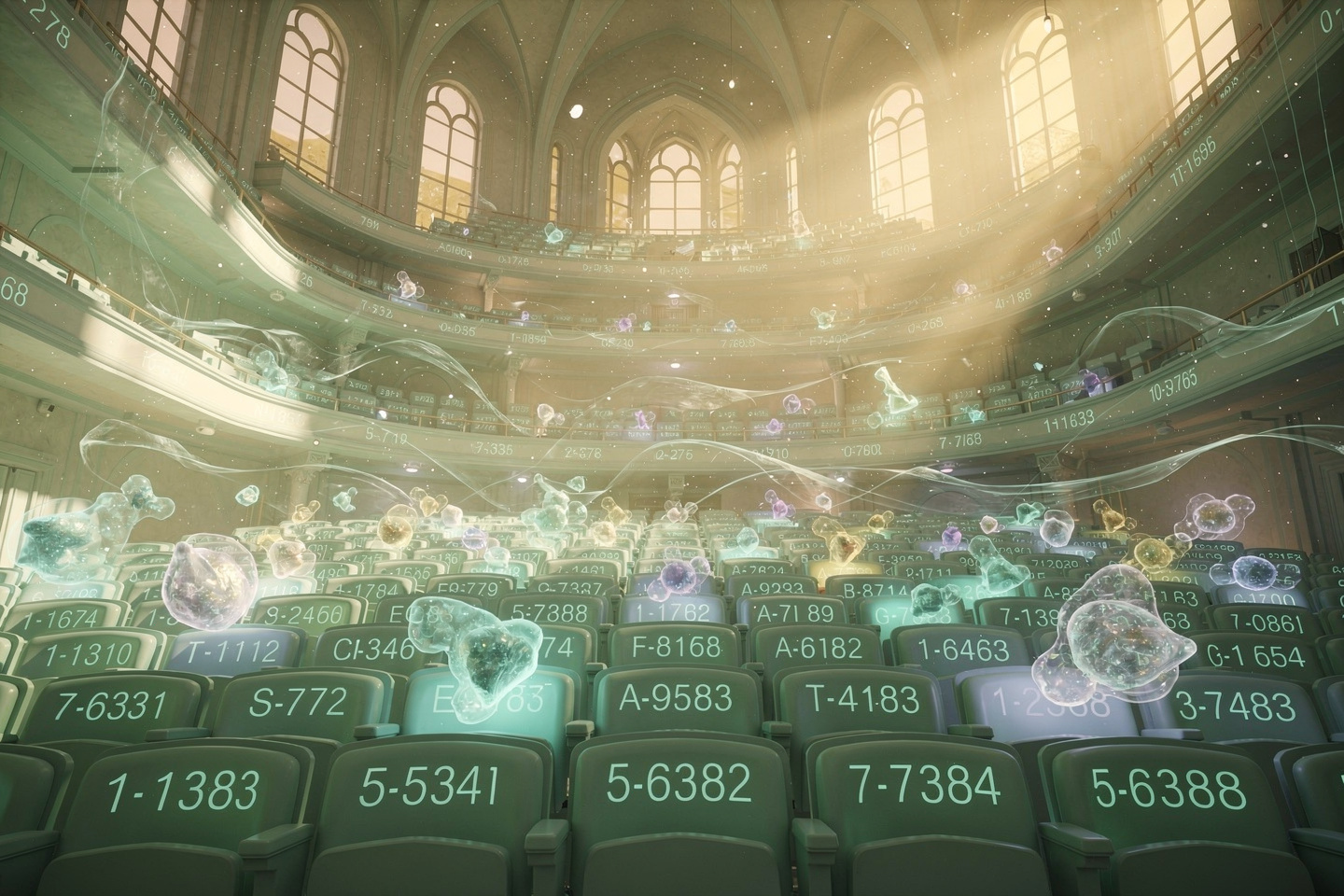
The Pauli exclusion principle is a rule of the quantum world that forbids two particles from being in the same state at the same time. Imagine a theater where each seat has a unique row and seat number. Fermion spectators (such as electrons) cannot sit in the same seat together: each needs its own. Thanks to this, atoms do not collapse, and chemical elements differ from each other.

How it works

The principle works wherever there are fermions: in atoms, metals, white dwarf stars. In an atom, electrons fill orbitals sequentially, and this defines the Periodic Table. In metals, thanks to the Pauli principle, electrons are distributed by energy, creating degenerate gas pressure that resists the compression of white dwarfs.

💡 If it weren't for the Pauli principle, all electrons in an atom would gather in the lowest orbital, and then there would be no chemistry, no life — all atoms would be like inert gases.
\Psi(\dots, x_i, \dots, x_j, \dots) = -\Psi(\dots, x_j, \dots, x_i, \dots)
Ψ is the wave function of the system, x_i are the coordinates and spin of the i-th particle.
Links in the knowledge graph 1
Discovered by
Wolfgang PauliErwin SchrödingerPaul Dirac
Related concepts
angular momentumsuperconductivity
Related laws
Schrödinger equationDirac equation

Related articles

The Skyrmion Dance: How a Magnetic Vortex Conducts the Quantum Orchestra

A hybrid quantum system has been proposed, combining long-lived spin memory, a fast superconducting processor, and a topologically protected mediator — a magnetic skyrmion. Its oscillations bridge the atomic world of defects with macroscopic circuits, overcoming the scale chasm. Calculations promise
arXiv:2505.00266v1 · 2025-05-01

Light in a Cryostat: How Imperfect Converters Build Quantum Bridges

Superconducting quantum computers hit a cooling wall: a single cryostat can't hold millions of qubits. The solution is optical channels, but they need microwave-to-optical converters, which are still far from perfect. The authors showed that with feedback protocols, parallel attempts, and quantum di
arXiv:2505.00542v1 · 2025-05-01

Death and Rebirth of Quantum Echo: A Hierarchy of Temporal Correlations in a Qubit

Physicists made a superconducting qubit forget its past—and saw how three types of temporal correlations (non-macrorealism, temporal steering, temporal non-separability) arrange themselves into a logical ladder. These echoes die at different noise levels and can resurrect when the environment briefl
arXiv:2505.01379v1 · 2025-05-02

A Glass Loom for Light: 99.7% Fidelity Across 24 Quantum Threads

Researchers from Ephos and the Polytechnic University of Milan inscribed a 24-mode universal photonic processor into glass, using femtosecond lasers like a sewing machine needle. Operating at 925 nm—ideal for quantum-dot single-photon sources—the device is controlled by microheaters and uses less po
arXiv:2505.01609v2 · 2025-05-02

Quantum Internet: How Entanglement Became a Data Packet

Superconducting qubits and optical photons are separated by a five-order-of-magnitude frequency gap. Direct qubit translation is an engineering dead end, but an architectural trick inspired by packet switching turns weak transducers into entanglement generators. Thus the quantum internet transforms
arXiv:2505.02057v4 · 2025-05-04

The Horizon's Silent Roar: The Fading Ring of Analog Black-White Holes

A new theoretical study demonstrates how analog black-white holes created in superconducting SNAIL chains respond to perturbations: they don’t explode, but quietly fade, emitting a pure dissipative tone. Supersymmetric quantum mechanics proves the absence of growing modes, and quasinormal frequencie
arXiv:2605.11565v1 · 2026-05-12