Quantum Boomerang: Fugue in a Detuned Orchestra ✦
Original: "Boomerang quantum walks"
The quantum boomerang effect found in discrete walks: internal momentum and chaotic disorder cause the wave packet to return, but not to the starting point—it comes back from the opposite side.
Links in the knowledge graph 1
In a quantum walk, the wave packet runs away, pauses, and rolls back—but not to the beginning, rather to the opposite edge. Internal momentum without external force creates the boomerang effect: a melody returned by the orchestra in a different key. Playing with disorder and the initial state turns chaos into a fine-tuning knob for quantum transport. This is a step toward making noise not a hindrance, but an ally of computation.
🎯 The quantum boomerang doesn't return to the launch point—it localizes on the opposite end, as if you threw a boomerang and caught it behind your back.
\hat{C}(\theta) = \cos\theta\,|R\rangle\langle R| + \sin\theta\,|R\rangle\langle L| + \sin\theta\,|L\rangle\langle R| - \cos\theta\,|L\rangle\langle L|
Angle θ is the conductor of asymmetry: a small tilt amplifies one part, establishing internal momentum without external force. This is how the quantum boomerang is born.
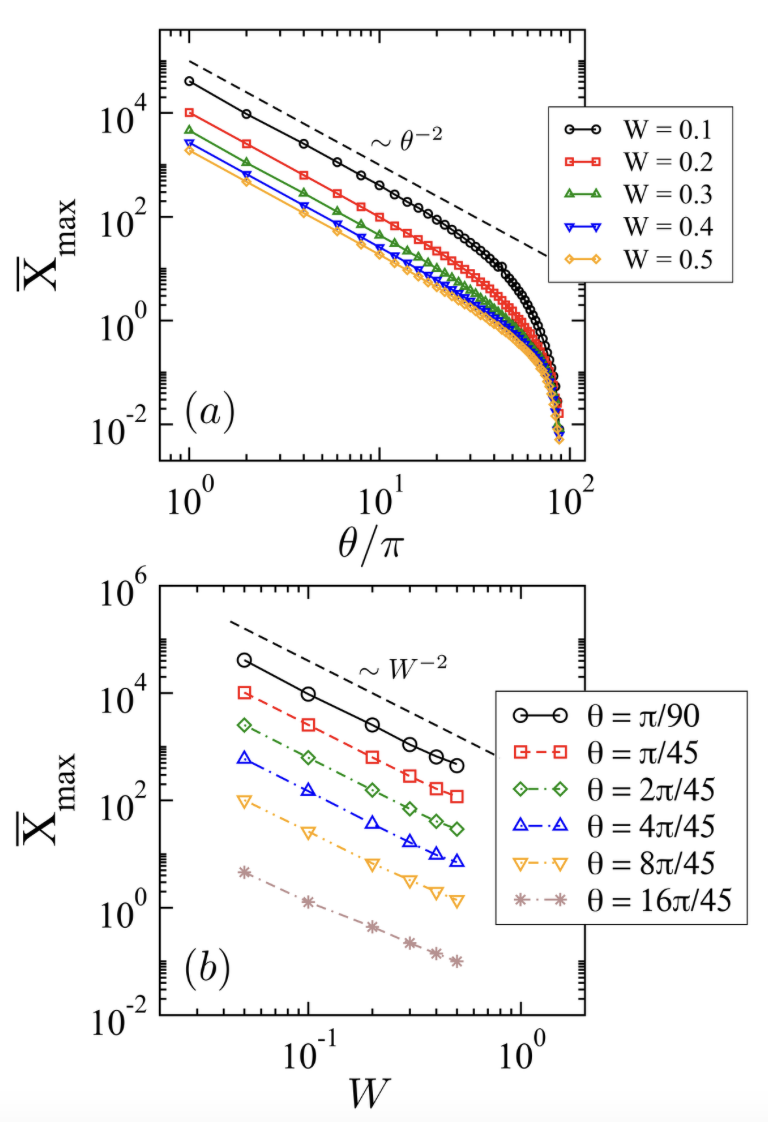
X_{\text{Max}} \propto \theta^{-2},\quad \theta\to 0
The smaller the coin angle, the shorter the boomerang's flight—the inverse-square law allows precise prediction of the return point.
Scientists
Erwin SchrödingerHugh Everett IIINiels BohrPascual JordanWerner HeisenbergStephen Hawkingquantum computer
quantum information
superposition
quantum entanglement
quantum measurement
quantum decoherence
quantum algorithmLaws
Schrödinger equationHeisenberg uncertainty principleHawking radiationsuperposition principleBell's theoremEuler's formula