Quantum Boomerang: Fugue in a Detuned Orchestra ✛ ✦
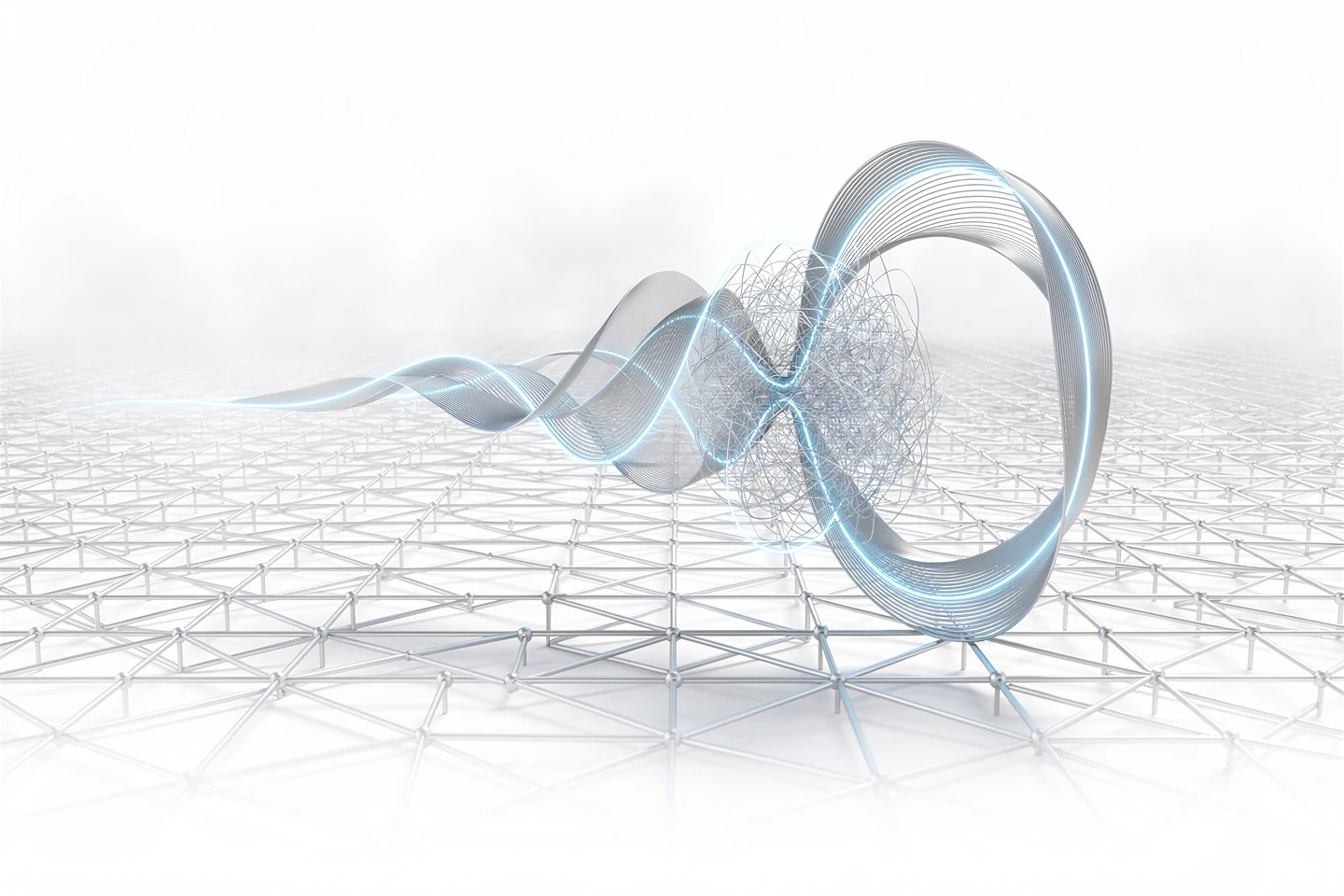
Quantum walking is not a series of random steps, but a musical score where the piano of space sounds under the conductor's baton of the internal state. The coin sets the tone. Until now, it was believed that detuned keys (phase disorder) mute any melody, leading to Anderson localization — a ringing silence. But simulations have captured a quantum boomerang: the wave packet, like a fugue theme, ventures into dissonances, and then an echo brings it back transposed — to the opposite end.
The heart of the walk is the coin operator \(\hat{C}(\theta)\), which mixes right and left into a superposition worthy of the thought experiments of Erwin Schrödinger. The angle \(\theta\) determines asymmetry: with an ideal coin (\(\theta = 0\)), no boomerang appears, but a tiny tilt gives birth to internal momentum — not an external force, but the character of a state on the Bloch sphere. Then disorder enters: random phase shifts, like detuned strings, introduce decoherence, yet paradoxically organize the return.
The secret lies in the entanglement between motion and the internal state, foreseen by pioneer David Deutsch. It forces the centroid to unwind: the temporal arc contracts, and the packet settles on the opposite edge.
Numerical experiments sifted through 50 thousand disorder landscapes and laid bare power laws. The maximum span \(X_{\text{Max}}\) obeys \(X_{\text{Max}} \propto \theta^{-2}\) near a neutral coin and \(X_{\text{Max}} \propto W^{-2}\) as the disorder strength \(W\) changes. Now the boomerang's span can be tuned like the tension of a string: at \(W=0.1\) and \(\theta=\pi/9\), the packet traveled almost 90 nodes before settling into reverse drift.
The discovery opens horizons for quantum algorithms on photonic lattices and ion traps. By tuning the initial asymmetry and disorder level, one can extract quantum information in a targeted way, making noise work for the return. This is a step toward secure data transmission protocols and a fundamental understanding of thermalization: how does an isolated quantum system forget its past? Viewed through the lens of John von Neumann's measurements, the boomerang effect raises the question of the boundary between the reversibility of unitary evolution and the irreversibility born of measurement. Perhaps the arrow of time itself does not fly here but swings — left, right, and back toward the center. In the future — multidimensional labyrinths, correlated disorder, and experimental verification of these predictions. Quantum computers may learn not just to correct errors, but to make them self-destruct, returning to the origin.
The quantum boomerang doesn't return to the launch point: it localizes on the opposite end, as if you threw a boomerang and caught it behind your back.