Quantum Echo: How Memory Changes the Fade ⚡ экспресс
Original: "Finite-Memory Extension of Tegmark's Decoherence Bound in Biological Media"
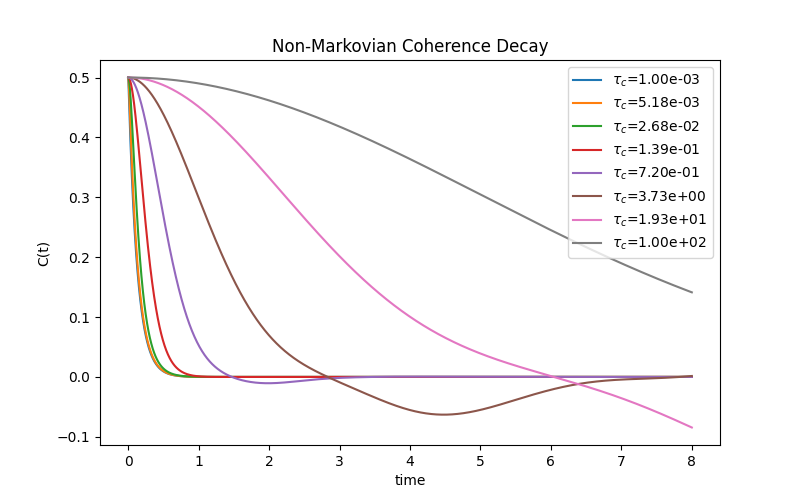
When the environment remembers, quantum information fades more gently at first.
Links in the knowledge graph 1
Quantum states don't vanish instantly when they meet the world. New research shows environments with even a tiny memory cause a gentle, slow fade at first – like an echo muffled by curtains, not smashed by a hammer. This quantum soft start might buy precious extra time for quantum computers.
🎯 An environment that forgets instantly is a mathematical ideal—it never occurs in nature. Even interstellar space has a faint memory, so every quantum fade starts gently.
🎬 Schrödinger’s cat might stay blurry a blink longer: the environment’s memory gives superpositions a slightly more generous lease on life.
t_{\text{decay}} \sim \sqrt{\tau_{\text{env}}}
t_decay: time for quantum information to fade; τ_env: memory time of the environment