Popular

Fritz Zwicky

1898-1974 · astrophysics, cosmology, rocketry
Swiss-American astrophysicist, renowned for his bold and prophetic ideas. He was the first to point out the existence of dark matter and neutron stars, predicted gravitational lensing, and the possibility of supernovae as standard candles. His eccentric character and aggressive style often caused rejection, but time has confirmed his correctness.

Biography

Born in Varna (Bulgaria) into a Swiss-Czech family. He graduated from the Swiss Federal Institute of Technology in Zurich (ETH). In 1925, he moved to California and joined Caltech, where he worked for most of his life. During World War II, he consulted on rocket programs and received the Presidential Medal of Freedom. He was known as a fierce polemicist.
Key discoveries

💡 Zwicky often called his colleagues "spherical bastards" because they "look stupid from any angle." He also pointed his finger directly in opponents' faces and once claimed that his ideas were so simple that only a genius could understand them. Despite this, many of his predictions form the basis of modern astrophysics.
Quote: "A true scientist must be a lone wolf, going his own way."
Links in the knowledge graph 1
Related tags
black holedark mattergravitational wavessupernova remnant
Related laws
gravitational lensingvirial theorem
Related scientists
Henri PoincaréJacob BekensteinSubrahmanyan ChandrasekharRainer WeissStephen HawkingKarl SchwarzschildJoseph WeberVera Rubin

Related articles

Fast stars reveal the Sun’s galactic path

Astronomers used 1,200 high-speed stars to compute the Sun's motion. By measuring their full 3D velocities, scientists refined the trajectory of our star and the gravity map of the Milky Way. This helped better understand the distribution of invisible dark matter in the outskirts.
arXiv:2501.12478 · 2025-01-21

Caught by a Stellar Kick: Webb Finds a Neutron Star

Astronomers have searched for decades for the object left behind by supernova 1987A. Webb finally saw it: a neutron star that is accelerating gas and flying sideways. By measuring its displacement, scientists determined its speed — 500 km/s, as if someone gave it a stellar 'kick'.
arXiv:2508.03395 · 2025-08-05

How Galaxies Spin: A Simple Rule Failed

Scientists tested hundreds of galaxies against the rule 'every twist in light matches a twist in spin.' While the dwarf NGC 1560 followed suit, the overall sample showed 'extra' motions that don't match the visible pattern, complicating both dark matter models and alternative theories.
arXiv:2508.03569 · 2025-08-05

Starquakes: The Birth of Cosmic Radio Signals

Magnetars are dead stars with colossal magnetic fields. Their crust can crack, sending a pulse into space that can outshine an entire galaxy. New calculations combine seismology and electrodynamics, tracing the full chain from the jolt to a fast radio burst.
arXiv:2508.18033 · 2025-08-25

White Dwarf Plays Hide-and-Seek with Cosmic Dust

The white dwarf ZTF J1944+4557 plays hide-and-seek: its light dims by 30% every 4 hours 58 minutes. The dust particles here are no smaller than 0.2 microns and they dim all colors of the spectrum equally. But the strangest twist: the pattern of eclipses changes faster than the orbit, and sometimes a
arXiv:2508.18348 · 2025-08-25

An Invisible Intruder Smashed Into the Milky Way: The Impact Scar Found in Stars

In the Milky Way's stellar disk, astronomers spotted a region where hundreds of stars suddenly changed their speed. Nearby, gas clouds are crumpled into a giant 'finger,' and at its tip, there's not a single star. It's a dwarf galaxy made of dark matter that rammed our disk millions of years ago, le
arXiv:2508.19643 · 2025-08-27

Carbon Giant by a Dead Star

A gas giant the size of Jupiter orbits the pulsar PSR J2322-2650b, heated to 1900°C. Its atmosphere is thick soot of carbon chains, not the usual water vapor. Carbon is a hundred times more abundant than oxygen compared to normal, and ten thousand times more than nitrogen. This doesn't fit the 'blac
arXiv:2509.04558 · 2025-09-04

Dense Fog Instead of a Cosmic Hurricane

The XRISM telescope discovered that the wind from neutron star GX 13+1 is not fast but exceptionally dense and slow. This changes our understanding of how such outflows are born and their impact on galaxies.
arXiv:2509.14555 · 2025-09-18

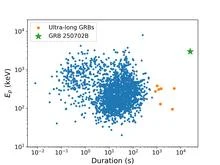
Invisible Lighthouse: Magnetar Pulse in a Gamma-Ray Burst

The collision of a pair of ultra-dense stars produced the explosion GRB 230307A, which lasted unusually long. In its glow, for a split second, a rhythmic signal at 909 Hz emerged—like the beam of a celestial lighthouse. This pointed not to a black hole but to the birth of a rapidly spinning neutron
arXiv:2509.15824 · 2025-09-19

Sky Hotspots: The Senders of Ultra-Particles Identified

Record-breaking energy particles point to nearby galaxies where rare neutron star collisions occur. This explains the mysterious hotspots and differences in observations by various telescopes.
arXiv:2510.06193 · 2025-10-07

Artificial Intelligence Unravels the Mysteries of Cosmic Radio Bursts

Astronomers trained a neural network to search for fast radio bursts without complex data preprocessing. On the repeating source FRB 20121102A, it found 5,927 signals—three times more than before. Analysis showed that the burst energies always split clearly into two classes, and this property is unc
arXiv:2510.07002 · 2025-10-08

The Milky Way's Dark Halo is Flattened and Twisted

Using the motions of millions of stars, astronomers have built a 3D map of the dark halo. Its shape is not a sphere, but an elongated, flattened cloud. Surprisingly, the halo's long axis is almost perpendicular to the stellar disk. This orientation hints at a possible 'flip' of the disk in the past
arXiv:2510.08684 · 2025-10-09

Dark Matter: An Invisible Web Explains Three Mysteries

Simulations show that if dark matter could clump, its lumps would explain perturbations in the stellar stream GD-1, the mysterious object from the gravitational lens, and the origin of the Fornax 6 cluster.
arXiv:2510.11006 · 2025-10-13

Earth's Shadow Hunts for Alien Probes

Astronomers tested the idea of using Earth's shadow to detect alien probes. An automated telescope captured brief light flashes near the shadow's edge — objects not listed in any catalog. This could change the approach to the search for extraterrestrial intelligence.
arXiv:2510.17907 · 2025-10-19

How Dark Matter Influences the Rhythm of Cosmic Collisions

Scientists examined how dark matter affects black hole mergers. If its particles interact, they slow down the giants' plunge toward each other. Analyzing just 70 events with LISA will reveal whether dark matter collides. A new method paves the way to decipher the nature of invisible mass.
arXiv:2511.13220 · 2025-11-17

The Frozen Dance of Dark Matter

Physicists have proposed a hypothesis: once, dark matter particles paired up and abruptly cooled, like vapor turning into ice. This scenario explains the coldness of modern matter and predicts a distinct pattern that can be compared with the afterglow map of the Big Bang and the panorama of galaxies
arXiv:2511.19802 · 2025-11-25

Sponge crystals listen to the whisper of dark matter

Scientists have built a dark matter detector out of sponge-like porous crystals. When an invisible particle flies into such a sponge, it creates a twisted sound wave with magnetic properties. This faint signal is picked up by a built-in magnetic sensor. A nice surprise: the sensitivity barely depend
arXiv:2511.20461 · 2025-11-25

Dark Stars: First Light from Invisible Matter

Invisible dark matter could have fueled the first stars. As its particles collided, they released heat and ignited giant luminaries that later collapsed into black holes. Calculations show their collective gamma-ray glow should be noticeable, opening a new way to hunt for dark matter.
arXiv:2512.04061 · 2025-12-03

Cosmic Heavyweight: Neutron Star Sets Mass Record

Astronomers measured the mass of a neutron star in a binary system—it turned out to be 2.35 times heavier than the Sun. This pushes the theoretical mass limit for such objects up to 2.27 solar masses. The result narrows down the possibilities for how matter behaves under unimaginable pressure.
arXiv:2512.05099 · 2025-12-04

Vortons: Invisible Rings of Dark Matter

Scientists calculated how light and matter move near vortons—rotating loops of spacetime. It turns out their gravity creates bizarre trajectories and can reveal their presence through distortions of starlight. This is a new way to search for the universe's hidden mass.
arXiv:2512.07364 · 2025-12-08

Dark Matter: A Hidden Threat to Neutron Stars

In a five-dimensional space, gravity behaves differently, and a tiny cloud of dark matter inside a neutron star can compress it into a black hole. The hole grows, devouring the star, thereby ruling out many possible compositions of dark matter.
arXiv:2512.14837 · 2025-12-16

A Solar Trap for Dark Matter

The Sun’s gravity creates an invisible funnel where dark matter particles not only accumulate but occupy strictly defined energy levels — like electrons in an atom. It turns out that over long observations, some of this matter regains wave synchrony, greatly amplifying the potential signal in detect
arXiv:2601.00955 · 2026-01-02

Gravitational Echo Will Reveal the Number of Primordial Black Holes

Future gravitational wave detectors will see millions of black hole mergers. Sometimes the signal won’t arrive just once—massive invisible objects, like mountains, will create echoes. By measuring the delays between repeats, scientists will determine what fraction of dark matter is made up of primor
arXiv:2601.01034v2 · 2026-01-03

Dark matter isn’t so cold after all

Scientists analyzed cosmological data and found that dark matter might have a subtle negative pressure. This contradicts the standard model, which treats it as completely inert. The result doesn’t depend on the dark energy model used. The discovery points to new physics, but leaves unsolved the myst
arXiv:2601.01340v1 · 2026-01-04

How to Hear Stellar Collisions More Clearly

Scientists improved a model of neutron star mergers by including heating. This cut the error by a factor of 10 and showed that the main burst frequency shifts by 150 Hz depending on the star's composition. The finding will help next-generation detectors study ultra-dense matter.
arXiv:2601.01402v1 · 2026-01-04

Gravity Without Dark Matter: The Entropic Approach Triumphs

Analysis of star motions in 23 dwarf galaxies showed that emergent gravity — a theory explaining attraction through the information capacity of space — is more accurate than modified Newtonian dynamics. The result with a confidence of 5.2σ casts doubt on the existence of dark matter.
arXiv:2601.01715v1 · 2026-01-05

Hiding in Plain Sight: A Nearby Neutron Star

The star J2354, a few hundred light-years away, has a hidden companion that heats one side of the star. Observations of the star's wobble and light spectrum suggest the companion is a neutron star, firing winds that create a permanent hotspot. This proximity makes it one of the closest neutron stars
arXiv:2601.01755v1 · 2026-01-05

How a Crystal’s Hidden Order Sharpens Gamma-Ray Telescopes

Gamma rays are hard to catch. In a telescope’s crystal detector, they create a particle shower that usually fans out, demanding heavy hardware. But if the crystal’s atomic grid aligns with the ray, the shower tightens. A small, oriented crystal then does a better job, even measuring the gamma ray’s
arXiv:2601.04129v2 · 2026-01-07

A Trap for Invisible Axions: A Magnetic Detector

Physicists are hunting axions—light particles that might make up dark matter. They built a device with a levitating magnetized rod that should tremble if axions fly through it. In a new experiment, the rod stayed still, but the scientists set record constraints on how strongly axions interact with o
arXiv:2601.04576v1 · 2026-01-08

Red Eyes: Cosmic Lens Reveals a Pair of Black Holes

Using a gravitational lens — a massive cluster of galaxies bending light — the James Webb Space Telescope detected two red dots in a distant galaxy. These are intermediate-mass black holes, located not in the center but on the outskirts. The discovery suggests such invisible objects might be widespr
arXiv:2601.06015v1 · 2026-01-09

A Cosmic Lighthouse Born from a Star's Explosion

Years after a supernova flash, astronomers noticed a growing radio signal. By combining several telescopes into a giant antenna, they spotted a tiny, almost stationary source. Everything points to a young pulsar — a spinning neutron star that, like a lighthouse, beams narrow jets of radiation. If co
arXiv:2601.06278v2 · 2026-01-09

Dark Matter and Its Taste Preferences

Like a fussy chef, dark matter can only 'cook' the Universe using certain particles. New work shows how strongly it prefers quarks (the building blocks of atomic nuclei) over leptons (electrons and their kin). Using the idea of culinary symmetries and their violations, scientists estimated how far o
arXiv:2601.07921v1 · 2026-01-12

Magnetar Polarizes X-rays Up to 47%

Using the IXPE telescope, which measures the direction of X-ray waves, astronomers peered into the heart of a magnetar—a neutron star with a colossal magnetic field. The light turned out to be highly polarized: its oscillations are aligned almost in a single plane, like after passing through a filte
arXiv:2601.15452 · 2026-01-21

How Earthly Atomic Nuclei Reveal the Size of Neutron Stars

Neutron stars are among the densest objects, but their exact size long remained a puzzle. Now physicists have found a universal link: the easier it is to deform a lead nucleus in the lab, the softer the matter inside a neutron star and the smaller its radius. Using lab data, scientists calculated th
arXiv:2601.16894 · 2026-01-23

Two Giant Galaxies Spin in a Cosmic Waltz

Astronomers measured the motion of Centaurus A and M83 and found that the galaxies are gravitationally bound and impossibly drifting closer. Together, they pack about 6 trillion solar masses. This dance mirrors the future scenario of the Milky Way meeting Andromeda, helping us understand galaxy evol
arXiv:2602.11268 · 2026-02-11

Cosmic Kitchen: Nuclear Pasta in the Depths of Stars

By modeling a neutron star's crust, scientists discovered that deep down, atomic nuclei stretch into strands and sheets resembling pasta. These layers occupy only 14% of the thickness but account for nearly half the crust's mass. The star's trembling, caused by this pasta, was matched to actual puls
arXiv:2602.19125 · 2026-02-22

Radio Burst Reveals the Secret of a Newborn Supernova

Astronomers observed the radio burst for three years and noticed that the cloud of scattering particles around it was thinning — a sign of an expanding supernova. A temporary intensification of the magnetic field pointed to a neutron star with an extraordinarily powerful field.
arXiv:2602.22309 · 2026-02-25

Dark matter stars mimic black holes

A small neutron star, orbiting a huge ball of dark matter, accelerates its fall due to friction and creates gravitational waves. This signal closely resembles a black hole merger. Future detectors, like LISA, will be able to distinguish these cosmic impostors.
arXiv:2603.08795 · 2026-03-09

DF9: The Third Galaxy Without Dark Matter

Three dwarf galaxies in the constellation Cetus lack dark matter. Velocity measurements in DF9 showed: stars crawl like pedestrians, instead of racing as usual. This pace indicates mass from visible stars only. Likely, all three arose when a galaxy collision filtered gas from dark matter, like a kit
arXiv:2603.15860 · 2026-03-16

Astronomy Teaches Us to See the Invisible in the Brain

An astronomical method for finding supernovae helped reveal nearly invisible neural activity. The Astro-BEATS program subtracts the background from microscope videos, highlighting tiny flashes—they occur spontaneously and previously eluded researchers. This will accelerate the study of brain functio
arXiv:2603.22311 · 2026-03-19

Levitating Magnet Catches Dark Matter

The invisible substance that makes up most of the cosmos might reveal itself through the faintest nudges. A new method uses a levitating superconductor that picks up the slightest influences. Analysis shows that the magnetic response will be especially bright – this opens the door to a laboratory se
arXiv:2603.22647 · 2026-03-23

Faint Light Reveals the Shape of Invisible Dark Matter

The faint light diffused throughout galaxy clusters turns out to be a precise impression of dark matter. Stars ripped from galaxies fill its gravitational scaffold like plaster into a mold. This discovery gives astronomers a direct way to study the hidden structure of the Universe, without resorting
arXiv:2603.23158 · 2026-03-24

Mysterious Blue Flashes: What Their Host Galaxies Hide

Astronomers have found that mysterious blue flashes prefer dwarf galaxies but avoid regions of new star formation. This indicates their nature: a merger of a dead neutron star with a massive dying star — not an explosion, but a collision.
arXiv:2603.23597 · 2026-03-24

Dark Matter May Be Less Abundant Due to Galaxy Shape

Standard mass estimates assumed galaxies are spheres. But galaxies resemble pancakes. A new model that accounts for their true shape slashes the need for mysterious dark matter by a third. Some of the invisible mass may have been just an artifact of oversimplified geometry.
arXiv:2604.06917 · 2026-04-08

Secrets of the Lunar Garden: How Meteorites Mix Cosmic Dust

The Moon looks dead, but its surface is constantly refreshed by meteorite impacts. A new mathematical model recreated this process as a fascinating form of cosmic gardening. It accurately predicted the distribution of rare atom varieties from supernovae. In the future, by studying lunar samples, we’
arXiv:2604.09524 · 2026-04-10

Neutron Star Glitches: Solved in the Lab

Neutron stars sometimes abruptly speed up on their own. Experiments with superfluid helium in aerogel replicated the mechanism: in the star's crust and core, quantum whirlpools either break loose or are born in avalanches, nudging the star forward.
arXiv:2604.18016 · 2026-04-20

18 Years Later: A Supernova Lights Up the Radio

Scientists recorded radio emission from supernova SN 2007it, which flared in 2007. The signal arrived 18 years later: all that time, the shock wave was pushing through rarefied space until it hit a dense gas cloud. The discovery clarifies how massive stars lose mass before exploding.
arXiv:2604.20076 · 2026-04-22

The Final Symphony of Neutron Stars

New simulations show: before merging, neutron stars twist magnetic fields like strings, generating gamma-ray bursts and radio signals. These precursors will help astronomers prepare for the event and perhaps unravel the mystery of fast radio bursts.
arXiv:2604.22059 · 2026-04-23

The Universe Sings: Resonance of Dark and Ordinary Matter

Scientists have shown that different speeds of dark and ordinary matter create a gravitational resonance. Like a bow on a string, it amplifies sound waves in ordinary matter, explaining the longevity of spiral arms and gas heating. This makes it possible to 'hear' dark matter by its seismic imprint.
arXiv:2604.22665 · 2026-04-24

Primordial [tag:black_hole]black holes[/tag]: cracking the [tag:gravitational_waves]gravitational hum[/tag]

Primordial black holes are the key to two puzzles. They may make up dark matter (an idea by Vera Rubin and Fritz Zwicky), help black holes grow by generating a gravitational hum, and explain the giant black holes in early galaxies spotted by the Webb telescope.
arXiv:2605.03156v1 · 2026-05-04

Interstellar Comets vs. Dark Matter

A huge number of unaccounted interstellar comets could overturn our understanding of the Galaxy’s mass, reducing the need for mysterious dark matter by almost half.
arXiv:2605.04801 · 2026-05-06

Cosmic Magnifying Glasses Catch Gravitational Waves

When ripples in space from colliding black holes pass by a galaxy, it bends their path and makes the signal brighter — like a cosmic magnifying glass. This helps us hear the most distant cataclysms and weigh invisible dark matter.
arXiv:2605.06321v2 · 2026-05-07

Кварковая симфония нейтронной звезды

Байесовский ансамбль уравнений состояния, построенный на гауссовских процессах, восстанавливает термодинамику холодной сверхплотной материи без предвзятых параметризаций. Ограничения от рентгеновских наблюдений NICER и гравитационно-волнового сигнала GW170817 заставляют скорость звука сначала взлете
arXiv:2605.08584v2 · 2026-05-09

Stellar Mimicry: Boson Stars Pretend to Be Black Holes

The heart of the Milky Way, the object Sagittarius A*, might turn out not to be a black hole, but its perfect cosmic counterfeit — a boson star. Data from the infrared interferometer GRAVITY were compared with models of twelve such stars — giant scalar clumps — and the Bayesian verdict could not tel
arXiv:2605.09521v1 · 2026-05-10

Dark Matter vs. Modified Gravity: Stars Deliver the Verdict

Data from the Gaia satellite allowed a double check of gravity: how stars rotate and how they oscillate up and down. No modified gravity variant could explain both motions at once. But the invisible dark matter cloud handled it effortlessly. This is a strong argument that dark matter is real, and Ei
arXiv:2605.10857 · 2026-05-11

Ancient Black Hole Jet Left a Gamma Trail in the Center of the Galaxy

Mysterious gamma-ray glow in the center of the Milky Way has been attributed for 15 years to either dark matter or pulsars. New work links it to the echo of an ancient jet: the same black hole Sagittarius A* ejected particles millions of years ago and inflated giant bubbles. Collisions of these part
arXiv:2605.12448v2 · 2026-05-12

The Bicycle Dynamo in Space: How Collapsar Jets Are Born

Three-dimensional modeling of a collapsing star has shown for the first time: from chaotic magnetic fields, a dynamo effect spontaneously arises, creating giant magnetic loops that feed oscillating jets. This mechanism explains the launch of long gamma-ray bursts and predicts their unusual 'striped'
arXiv:2605.12931 · 2026-05-13

The Angular Momentum Symphony: When Weak Gravity Is Strong

The diagnostic parameter \(\tilde{\alpha}\) reveals that in galaxies and clusters, the post-Newtonian approximation loses reliability due to accumulated nonlocal gravitational correlations. Its value skyrockets precisely where dark matter is traditionally invoked—and this finding could overturn our
arXiv:2605.13557v1 · 2026-05-13

Stellar Echoes: What Neutron Stars Conceal

When ripples in spacetime strike a neutron star, it doesn't respond right away. First comes a sharp reflected pulse, then a series of fading echoes: the wave bounces around inside the ultra-dense sphere and emerges with a delay. A new method breaks this smeared signal into clear steps. From them, li
arXiv:2605.15429 · 2026-05-14

Dark Dialogue: Gravitational Lenses Reveal an Exchange of Matter and Energy

Scientists studied how dark matter and dark energy influence each other. Using gravitational lenses—massive galaxy clusters that bend light—they found that dark energy slowly transforms into dark matter. This explains why the universe's expansion began accelerating earlier than expected.
arXiv:2605.16155 · 2026-05-15

How to Reconcile Two Neutron Stars

Observations of two cosmic cataclysms gave conflicting hints about neutron star density. New analysis shows that sound inside them can accelerate to nearly the speed of light, and the structure can be two-layered. This resolves the paradox while staying within relativity.
arXiv:2605.30369 · 2026-05-18

Resonance in the Dark: How Dark Particles Can Amplify Light

In the dark universe, two types of particles are connected. When a massive particle oscillates, it makes a light particle vibrate, which changes light's properties. This cascade resonance could betray dark matter. Plot twist: the mechanism doesn't distinguish the direction of light's wobble — left a
arXiv:2605.20333 · 2026-05-19

Ghosts of the Universe: Neutrinos as Dark Matter

Scientists propose a new take on dark matter: it might be made of ordinary neutrinos. Their quantum transformations in curved space create extra gravity, like ghostly glue. This holds stars at the edges of galaxies without needing new particles.
arXiv:2605.26134 · 2026-05-21

Neutron Stars with a Secret 'Doughnut' Inside

Neutron stars may hide a secret. Inside them, an invisible ring sometimes forms—a 'doughnut' made of a special field. It alters the internal structure so that the star mimics a quark star, but from the outside it's unnoticeable. The discovery explains the strange sizes and masses of some neutron sta
arXiv:2605.26228 · 2026-05-25

Dark Matter: Quantum Vortices Around Black Holes

A new study models dark matter as a superfluid near a black hole. Physicists found two types of stable structures: a dense core and a rotating vortex. It turns out the vortex is stable if dark matter particles attract each other weakly; strong attraction makes it collapse. This discovery suggests th
arXiv:2605.29069 · 2026-05-27

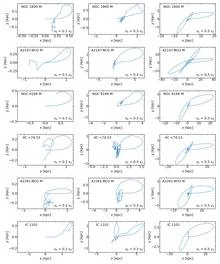
A Polygraph for Flashes: How the Pincus–Lyapunov Diagram Uncovers FRBs

To unravel the nature of fast radio bursts (FRBs), astrophysicists applied methods from nonlinear dynamics and constructed the Pincus–Lyapunov diagram, comparing them with pulsar glitches, solar flares, and earthquakes. It turned out: repeating FRBs form a compact cluster on the border between stoch
arXiv:2606.01855v1 · 2026-06-01

Light Leaks into Darkness: How Photons Become Dark Matter

Two key methods for measuring the expansion rate of the Universe — the cosmic microwave background and supernovae — yield values differing by 5 sigma. A hybrid model adds to the cosmological redshift a contribution from quantum conversion of photons into hidden mass. Analysis of the Pantheon+SH0ES c
arXiv:2606.02097v1 · 2026-06-01

Ghost Wind of the Cosmic Dawn: How Lyman-alpha Destroys Stellar Cradles

The first two-dimensional radiation-hydrodynamic simulations prove that the radiation pressure in the Lyman-alpha (Lyα) line can exceed the direct stellar light force by up to 16 times and serve as the main feedback mechanism even before the explosion of supernovae in environments poor in dust. This
arXiv:2606.02711v1 · 2026-06-01

Milky Way passes the baton: seamless transition of cosmic rays

Precision data from DAMPE, LHAASO, and IceTop for protons, helium, and iron (40 GeV – 500 PeV) are well described by the sum of three components: a low-energy galactic one with a curved spectrum, a high-energy galactic one that creates the PeV knee, and an extragalactic one that dominates above ~100
arXiv:2606.02748v1 · 2026-06-01

Ruby Pupae: How Dark Matter Transforms the Face of Galaxies

The James Webb Space Telescope discovered a population of 'little red dots' (LRDs) — compact objects with disproportionately massive black holes that almost disappear at z<3. A study of 98 such sources showed that at z>4 they reside in sparse regions, but by z~3.5 their environment and dark halo mas
arXiv:2606.02773v1 · 2026-06-01

Quiet Quark Waltz: New Data Tighten Bounds on Color Superconductivity

Weaving together NICER, LIGO, and heavy pulsar observations with neural networks and quantum chromodynamics equations, scientists have for the first time imposed a tight constraint on the color-flavor locking parameter (ΔCFL < 66 MeV) — half as wide as previous model estimates. It turns out that col
arXiv:2606.03707v2 · 2026-06-02

Dance of Vortices in the Magnetic Heart of a Pulsar

Why do pulsars—rapidly spinning neutron stars—fall silent for tens of periods, then emit modulated pulses one after another? New three-dimensional modeling unveils the dance of non-axisymmetric plasma vortices: the diocotron instability makes charges break into a dance across magnetic field lines, r
arXiv:2606.03984v1 · 2026-06-02

Dark mountains of neutron stars: gravitational waves probe dark matter

Researchers combined a two-fluid model of neutron stars with fermionic dark matter and results from the search for continuous gravitational waves by the LIGO detectors. An anisotropic distribution of dark matter can create 'dark mountains' — quadrupole deformations that amplify emission. Comparison
arXiv:2606.05082v1 · 2026-06-03

The Cosmic Pearl String: How Galaxies Lost Their Dark Matter

Stretching around NGC 1052 is a chain of ultra-diffuse dwarfs — galaxies almost devoid of dark matter. According to the 'bullet dwarf' hypothesis, they were born from a head-on collision of gas clouds: dark matter slipped through, while the stars lined up in a row. Skeptics saw a projection illusion
arXiv:2606.05144v2 · 2026-06-03

A Cosmic Sketch Without Smudges: JWST Confirms Cold Dark Matter

The JWST peered into the hearts of gravitational lenses — and found not a single smudge expected from lightweight dark matter particles. New data shut down many warm dark matter models and bolster the standard cold scenario. Limits on the half-mode mass and thermal relic mass are among the tightest
arXiv:2606.05277v1 · 2026-06-03

Lead Archives: Ancient Minerals vs. Higgsino

Dark matter is physics' greatest intrigue. Paleodetection opens a new chapter: million-year-old minerals, like laurionite (PbClOH), preserve traces of dark particles. Thanks to massive lead nuclei and exceptional purity, crystals can detect the Higgsino — the superpartner of the Higgs boson, whose s
arXiv:2606.05299v1 · 2026-06-03

Neutrino Lighthouse: The Hidden Heart of Supernova SN 2021foa

For the first time, a collapsing supernova is reliably linked to high-energy neutrinos. IceCube detected four neutrino events clustered in time and space near the peak brightness of SN 2021foa, a rare Type IIn supernova. The energy of the neutrino burst exceeded the optical by two orders of magnitud
arXiv:2606.06409v1 · 2026-06-04

The Dusty Truth: Why Supernovae Finally Spoke with One Voice

An international team led by Marco Giunto analyzed nearly a thousand Type Ia supernovae from the ZTF survey and showed that the differences in their color and brightness are almost entirely caused by dust in their host galaxies, not by the physics of the explosions themselves. This settles a long-st
arXiv:2606.06593v1 · 2026-06-04

PeVatron's Hybrid Orchestra: A Particle Symphony at the Edge

Astrophysicists have built a self-consistent model of the source LHAASO J1849-0002, associated with the pulsar PSR J1849-0001. In the hybrid scenario, relativistic electrons from the pulsar wind nebula scatter the cosmic microwave background, while protons collide with a nearby molecular cloud, prod
arXiv:2606.06974v1 · 2026-06-05

A Lens in the Depths: Why the Axion Limit Isn't Afraid of Exotics

Neutron stars are ultra-dense laboratories where matter is compressed to its limit, and hypothetical axions can reveal themselves through accelerated cooling. Even the addition of exotic baryons in the core hardly shifts the tight constraint on the axion mass; in some models, the limit brushes again
arXiv:2606.07742v1 · 2026-06-05

Message from the Invisible World: FAST Listens to Axions

Axions are ghostly particles, candidates for dark matter, capable of explaining both the hidden mass of the Universe and the violation of strong interaction symmetry. In the monstrous magnetic fields of neutron stars, they can momentarily become light — a radio pulse at a precisely defined frequency
arXiv:2606.17067v1 · 2026-06-05

Dark Matter Sways Distant Planets

Planets on the outskirts of star systems prove to be perfect scales for invisible matter. A drifting clump of dark matter nudges their orbit just enough— a shift we can now measure. This method could uncover the primordial invisible structures lingering from the Big Bang and let us chart the dark un
arXiv:2606.14827 · 2026-06-12

Dancing Dispersion: The Millisecond Life of a Neutron Star

FRB 20250613A, caught in a dwarf galaxy at z=0.0987, surprised us: its dispersion varied 50 times within minutes. The bursts repeat with a rhythm of 6.8 ms, as if a neutron star is spinning. And most strikingly, the brighter the pulse, the cleaner the ether: the radio wave accelerates oncoming elect
arXiv:2607.00505v1 · 2026-07-01

Mirror Labyrinth of Dark Energy: How Galactic Twins Refract Cosmology

In pursuit of elusive dark energy, scientists have found a workaround: using pairs of independent gravitational lenses with nearly identical deflectors. Simulations for the LSST survey show that such 'pseudo-double' systems allow measuring the cosmological equation of state with unprecedented statis
arXiv:2607.01005v1 · 2026-07-01

Dim Architects of Dawn: How Invisible Galaxies Lit Up the Universe

Analysis of ultra-deep images of the Abell S1063 cluster, boosted by nature's own gravitational telescope, has for the first time peered into the population of ultra-faint galaxies at redshifts 6 to 11. It turns out that even under the most conservative suppression of star formation, these tiny obje
arXiv:2607.01129v1 · 2026-07-01

Cosmic Radio: How a Neural Network Catches the Whisper of Neutron Stars

The Aframe algorithm, previously honed on black hole mergers, now teases out signals from binary neutron star mergers from the noise of gravitational wave detectors in fractions of a second. Thanks to a trick from the radio engineer's toolbox—heterodyning—minute-long 'chirps' are compressed to just
arXiv:2607.01372v1 · 2026-07-01

Invisible Planet in Warped Light

For the first time, a planet has been detected in TESS data using gravitational microlensing. The event Gaia23bra, identified by the Gaia survey as an isolated lens, revealed sharp caustic-crossing peaks in the TESS light curve—an unmistakable sign of a binary system with a planetary companion. Join
arXiv:2607.01853v1 · 2026-07-02

Gravitational Atoms: When Boson Stars Break the Laws of Energy

Physicists investigated boson stars in teleparallel gravity, where a scalar field is non-minimally coupled to spacetime torsion. It turned out that excited states of these objects can have negative energy density, violating all four classical energy conditions. The compactness of these stars exceeds
arXiv:2607.02017v1 · 2026-07-02

Sulfur Anomaly: B[e] Supergiant as a Photochemical Reactor

Using ALMA radio telescopes, astronomers peered into the vicinity of the extremely rare B[e] supergiant HD 87643 and found a rich array of sulfur-bearing compounds. The anomalously high concentration of SO₂ and the unusual sulfur isotope ratio indicate rapid photochemical processing of gas, as if in
arXiv:2607.02191v1 · 2026-07-02

Polar Vision: How to Unfold a Gravitational Lens and Find Traces of Dark Matter

The hunt for dark matter demands the ability to read the subtlest distortions of light. In a new study, astrophysicists transformed the curved arcs of gravitational lenses into straight lines using a polar transform — and the neural network started noticing previously invisible subhalos. On simulate
arXiv:2607.02663v1 · 2026-07-02

Corkscrew Galaxy: How a Twisted Jet Reveals the Magnetic Signature of Clusters

The spiral radio jet of the 'Corkscrew Galaxy' served as a natural magnetometer: astronomers compared its bends with Faraday rotation measure and proved that RM oscillations are synchronous with its morphology. In the eastern part of the jet, rotation is generated by its own magnetic field, while in
arXiv:2607.02665v1 · 2026-07-02

Pendulum without heating: X-ray mystery of PSR J0901-4046

Observations by the Chandra space observatory set a record-low upper limit on X-ray luminosity for the periodic radio pulse source PSR J0901-4046. Its period—75.9 seconds—is too long for a classical pulsar: there isn't enough electric potential to pull particles out of the vacuum. It was thought tha
arXiv:2607.03848v1 · 2026-07-04

Cosmic Lightning: How Fast Radio Bursts Illuminate Hidden Baryons

Analysis of 3455 fast radio bursts from the CHIME telescope has mapped electron density fluctuations in the cosmic web. The statistically significant signal at >3σ confirms that residual dispersion measures are not random, but reflect real baryon clumping. The method, which does not require precise
arXiv:2607.04106v1 · 2026-07-05

Quasi-interstellar objects: when the Solar System meets its own exiles

The discovery of 1I/‘Oumuamua made us wonder: could some interstellar wanderers actually be our own comets, ejected from the Oort cloud and returning millions of years later? Simulations show that such ‘quasi-interstellar objects’ are indeed possible, but they have unique characteristics: extremely
arXiv:2607.04216v1 · 2026-07-05

The Universe's Dance Floor: When Dark Matter Breaks into a Quantum Rhythm

Scientists have constructed a rigorous quantum-kinetic theory of gravitational instability for the fuzzy dark matter model—ultralight bosons with a mass on the order of 10⁻²² eV. By applying the Wigner equation and the Landau method, they derived a dispersion relation that revealed a sharp crossover
arXiv:2607.04893v1 · 2026-07-06

Magnetic Echolocation: Measuring the Cosmic Cocoons of Fast Radio Bursts

Fast radio bursts (FRBs) — millisecond signals of colossal energy — remain one of the great mysteries of astrophysics. Their environment is often saturated with magnetized plasma that distorts polarization and scatters the pulses. A new technique combines the analysis of these distortions, akin to d
arXiv:2607.05289v1 · 2026-07-06

Symphony of Shadows: Neutrino Telescopes Catch the Whisper of Dark Matter

Using 13 years of data from the ANTARES telescope, scientists have set stringent limits on the interaction of dark matter with ordinary matter across mass scales from keV to GeV. Collisions of cosmic rays with dark matter particles in the Galactic Ridge produce neutrinos that are detected by deep-se
arXiv:2607.05335v1 · 2026-07-06

The Mystery of Fragile Satellites: Dark Matter Under Tidal Assault

Elena Asencio and her colleagues showed that, contrary to standard cosmology, the Milky Way’s classical satellites suffer strong tidal deformations. In MOND (modified Newtonian dynamics) these disruptions are natural, while cold dark matter predicts they should be almost completely shielded by massi
arXiv:2607.05502v1 · 2026-07-06

Flattened Darkness: Stellar Streams Outline Invisible Halos

Using the STRRINGS catalog of 32 stellar streams, astronomers have for the first time measured the population distribution of dark matter halo shapes beyond the Local Group. Applying Bayesian analysis, they found that for the 17 most reliable streams, the median flattening is about 0.72 — meaning th
arXiv:2607.05510v1 · 2026-07-06

Music of the Spheres: How LISA Will Hear Dark Matter's Duet

Researchers assessed the capability of the space-based gravitational-wave observatory LISA (launch in 2035) to detect ultralight dark matter interacting with Standard Model fields via quadratic coupling—a common mechanism in axion and dilaton models. Through this interaction, the signal emerges on t
arXiv:2607.08248 · 2026-07-09