Popular

Vera Rubin

1928 – 2016 · Astrophysics, Cosmology
American astronomer whose measurements of galaxy rotation speeds provided compelling evidence for the existence of dark matter. Her work changed our understanding of the Universe, showing that visible matter constitutes only a small fraction of its mass. She became a pioneer for women in science, overcoming discrimination and opening the way for many.

Biography

Vera Cooper Rubin was born in Philadelphia, USA. From childhood, she was fascinated by stars and built her first telescope. She received her education at Vassar College, Cornell and Georgetown Universities, where she earned her doctorate under the supervision of George Gamow. She worked at the Carnegie Institution in Washington. Observing galaxies with spectrographs, she discovered that stars on the periphery rotate too fast to be held by the gravity of visible matter. In 1993, she received the National Medal of Science. Many believe she deserved the Nobel Prize but did not receive it.

Key discoveries

💡 In her youth, Rubin could not enter Princeton graduate school because women were not allowed to study in the astronomy department. She joked that her career was due to three lucky circumstances: she was allowed to work at night, she had access to good telescopes, and she found a topic that no one considered important.
Quote: "There is no room in science for discrimination; we need all the minds we can find."
Links in the knowledge graph 1
Related tags
dark matterspectroscopy
Related laws
gravitational lensing
Related scientists
Robert HookeFritz ZwickyJohann Jakob BalmerJocelyn Bell BurnellArno PenziasCharles TownesJames Clerk MaxwellErwin Schrödinger

Related articles

Fast stars reveal the Sun’s galactic path

Astronomers used 1,200 high-speed stars to compute the Sun's motion. By measuring their full 3D velocities, scientists refined the trajectory of our star and the gravity map of the Milky Way. This helped better understand the distribution of invisible dark matter in the outskirts.
arXiv:2501.12478 · 2025-01-21

A Dust Particle Suspended in Light Hunts for Dark Matter

Physicists have turned a dust grain levitating in a vacuum into a detector capable of feeling the faint bump from a passing dark matter particle. The hunt for this mysterious substance that binds galaxies together has reached a new level: they've set record limits on its interaction with ordinary ma
arXiv:2508.00815 · 2025-08-01

How Galaxies Spin: A Simple Rule Failed

Scientists tested hundreds of galaxies against the rule 'every twist in light matches a twist in spin.' While the dwarf NGC 1560 followed suit, the overall sample showed 'extra' motions that don't match the visible pattern, complicating both dark matter models and alternative theories.
arXiv:2508.03569 · 2025-08-05

First Stars Found: Webb Peers into the Universe's Childhood

The James Webb Space Telescope has for the first time captured light from stars consisting solely of hydrogen and helium — exactly what the very first stars after the Big Bang were probably made of. A cosmic magnifying glass helped: a galaxy cluster whose gravity amplified the faint shine of the dis
arXiv:2508.03842 · 2025-08-05

Quantum Glue for the Universe

Physicists have found that in the extreme gravity of neutron stars and black holes, a Bose–Einstein condensate emerges — a quantum state where particles merge into a single whole, like droplets of mercury. If dark matter consists of ultra-light axions, it naturally turns into a cosmic glue that keep
arXiv:2508.15864 · 2025-08-20

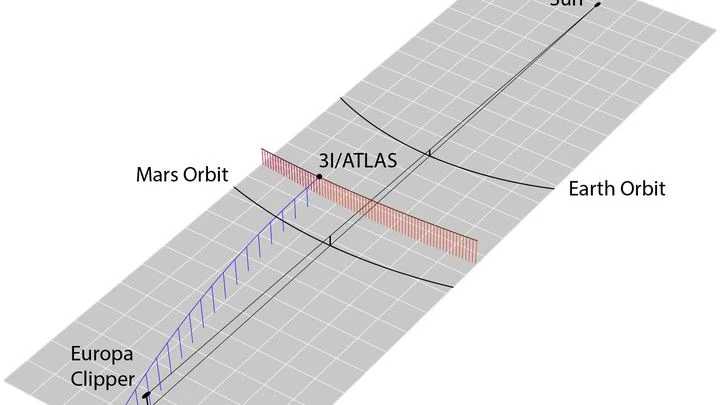
Interstellar Visitors: Searching for Alien Technology

The Vera Rubin Telescope will discover thousands of interstellar visitors. To tell a natural object from a relic of another civilization, scientists have developed a protocol: they’ll study the light 'fingerprints' of these guests.
arXiv:2508.16825 · 2025-08-22

An Invisible Intruder Smashed Into the Milky Way: The Impact Scar Found in Stars

In the Milky Way's stellar disk, astronomers spotted a region where hundreds of stars suddenly changed their speed. Nearby, gas clouds are crumpled into a giant 'finger,' and at its tip, there's not a single star. It's a dwarf galaxy made of dark matter that rammed our disk millions of years ago, le
arXiv:2508.19643 · 2025-08-27

Axions Connect Two Cosmic Radio Mysteries

Two cosmic mysteries—the excess of radio waves in the sky (ARCADE2) and the anomalously weak signal from the earliest hydrogen (EDGES)—have received a common explanation. The culprit could be axions, ultralight dark matter particles. In primordial magnetic fields, axions turn into radio waves, creat
arXiv:2509.09472 · 2025-09-11

Earth as a Dark Matter Detector

Analysis of years-long records of Earth's magnetic field has set the tightest limits on dark photons — dark matter particle candidates. Using the ionosphere as a giant resonator, scientists amplified faint magnetic fluctuations hundreds of times, but no direct signal has been found yet.
arXiv:2509.15783 · 2025-09-19

Invisible Object Weighing a Million Suns: Gravity Acts as a Magnifying Glass

Using a network of radio telescopes, astronomers spotted a tiny flaw in a thin arc of a distant galaxy. It revealed an invisible object with a mass of about a million Suns — a hundred times lighter than anything previously weighed at such distances. The discovery proves that gravitational lensing ca
arXiv:2510.07382 · 2025-10-08

The Milky Way's Dark Halo is Flattened and Twisted

Using the motions of millions of stars, astronomers have built a 3D map of the dark halo. Its shape is not a sphere, but an elongated, flattened cloud. Surprisingly, the halo's long axis is almost perpendicular to the stellar disk. This orientation hints at a possible 'flip' of the disk in the past
arXiv:2510.08684 · 2025-10-09

Dark Matter: An Invisible Web Explains Three Mysteries

Simulations show that if dark matter could clump, its lumps would explain perturbations in the stellar stream GD-1, the mysterious object from the gravitational lens, and the origin of the Fornax 6 cluster.
arXiv:2510.11006 · 2025-10-13

Earth as a Lens for Searching Dark Matter

By turning Earth into a gravitational lens, scientists found a way to focus dark matter particles into a single point. There, a laser makes them instantly convert into light, which is then caught by detectors. The method promises to detect even ultralight particles from thousands of light-years away
arXiv:2510.27416 · 2025-10-31

How Dark Matter Influences the Rhythm of Cosmic Collisions

Scientists examined how dark matter affects black hole mergers. If its particles interact, they slow down the giants' plunge toward each other. Analyzing just 70 events with LISA will reveal whether dark matter collides. A new method paves the way to decipher the nature of invisible mass.
arXiv:2511.13220 · 2025-11-17

Why 'impossible' galaxies don't break cosmology

JWST data on massive galaxies at the dawn of time threatened to overturn dark matter theory. But new work shows the reason: systematic errors when converting brightness to mass. With those accounted for, 'impossible' galaxies vanish.
arXiv:2511.13708 · 2025-11-17

The Frozen Dance of Dark Matter

Physicists have proposed a hypothesis: once, dark matter particles paired up and abruptly cooled, like vapor turning into ice. This scenario explains the coldness of modern matter and predicts a distinct pattern that can be compared with the afterglow map of the Big Bang and the panorama of galaxies
arXiv:2511.19802 · 2025-11-25

Sponge crystals listen to the whisper of dark matter

Scientists have built a dark matter detector out of sponge-like porous crystals. When an invisible particle flies into such a sponge, it creates a twisted sound wave with magnetic properties. This faint signal is picked up by a built-in magnetic sensor. A nice surprise: the sensitivity barely depend
arXiv:2511.20461 · 2025-11-25

Invisible Vortices of Dark Matter

Computer simulations show: if dark matter is a frictionless fluid condensate, vortex lattices arise in galaxies. Light passing through them bends, creating a characteristic geometric pattern detectable by telescopes.
arXiv:2512.03357 · 2025-12-03

Dark Stars: First Light from Invisible Matter

Invisible dark matter could have fueled the first stars. As its particles collided, they released heat and ignited giant luminaries that later collapsed into black holes. Calculations show their collective gamma-ray glow should be noticeable, opening a new way to hunt for dark matter.
arXiv:2512.04061 · 2025-12-03

Vortons: Invisible Rings of Dark Matter

Scientists calculated how light and matter move near vortons—rotating loops of spacetime. It turns out their gravity creates bizarre trajectories and can reveal their presence through distortions of starlight. This is a new way to search for the universe's hidden mass.
arXiv:2512.07364 · 2025-12-08

Quantum Sensors Will Hear the Hum of Dark Matter

A network of quantum detectors, working as a single organism, catches elusive dark matter. The collective effect yields supersensitivity and noise resilience. Along the way, the system also detects gravitational waves.
arXiv:2512.14821 · 2025-12-16

Dark Matter: A Hidden Threat to Neutron Stars

In a five-dimensional space, gravity behaves differently, and a tiny cloud of dark matter inside a neutron star can compress it into a black hole. The hole grows, devouring the star, thereby ruling out many possible compositions of dark matter.
arXiv:2512.14837 · 2025-12-16

Mysterious Red Dots: How Dark Matter Hides Growing Galaxies?

The James Webb Space Telescope has discovered mysterious “red dots”—distant sources glowing in hydrogen but nearly invisible in X-rays. A dense gas curtain conceals them. This may be a brief stage of galaxy growth when their dark matter cores are flooded with matter. The “light” dark matter hypothes
arXiv:2601.00044 · 2025-12-31

Dark Matter Gave Rise to Galactic Magnetic Fields

A new hypothesis: dark matter acted like a sound amplifier. Its rhythmic oscillations, like microphone feedback on stage, turned faint magnetic seeds into the fields that shrouded galaxies. This explains the origin of cosmic magnetism without exotic additions.
arXiv:2601.00443v1 · 2026-01-01

A Solar Trap for Dark Matter

The Sun’s gravity creates an invisible funnel where dark matter particles not only accumulate but occupy strictly defined energy levels — like electrons in an atom. It turns out that over long observations, some of this matter regains wave synchrony, greatly amplifying the potential signal in detect
arXiv:2601.00955 · 2026-01-02

Gravitational Echo Will Reveal the Number of Primordial Black Holes

Future gravitational wave detectors will see millions of black hole mergers. Sometimes the signal won’t arrive just once—massive invisible objects, like mountains, will create echoes. By measuring the delays between repeats, scientists will determine what fraction of dark matter is made up of primor
arXiv:2601.01034v2 · 2026-01-03

Dark matter isn’t so cold after all

Scientists analyzed cosmological data and found that dark matter might have a subtle negative pressure. This contradicts the standard model, which treats it as completely inert. The result doesn’t depend on the dark energy model used. The discovery points to new physics, but leaves unsolved the myst
arXiv:2601.01340v1 · 2026-01-04

Why Has Cosmology Cracked?

Different ways to measure the expansion rate, the properties of dark matter and energy, yield contradictions. Before changing physics, scientists are checking if their instruments are off. But increasingly it seems: the yeast is alive, and the recipe of the cosmos is not eternal.
arXiv:2601.01525v1 · 2026-01-04

The first galaxies lived in tiny clouds of dark matter

Analysis of early galaxies clustering revealed that their invisible cocoons were tens of times lighter than modern ones. This sheds light on the joint growth of matter and dark matter.
arXiv:2601.01697v1 · 2026-01-05

Gravity Without Dark Matter: The Entropic Approach Triumphs

Analysis of star motions in 23 dwarf galaxies showed that emergent gravity — a theory explaining attraction through the information capacity of space — is more accurate than modified Newtonian dynamics. The result with a confidence of 5.2σ casts doubt on the existence of dark matter.
arXiv:2601.01715v1 · 2026-01-05

Bubbles in a Boiling Universe: How Dark Matter and Gravitational Waves Were Born

In the first moments after the Big Bang, the universe boiled, spawning bubbles of a new reality. Their collisions accelerated particles more powerfully than any collider. This is how super-heavy neutrinos were born – particles that explain both dark matter and the mysterious excess of matter, and th
arXiv:2601.02458v3 · 2026-01-05

How a Crystal’s Hidden Order Sharpens Gamma-Ray Telescopes

Gamma rays are hard to catch. In a telescope’s crystal detector, they create a particle shower that usually fans out, demanding heavy hardware. But if the crystal’s atomic grid aligns with the ray, the shower tightens. A small, oriented crystal then does a better job, even measuring the gamma ray’s
arXiv:2601.04129v2 · 2026-01-07

How Weak Gravity Does Without Dark Matter

This approach rewrites gravity's rules where it's barely felt—at the edges of galaxies. Under normal conditions, it aligns with Einstein's theory, but for weak fields, it adds a tweak. The solution needs no new particles and explains why galaxies spin faster than their visible mass permits.
arXiv:2601.04290v1 · 2026-01-07

A Trap for Invisible Axions: A Magnetic Detector

Physicists are hunting axions—light particles that might make up dark matter. They built a device with a levitating magnetized rod that should tremble if axions fly through it. In a new experiment, the rod stayed still, but the scientists set record constraints on how strongly axions interact with o
arXiv:2601.04576v1 · 2026-01-08

Gravitational waves refine cosmic expansion rate

By combining gravitational waves from merging neutron stars with galaxy surveys, scientists refined the universe’s expansion rate to 67.9 km/s per megaparsec (6.4% uncertainty), bridging a long-standing debate.
arXiv:2601.04774v1 · 2026-01-08

Dark Energy Controls the Weight of Dark Matter

Scientists have proposed that dark energy affects the mass of dark matter particles. This energy exchange accurately reproduces the observed expansion of the Universe and alters the growth of galaxy clusters by 10% — a difference that new telescopes will test. If the connection is confirmed, our und
arXiv:2601.05235v1 · 2026-01-08

Cosmic Fireflies: How Dark Matter Turns into Visible Light

Dark matter may consist of invisible particles that clump into clouds. Once such a cloud finds itself in a magnetic field, it lights up with ordinary light — like a firefly in the night. This effect offers a new way to detect the mysterious substance that makes up 85% of the Universe.
arXiv:2601.05351v2 · 2026-01-08

Dark Matter from the Bends of Space

After rapid expansion (inflation), spacetime quickly restructures, triggering instability in the dark matter field. This kicks off an avalanche of particle creation — a purely gravitational mechanism. Calculations and computer simulations confirm that this can explain the observed density of dark ma
arXiv:2601.07670v2 · 2026-01-12

Dark Matter and Its Taste Preferences

Like a fussy chef, dark matter can only 'cook' the Universe using certain particles. New work shows how strongly it prefers quarks (the building blocks of atomic nuclei) over leptons (electrons and their kin). Using the idea of culinary symmetries and their violations, scientists estimated how far o
arXiv:2601.07921v1 · 2026-01-12

The Mystery of Asteroid Kamo'oalewa: Why It's Not from the Moon

Astronomers have unraveled the origin of Kamo'oalewa. The lunar shard hypothesis hasn't held up: there are dozens of times more similar bodies from the asteroid belt. The Chinese Tianwen-2 mission will settle the matter.
arXiv:2601.08923v1 · 2026-01-13

Primordial Black Holes Build Early Galaxies

The James Webb Space Telescope has spotted enormous black holes in the young universe that couldn't have grown in the usual way. Their secret might be primordial black holes—tiny objects from the universe's first moments. Playing the role of dark matter, they rapidly merged at the centers of galaxie
arXiv:2601.08936v1 · 2026-01-13

Dark Matter: Why It Hides from Us Behind the Atmosphere

Some theories suggest dark matter interacts with ordinary matter in a special way. If this interaction is strong enough, Earth's atmosphere acts as a shield, limiting the signal in labs. Orbital experiments, like those with quantum clocks, could detect changes in fundamental constants caused by dark
arXiv:2601.16259 · 2026-01-22

Two Giant Galaxies Spin in a Cosmic Waltz

Astronomers measured the motion of Centaurus A and M83 and found that the galaxies are gravitationally bound and impossibly drifting closer. Together, they pack about 6 trillion solar masses. This dance mirrors the future scenario of the Milky Way meeting Andromeda, helping us understand galaxy evol
arXiv:2602.11268 · 2026-02-11

Dark Matter: The Annihilation Fireworks

A new theory explains the dark matter puzzle: instead of gradually fading away, it underwent a grand explosion, leaving behind just a tiny fraction that now holds galaxies together.
arXiv:2603.08749 · 2026-03-06

DF9: The Third Galaxy Without Dark Matter

Three dwarf galaxies in the constellation Cetus lack dark matter. Velocity measurements in DF9 showed: stars crawl like pedestrians, instead of racing as usual. This pace indicates mass from visible stars only. Likely, all three arose when a galaxy collision filtered gas from dark matter, like a kit
arXiv:2603.15860 · 2026-03-16

Levitating Magnet Catches Dark Matter

The invisible substance that makes up most of the cosmos might reveal itself through the faintest nudges. A new method uses a levitating superconductor that picks up the slightest influences. Analysis shows that the magnetic response will be especially bright – this opens the door to a laboratory se
arXiv:2603.22647 · 2026-03-23

Trap for the Invisible: How to Catch Dark Matter

A method for direct detection of axions — dark matter candidates — is proposed. The system, consisting of a layered resonator, a cloud of supersensitive atoms, and a superconducting nanowire, can catch single photons born from axions. This opens up a previously unexplored frequency range for dark ma
arXiv:2603.23337 · 2026-03-24

First Images from the New Cosmic Eye

The Vera C. Rubin telescope has released test images of a tiny patch of sky, packed with millions of galaxies and 93 new asteroids. These data will help fine-tune the equipment ahead of a full survey set to begin in 2026, turning the static sky into a movie.
arXiv:2603.23786 · 2026-03-24

Dark Matter May Be Less Abundant Due to Galaxy Shape

Standard mass estimates assumed galaxies are spheres. But galaxies resemble pancakes. A new model that accounts for their true shape slashes the need for mysterious dark matter by a third. Some of the invisible mass may have been just an artifact of oversimplified geometry.
arXiv:2604.06917 · 2026-04-08

The Universe Sings: Resonance of Dark and Ordinary Matter

Scientists have shown that different speeds of dark and ordinary matter create a gravitational resonance. Like a bow on a string, it amplifies sound waves in ordinary matter, explaining the longevity of spiral arms and gas heating. This makes it possible to 'hear' dark matter by its seismic imprint.
arXiv:2604.22665 · 2026-04-24

How Comets Revealed Dark Matter's Secret

When invisible black holes pass through the Oort Cloud, they leave a trail: comets fly off in all directions, some even falling toward Earth. By comparing the actual frequency of comet appearances with calculations, scientists found that black holes a thousand times the mass of the Sun make up only
arXiv:2604.22961 · 2026-04-24

Primordial [tag:black_hole]black holes[/tag]: cracking the [tag:gravitational_waves]gravitational hum[/tag]

Primordial black holes are the key to two puzzles. They may make up dark matter (an idea by Vera Rubin and Fritz Zwicky), help black holes grow by generating a gravitational hum, and explain the giant black holes in early galaxies spotted by the Webb telescope.
arXiv:2605.03156v1 · 2026-05-04

Interstellar Comets vs. Dark Matter

A huge number of unaccounted interstellar comets could overturn our understanding of the Galaxy’s mass, reducing the need for mysterious dark matter by almost half.
arXiv:2605.04801 · 2026-05-06

Curved Cosmos: The Secret Life of the Local Universe

Using Cosmicflows-4++, scientists directly estimated relativistic corrections and found that curvature contributes about 10% to the expansion dynamics on scales up to 300 Mpc/h, while kinematic backreaction is negligible. This challenges the globality of ΛCDM and threatens systematic errors in cosmo
arXiv:2605.05454v1 · 2026-05-06

The Invisible Artist: How Dark Matter Distorts Portraits of Black Holes

Simulating black hole images against different dark matter profiles revealed a frightening flexibility: a cored-NFW-type flattened halo noticeably inflates the bright ring, shifts its center, and amplifies asymmetry — almost exactly replicating real Event Horizon Telescope data. The Einasto profile,
arXiv:2605.05635v3 · 2026-05-07

The Funeral March of Negative Mass: Why LIGO Doesn't Hear Anti-Chirps

A new study proposes a simple observational test: any binary system with a negative-mass component must either produce an anomalous signal with a falling frequency or instantly fly apart. Not a single such 'note' has been found in the LIGO, Virgo, and KAGRA archives. The silence shuts down an entire
arXiv:2605.10976v1 · 2026-05-08

Dark Matter vs. Modified Gravity: Stars Deliver the Verdict

Data from the Gaia satellite allowed a double check of gravity: how stars rotate and how they oscillate up and down. No modified gravity variant could explain both motions at once. But the invisible dark matter cloud handled it effortlessly. This is a strong argument that dark matter is real, and Ei
arXiv:2605.10857 · 2026-05-11

Big Mysteries: Survey Reveals Physicists' Disagreements

Hundreds of scientists answered questions about the deepest mysteries of the Universe. The results showed that topics which seem settled in textbooks actually provoke fierce debate. Science is not a set of dogmas but a living dialogue, and this research confirms it.
arXiv:2605.11058v1 · 2026-05-11

Cosmic sous-vide: How slow reheating resurrects primordial black holes

Primordial black holes (PBHs)—candidates for dark matter—were long thought impossible to produce during phase transitions due to the gauge dependence of density contrast. However, new research shows that slow reheating after the transition creates a matter-dominated era where even weak perturbations
arXiv:2605.11332v2 · 2026-05-11

Ancient Black Hole Jet Left a Gamma Trail in the Center of the Galaxy

Mysterious gamma-ray glow in the center of the Milky Way has been attributed for 15 years to either dark matter or pulsars. New work links it to the echo of an ancient jet: the same black hole Sagittarius A* ejected particles millions of years ago and inflated giant bubbles. Collisions of these part
arXiv:2605.12448v2 · 2026-05-12

Gravitational Radio Forest: How a Hydrogen Quantum Detector Reveals Dark Matter

Astrophysicists have proposed a new method for hunting dark matter — not searching for the black holes themselves, but listening to the quantum echo of gravity. In regions of ionized hydrogen, tidal forces from primordial black holes split the atomic level 2P₃/₂, turning a single 9.9 GHz absorption
arXiv:2605.13042v1 · 2026-05-13

The Angular Momentum Symphony: When Weak Gravity Is Strong

The diagnostic parameter \(\tilde{\alpha}\) reveals that in galaxies and clusters, the post-Newtonian approximation loses reliability due to accumulated nonlocal gravitational correlations. Its value skyrockets precisely where dark matter is traditionally invoked—and this finding could overturn our
arXiv:2605.13557v1 · 2026-05-13

Invisible Drums: How Gravitational Waves Give Birth to Black Holes

A mechanism is proposed in which gravitational waves from bubble collisions during phase transitions and domain wall annihilation induce second-order scalar inhomogeneities. These inhomogeneities can collapse into primordial black holes of asteroid masses, fully accounting for dark matter. Model-ind
arXiv:2605.15197v1 · 2026-05-14

Dark Matter Around Black Holes: How to Hear the Invisible

The future LISA detector will be able to catch distortions in gravitational waves from black hole mergers, caused by clouds of dark matter. If dark matter consists of ultra-light particles, their clusters act like a sound-absorbing fog. By changes in the 'ringing' of space, scientists will determine
arXiv:2605.17589 · 2026-05-17

Resonance in the Dark: How Dark Particles Can Amplify Light

In the dark universe, two types of particles are connected. When a massive particle oscillates, it makes a light particle vibrate, which changes light's properties. This cascade resonance could betray dark matter. Plot twist: the mechanism doesn't distinguish the direction of light's wobble — left a
arXiv:2605.20333 · 2026-05-19

A Star Dances with Dark Matter Near a Black Hole

Astronomers used the orbit of star S2 near the black hole at the center of the Galaxy to measure invisible dark matter. The new model didn't require guessing the shape of the dark cloud—it adjusted itself to the observations. This opens the door to understanding how invisible mass governs the evolut
arXiv:2605.22210 · 2026-05-21

Ghosts of the Universe: Neutrinos as Dark Matter

Scientists propose a new take on dark matter: it might be made of ordinary neutrinos. Their quantum transformations in curved space create extra gravity, like ghostly glue. This holds stars at the edges of galaxies without needing new particles.
arXiv:2605.26134 · 2026-05-21

Virtual Universes Reveal the Cosmos with Greater Precision

Thanks to the discoveries of Edwin Hubble and Vera Rubin, we know that the Universe is expanding and contains invisible mass—dark matter. Astronomers have developed a new method: they create computer simulations to guess the Universe's properties without complex formulas. Combining maps of galaxies
arXiv:2605.26210 · 2026-05-25

Dark Matter: One Survivor Among Triplets

Researchers checked several types of triplet particles predicted by theory against astrophysical data. Almost all conflict with observations, except one. Future gamma-ray telescopes will be able to confirm or refute it.
arXiv:2605.29031 · 2026-05-27

Cradle for a Black Hole: Dark Matter and the Mystery of Red Dots

Observations by the JWST have revealed a population of compact, anomalously red and bright sources in the early Universe — the so-called 'little red dots' (LRDs). Their nature remains a mystery: standard models of stars or active galactic nuclei cannot explain their spectra. One candidate is quasi-s
arXiv:2606.02539v1 · 2026-06-01

The Mystery of 'Impossible' Galaxies: How Outer Color Maps Are Rescuing Cosmology

Using NIRCam on JWST, astronomers studied four supermassive quiescent galaxies whose light has been traveling to us for over 11 billion years. It turns out that in three of them, the color shifts smoothly from center to outskirts: red old cores surrounded by bluer, younger regions. This color map re
arXiv:2606.02698v1 · 2026-06-01

Ruby Pupae: How Dark Matter Transforms the Face of Galaxies

The James Webb Space Telescope discovered a population of 'little red dots' (LRDs) — compact objects with disproportionately massive black holes that almost disappear at z<3. A study of 98 such sources showed that at z>4 they reside in sparse regions, but by z~3.5 their environment and dark halo mas
arXiv:2606.02773v1 · 2026-06-01

The Universe's Radio Concert: How 30 Seconds of Silence Are Changing Physics

Using the OVRO–LWA array, astronomers conducted an unprecedented survey in the 50–86 MHz band with 10 Hz resolution. The 30-second exposure produced over three million images, setting strict limits on the power of hypothetical transmitters around nearby stars. No extraterrestrial signal was detected
arXiv:2606.04304v1 · 2026-06-03

The Cosmic Pearl String: How Galaxies Lost Their Dark Matter

Stretching around NGC 1052 is a chain of ultra-diffuse dwarfs — galaxies almost devoid of dark matter. According to the 'bullet dwarf' hypothesis, they were born from a head-on collision of gas clouds: dark matter slipped through, while the stars lined up in a row. Skeptics saw a projection illusion
arXiv:2606.05144v2 · 2026-06-03

A Cosmic Sketch Without Smudges: JWST Confirms Cold Dark Matter

The JWST peered into the hearts of gravitational lenses — and found not a single smudge expected from lightweight dark matter particles. New data shut down many warm dark matter models and bolster the standard cold scenario. Limits on the half-mode mass and thermal relic mass are among the tightest
arXiv:2606.05277v1 · 2026-06-03

Lead Archives: Ancient Minerals vs. Higgsino

Dark matter is physics' greatest intrigue. Paleodetection opens a new chapter: million-year-old minerals, like laurionite (PbClOH), preserve traces of dark particles. Thanks to massive lead nuclei and exceptional purity, crystals can detect the Higgsino — the superpartner of the Higgs boson, whose s
arXiv:2606.05299v1 · 2026-06-03

Plateau and Dip: The Music of Cosmic Strings

Two unrelated puzzles of the Standard Model — the flavor hierarchy and the strong CP problem — find a common solution in a model with flavor gauge symmetry and an axion. Born in the early Universe, two types of cosmic strings after the QCD phase transition become efficient sources of gravitational w
arXiv:2606.05320v1 · 2026-06-03

Gravitational Phantoms: Domain Walls Instead of Black Holes

The recent short gravitational-wave transients GW190521 and GW231123 have caused puzzlement: their parameters — extreme masses and spins — challenge the standard black hole merger scenarios. Scientists tested an exotic hypothesis: perhaps these bursts are not generated by cosmic catastrophes, but by
arXiv:2606.06478v1 · 2026-06-04

Roots of the Cosmic Banyan: How Black Holes Feed

New data from the JWST telescope on galaxy NGC 4696 in the Centaurus cluster have for the first time traced the kinematic connection between large-scale filaments and a compact circumnuclear disk with a radius of about 120 parsecs. The S-shaped structure, familiar from Hubble images, turned out to b
arXiv:2606.06620v1 · 2026-06-04

The Cosmic Hump: How a New Spectrum Creates Massive Galaxies at the Dawn of Time

Observations by the James Webb Space Telescope have shown that in the early Universe, there are tens to hundreds of times more massive galaxies than standard cosmology allowed. A new model offers a paradoxically simple solution: a tiny 'hump'—a local enhancement—in the spectrum of primordial perturb
arXiv:2606.07357v1 · 2026-06-05

Message from the Invisible World: FAST Listens to Axions

Axions are ghostly particles, candidates for dark matter, capable of explaining both the hidden mass of the Universe and the violation of strong interaction symmetry. In the monstrous magnetic fields of neutron stars, they can momentarily become light — a radio pulse at a precisely defined frequency
arXiv:2606.17067v1 · 2026-06-05

Dark Matter Sways Distant Planets

Planets on the outskirts of star systems prove to be perfect scales for invisible matter. A drifting clump of dark matter nudges their orbit just enough— a shift we can now measure. This method could uncover the primordial invisible structures lingering from the Big Bang and let us chart the dark un
arXiv:2606.14827 · 2026-06-12

The Universe Isn't Getting Younger: Ancient Stars Rule Out "Early" Solutions

Astronomers led by Indranil Banik analyzed 155,600 subgiants from the LAMOST and Gaia catalogs. Bayesian age reconstruction revealed the oldest star at 13.73 billion years. Adding 0.2 billion years for the formation of the first stars gives a Universe age of about 13.93 billion years—a perfect match
arXiv:2607.00764v1 · 2026-07-01

Dark Blizzard on the Edge of the Abyss: How Invisible Particles Ignite Stars

Star S4714 orbits the supermassive black hole at the center of the Milky Way on an extremely tight path, dipping into a hypothetical dark matter density spike. Scientists have shown that elastic scattering of dark matter particles off hydrogen nuclei and electrons can transfer energy to the star com
arXiv:2607.00840v2 · 2026-07-01

The Hourglass of an Ancient Galaxy: JWST Spots Maturity That Arrived Too Soon

Analysis of images from JWST and Hubble with NIRSpec spectroscopy has revealed details of a distant disk galaxy at z=0.92. Multi-component modeling showed that an X-shaped bulge 4.5 kpc long and a bar of about 12 kpc were already present when the Universe was only 6.2 billion years old. A total stel
arXiv:2607.00982v1 · 2026-07-01

The Smoking Gun of Hierarchy: Black Holes Betray Their Ancestors

Using a flexible mixed population model, scientists discovered a striking coincidence: the mass distribution of high-spin black holes exactly matches the distribution of remnant masses from the low-spin subpopulation. This ‘smoking gun’ proves that rapidly spinning black holes arose from hierarchica
arXiv:2607.01121v1 · 2026-07-01

Dim Architects of Dawn: How Invisible Galaxies Lit Up the Universe

Analysis of ultra-deep images of the Abell S1063 cluster, boosted by nature's own gravitational telescope, has for the first time peered into the population of ultra-faint galaxies at redshifts 6 to 11. It turns out that even under the most conservative suppression of star formation, these tiny obje
arXiv:2607.01129v1 · 2026-07-01

Dark Energy: When the Constant Stops Being Constant

A team of astrophysicists conducted a systematic examination of extensions to the standard ΛCDM cosmological model, using data from telescopes like Planck, DESI, Pantheon+, and others. They added dynamic dark energy, spatial curvature, massive neutrinos, and additional inflationary parameters. It tu
arXiv:2607.01226v1 · 2026-07-01

The Conductor's Baton: How a Phase Transition Creates Axion Dark Matter

Lattice simulations showed that a first-order cosmic phase transition — like a sudden sweep of a conductor's baton — causes the axion field to switch on abruptly rather than smoothly. This gives rise to two regimes: a fast transition enhances the axion abundance due to delayed oscillations, while a
arXiv:2607.01333v1 · 2026-07-01

Gravitational Atoms: When Boson Stars Break the Laws of Energy

Physicists investigated boson stars in teleparallel gravity, where a scalar field is non-minimally coupled to spacetime torsion. It turned out that excited states of these objects can have negative energy density, violating all four classical energy conditions. The compactness of these stars exceeds
arXiv:2607.02017v1 · 2026-07-02

Dark Champagne: What Pulsars Revealed About the Phase Transition

Recently, pulsar timing array collaborations detected a stochastic background of nanohertz gravitational waves. Scientists investigated whether a first-order phase transition in the simplest dark sector — an Abelian Higgs model — could have produced it. Precision thermodynamic analysis using dimensi
arXiv:2607.02505v1 · 2026-07-02

Polar Vision: How to Unfold a Gravitational Lens and Find Traces of Dark Matter

The hunt for dark matter demands the ability to read the subtlest distortions of light. In a new study, astrophysicists transformed the curved arcs of gravitational lenses into straight lines using a polar transform — and the neural network started noticing previously invisible subhalos. On simulate
arXiv:2607.02663v1 · 2026-07-02

Cosmic Jazz: Three Finales of an Encounter with a Black Hole

How does a primordial black hole, a dark matter candidate, alter the fate of a planetary system? Simulations of the TOI-2796 system revealed three dramatic outcomes: planet ejection, formation of a stable triple system, and capture of the planet into an eternal journey with the black hole. The rare
arXiv:2607.03724v1 · 2026-07-04

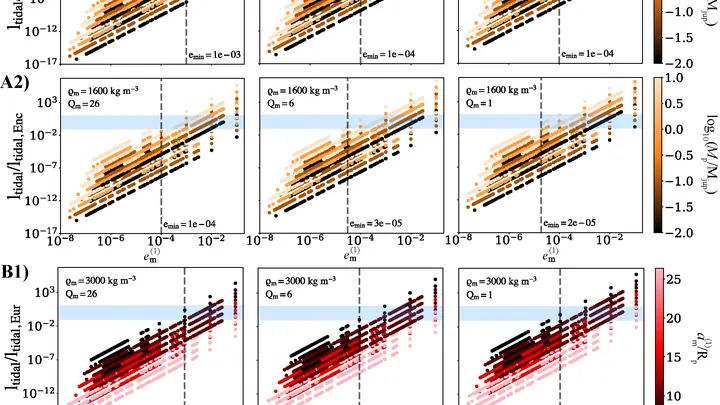
Dark Core or Pearlescent Layer: Metamorphoses of Neutron Stars

Scientists used an agnostic approach to study how dark matter affects neutron star structure. Light dark matter forms extended halos that boost tidal deformability, while heavy dark matter creates a dense core, making the star more compact. Constraints from NICER and GW170817 show that the fraction
arXiv:2607.03840v1 · 2026-07-04

Cosmic Lightning: How Fast Radio Bursts Illuminate Hidden Baryons

Analysis of 3455 fast radio bursts from the CHIME telescope has mapped electron density fluctuations in the cosmic web. The statistically significant signal at >3σ confirms that residual dispersion measures are not random, but reflect real baryon clumping. The method, which does not require precise
arXiv:2607.04106v1 · 2026-07-05

Quasi-interstellar objects: when the Solar System meets its own exiles

The discovery of 1I/‘Oumuamua made us wonder: could some interstellar wanderers actually be our own comets, ejected from the Oort cloud and returning millions of years later? Simulations show that such ‘quasi-interstellar objects’ are indeed possible, but they have unique characteristics: extremely
arXiv:2607.04216v1 · 2026-07-05

Cosmic Metronome: Binary Stars Search for Axion Dark Matter

Astrophysicists have proposed a method to search for ultralight axions — dark matter candidate particles — using high-precision polarimetric observations of close binary stars. In such systems, light reflected from the companion star's atmosphere creates a weak linear polarization strictly tied to t
arXiv:2607.04550v1 · 2026-07-05

The Universe's Dance Floor: When Dark Matter Breaks into a Quantum Rhythm

Scientists have constructed a rigorous quantum-kinetic theory of gravitational instability for the fuzzy dark matter model—ultralight bosons with a mass on the order of 10⁻²² eV. By applying the Wigner equation and the Landau method, they derived a dispersion relation that revealed a sharp crossover
arXiv:2607.04893v1 · 2026-07-06

Stellar Nurseries in the Jet's Shadow: JWST Explores Centaurus A

Centaurus A is the nearest radio galaxy to us, where an active supermassive black hole lives at its center, shooting out a powerful jet, while a warped dusty disk whirls around it. For a long time, it remained a mystery whether stars could be born under such extreme conditions. New observations with
arXiv:2607.04942v1 · 2026-07-06

Symphony of Dark Energy: From Heavy Adagio to Explosive Allegro

In the standard cosmological model, two epochs of the Universe speak different languages: the temperature of the cosmic microwave background demands one expansion rate, while supernova explosions demand another. The discrepancy has surpassed the five-sigma threshold, becoming a true crisis. The ECDM
arXiv:2607.05044v1 · 2026-07-06

The Ocean of Spacetime: The Hum of Black Holes and the Precision of Simulations

Recently, pulsar timing arrays have for the first time picked up the low-frequency hum of gravitational waves — a cosmic analog of the noise from distant storms in the ocean of spacetime. Comparing NANOGrav data with the Fable simulation showed that the predicted signal from supermassive black hole
arXiv:2607.05208v1 · 2026-07-06

The Pulse of a Black Hole: Birth of a Jet in X-ray Echo

Years of observations with XMM-Newton, Swift, and VLA showed how the changing-look active galaxy 1ES 1927+654 underwent a dramatic transition from a wind regime to a jet. X-ray spectra revealed oxygen emission lines and a broad iron line, while ionized absorption faded. Synchronously, radio emission
arXiv:2607.05246v1 · 2026-07-06

Symphony of Shadows: Neutrino Telescopes Catch the Whisper of Dark Matter

Using 13 years of data from the ANTARES telescope, scientists have set stringent limits on the interaction of dark matter with ordinary matter across mass scales from keV to GeV. Collisions of cosmic rays with dark matter particles in the Galactic Ridge produce neutrinos that are detected by deep-se
arXiv:2607.05335v1 · 2026-07-06

The Mystery of Fragile Satellites: Dark Matter Under Tidal Assault

Elena Asencio and her colleagues showed that, contrary to standard cosmology, the Milky Way’s classical satellites suffer strong tidal deformations. In MOND (modified Newtonian dynamics) these disruptions are natural, while cold dark matter predicts they should be almost completely shielded by massi
arXiv:2607.05502v1 · 2026-07-06

Globular Clusters: A Palimpsest of Ancient Gas Clouds

For decades astronomers puzzled over mysterious anti-correlations of light elements in globular clusters. New research based on high-resolution cosmological simulations shows: the chemical anomalies could have arisen long before the birth of the cluster's first stars—in giant gas clouds. This scenar
arXiv:2607.05509v1 · 2026-07-06

Flattened Darkness: Stellar Streams Outline Invisible Halos

Using the STRRINGS catalog of 32 stellar streams, astronomers have for the first time measured the population distribution of dark matter halo shapes beyond the Local Group. Applying Bayesian analysis, they found that for the 17 most reliable streams, the median flattening is about 0.72 — meaning th
arXiv:2607.05510v1 · 2026-07-06

Music of the Spheres: How LISA Will Hear Dark Matter's Duet

Researchers assessed the capability of the space-based gravitational-wave observatory LISA (launch in 2035) to detect ultralight dark matter interacting with Standard Model fields via quadratic coupling—a common mechanism in axion and dilaton models. Through this interaction, the signal emerges on t
arXiv:2607.08248 · 2026-07-09