A Rat Runs, and the Brain Tells All express
A rat runs down a track — not because a motor forces it, but because it feels like it. On its skull sits a grid of 32 tiny sensors, like a swim cap with wires. The sensors pick up the faint electrical waves emitted by the brain. Previously, to find out how fast an animal was running, you had to implant electrodes directly into the brain. Now it turns out that simply placing sensors on the head is enough, and you can see it all.
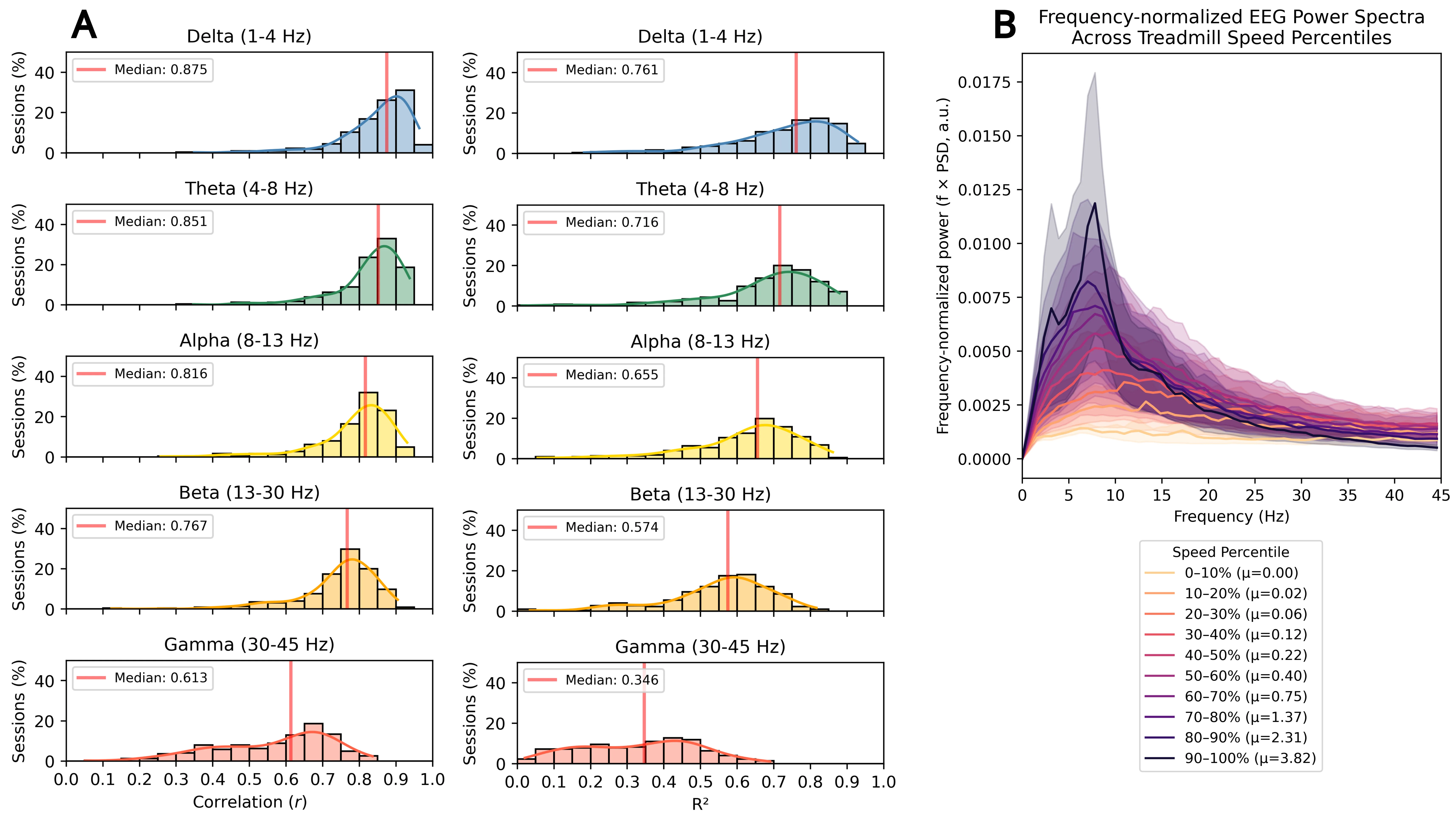
The neural network was trained on 133 hours of recordings. It looked at the pattern of brain waves and guessed the speed of the track. The result was remarkably accurate: a correlation of 0.88—like hitting the bull's-eye almost every time. The key players are slow-rhythm waves — fewer than eight oscillations per second. These are generated by the visual cortex, the part of the brain that processes visual input. So the brain isn't just commanding the legs; it's constantly checking the run against what the eyes see.
If you train the neural network on one rat, it won't work on another: each animal has its own brain "signature." But on the same rat, on a different day, it works perfectly. That means the pattern is stable, and you could build a device that you calibrate once, and it follows you every day.
The rat stops, and the waves in its brain quiet down. But the pattern of those waves has already told where and how fast it was running. Now we just need to learn to read it without wires, and then thought will be as free as a run.
Original abstract
as written by the authors arXiv:2602.18637
$$\textit{Objective.}$$ Accurate neural decoding of locomotion holds promise for advancing rehabilitation, prosthetic control, and understanding neural correlates of action. Recent studies have demonstrated decoding of locomotion kinematics across species on motorized treadmills. However, efforts to decode locomotion speed in more natural contexts$$-$$where pace is self-selected rather than externally imposed$$-$$are scarce, generally achieve only modest accuracy, and require intracranial implants. Here, we aim to decode self-paced locomotion speed non-invasively and continuously using cortex-wide EEG recordings from rats. $$\textit{Approach.}$$ We introduce an asynchronous brain$$-$$computer interface (BCI) that processes a stream of 32-electrode skull-surface EEG (0.01$$-$$45 Hz) to decode instantaneous speed from a non-motorized treadmill during self-paced locomotion in head-fixed rats. Using recurrent neural networks and a dataset of over 133 h of recordings, we trained decoders to map ongoing EEG activity to treadmill speed. $$\textit{Main results.}$$ Our decoding achieves a correlation of 0.88 ($$R^2$$ = 0.78) for speed, primarily driven by visual cortex electrodes and low-frequency ($$< 8$$ Hz) oscillations. Moreover, pre-training on a single session permitted decoding on other sessions from the same rat, suggesting uniform neural signatures that generalize across sessions but fail to transfer across animals. Finally, we found that cortical states not only carry information about current speed, but also about future and past dynamics, extending up to 1000 ms. $$\textit{Significance.}$$ These findings demonstrate that self-paced locomotion speed can be decoded accurately and continuously from non-invasive, cortex-wide EEG. Our approach provides a framework for developing high-performing, non-invasive BCI systems and contributes to understanding distributed neural representations of action dynamics.
The visual cortex is the brain region that processes what the eyes see. In rats, it takes up a large part of the brain because vision is their primary way of understanding the world.
In the movie "Avatar," people control avatars through a neural interface, but there the signals are read via a complex capsule. Here, a cap with sensors is enough — almost like science fiction, but without surgery.