Neurons and Cognition q-bio.NC

140 articles

Synapse, cortex, neuronal dynamics, neural network, sensorimotor control, behavior, attention.

articles

Quantum Measurement as a Deformation of Perception: The Bloch Sphere and the Birth of Categories
Quantum mechanics gave us a captivating image: a system’s state is not a frozen point but a wave of possibilities, dancing in an abstract space. Thanks to the work of Шрёдингера and Дирака, we represent it as vectors in Hilbert space.
Mental Entanglement: The Quantum Language of Neural Networks
In 1935, Erwin Schrödinger, peering into the equations of quantum mechanics, saw something strange: two particles could be linked so tightly that the state of one instantly determines the state of the other, even if they are separated by kilometers.
Thoughts Before Words: How to Catch the Unresolved
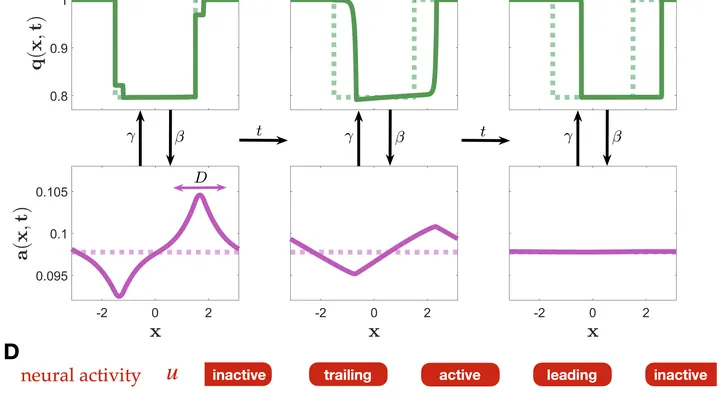
Before an important conversation, a person reaches for their phone but doesn't dial. Several possible phrases already exist inside, but none has been chosen. This state, when options exist but none has won, the authors call 'rogue variables.' To describe this mathematically, they build a graph: nodes are images, words, memories, and the links between them show how close they are.
The Finest Needles Listen to the Human Brain
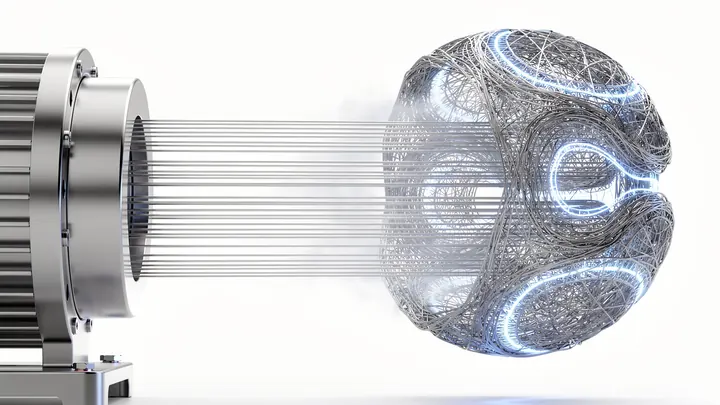
Silence in the operating room. The surgeon slowly lowers a needle thinner than a human hair into the patient's brain. At its tip is not a point but a whole palisade of nine hundred sixty microscopic microphones. Each one listens to its own tiny patch of gray matter.
A Map of Brain Aging
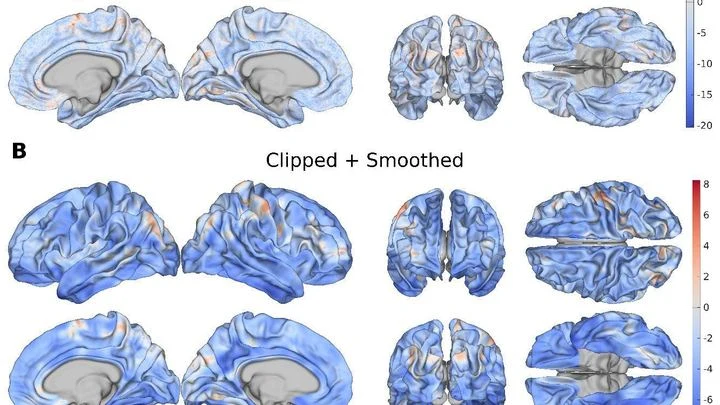
The cerebral cortex is like a crumpled sheet of paper: it has thickness, curves, and folds of varying depth. With age, this sheet changes unevenly — thinning in some places, losing the sharpness of its folds in others. Previously, doctors assessed brain age as a whole, as if looking at the sheet from a distance.
How a Pause Becomes a Reward
A pea-sized brain region brings a rat to a halt mid-step. A laser beam hits light-sensitive cells, and the animal stops as if it hit an invisible wall. This is the rostral pedunculopontine nucleus — a cluster of neurons in the brainstem that controls movement. The authors built a low-cost setup with a camera and a mini-computer.
Machine Learning2026-01-213 minarXiv:2601.15530express
Catching Alzheimer's Without a Poke
A detective is looking for a criminal in a file of mugshots, but the portraits are mixed up. Usually, they expect a man with a gray beard, but the culprit is young and clean-shaven. Similarly, doctors often fail to recognize Alzheimer's disease in those who show unusual symptoms — not memory loss, but problems with vision or speech.
Memory Under Load: How Anxiety Steers Recollections
You're trying not to think about the argument you had this morning, but vivid images keep popping into your head. At the same time, you're preparing a report and holding numbers in your mind. It doesn't go well: memory interferes with work, and work prevents forgetting. Scientists set out to see how the brain copes with this dual load in people with varying levels of anxiety.
Sleep as Brain Cleaning: Why Memory Gets Stronger at Night
Over the course of a day, the brain accumulates impressions the way a room accumulates stuff. At night, during deep sleep, it doesn't just rest: it tidies up: it sorts through the day's events and decides what to keep and what to toss. Scientists built a computer model of the brain that learns from a few examples during the day and 'replays' them at night, as if dreaming.
A Map in the Mind: How the Brain Transfers Experience
When moving to a new apartment, a person doesn't relearn how to open doors or turn on lights. Experience from the old home transfers automatically: a kitchen is a place with a stove and a sink, a bedroom is a place with a bed. The brain doesn't store an exact map but a flexible schema that it overlays onto unfamiliar space. Scientists have built a computer model of this transfer. It has two levels.
How the Brain Passes Thoughts
Imagine an office where employees exchange notes. When there are few tasks, everyone works independently. But when an urgent order arrives, some departments start actively messaging others, and the overall work becomes more coordinated. That's roughly how the brain behaves when we try to hold several things in mind at once.
Dreams as the Brain's Nightly Cleanup
At night, the brain doesn't switch off. Instead, it sorts through the day's events like a librarian arranging books on shelves. But where do those strange, sometimes nonsensical dream images come from? Many have assumed they're just random noise with no meaning. A new computer model shows that randomness doesn't hinder: it helps.
Neural Networks Learn to Read a Fish's Brain
The zebrafish larva is almost transparent, and its brain can be examined under a microscope. But even in such a tiny creature, neural connections are so tangled that sorting them out by hand is nearly impossible. Scientists made a clever move: they built an exact computer replica of the larva, where every connection is known.
The Glue of Memory: How Oligodendrocytes Drive Brain Aging
In the brain of each of us there is an invisible network that holds neurons in place and sets the rules for how they talk to one another. That network is the extracellular matrix, the protein scaffolding around cells. When we are young it is flexible, like a fresh rubber band, and it lets the connections between neurons rearrange easily whenever we learn something new.
How a Neural Network Learns to Speak Like a Human
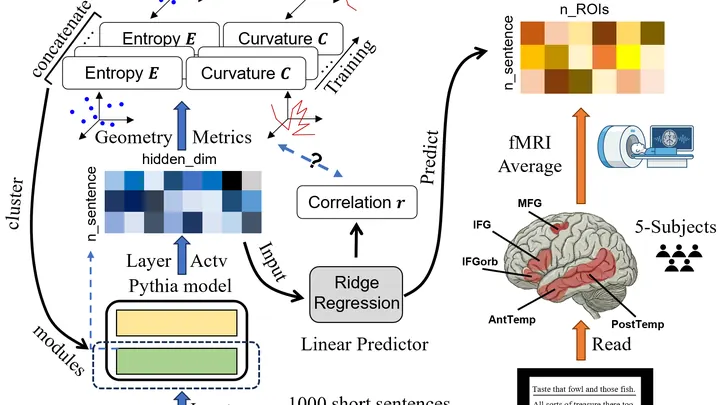
A language model is a multi-layered structure where each layer processes words in its own way. At the start of training, layers are chaotic, but gradually they organize into two teams. The first team works simply: its internal geometry smooths out, becoming less tangled. The second remains complex and intricate.
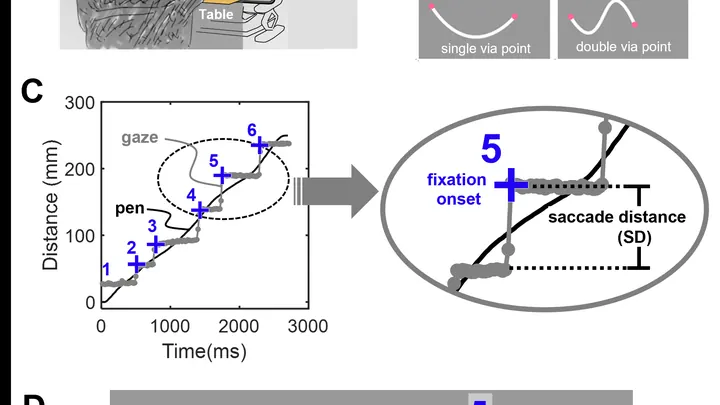
The Gaze's Signature: How Eyes and Hand Agree on Timing
When the hand draws a line, the gaze almost always runs ahead, like a scout peeking around the corner before the column turns. But how far ahead? It turns out that each person has their own distance, and it does not change from attempt to attempt. In the experiment, professional calligraphers and ordinary people traced a contour on a screen while instruments recorded eye and pen movements.
The Gut as the Conductor of an Aging Brain
In the orchestra of an aging brain, the instruments go out of tune one after another. The vessels that deliver oxygen thin out. The insulation around nerve fibers, like the sheathing on old wires, loses its density. The workshop for making new neurons, tucked away in the hippocampus, slows its assembly line.
Brain Folds Tell Tales of Dementia
Every human brain is covered with folds, much like a fingerprint: each with its own unique pattern. In dementia, this pattern changes, but for two similar diseases, Alzheimer's and dementia with Lewy bodies, the changes are nearly indistinguishable to the eye. Doctors need a reliable way to separate them, because the treatments differ.
Machine Learning2026-02-202 minarXiv:2602.18637express
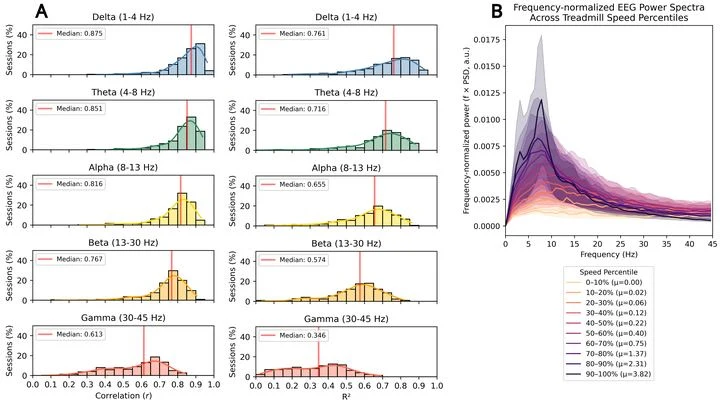
A Rat Runs, and the Brain Tells All
A rat runs down a track — not because a motor forces it, but because it feels like it. On its skull sits a grid of 32 tiny sensors, like a swim cap with wires. The sensors pick up the faint electrical waves emitted by the brain. Previously, to find out how fast an animal was running, you had to implant electrodes directly into the brain.
The Brain's Wiring: How White Matter Orchestrates Thought
The brain is like a sprawling city: districts-regions communicate via streets-neural pathways. If traffic lights at an intersection fail, traffic grinds to a halt. Similarly, in the brain, when bundles of nerve fibers (white matter) malfunction, distant regions stop working in concert, and thought stalls.
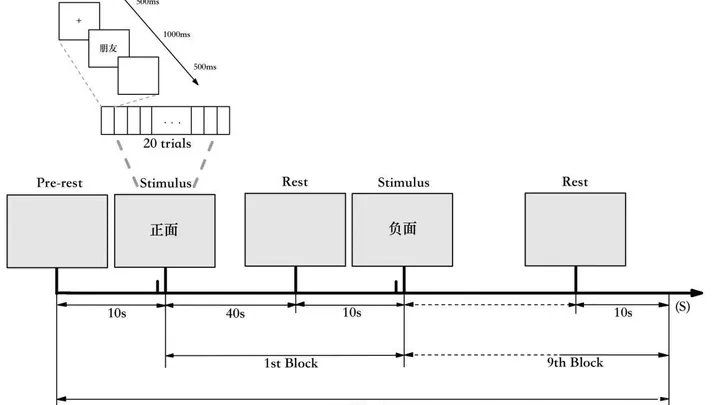
EEG Can't Tell Remission from Healthy
Depression is sometimes sought in the brain's electrical waves. The logic is simple: if a disease has stages (acute, maintenance, recovery) then the signals should change gradually, like volume when you turn a knob. Researchers took EEG recordings from 74 people: 24 in the acute phase, 23 in the maintenance phase, and 27 healthy.
The Neuron City: Why Some Brains Think Fast and Others Slow
A mouse brain contains about 70 million neurons, and the connections between them are far from evenly distributed: some cells have only a couple of dozen contacts, while others have thousands. It's like a city with quiet alleys and bustling squares. But until now, it was unclear how this unevenness affects the brain's actual function.
The Brain Learns by Making Neurons More Alike
A chef's knife and a peeler each handle different tasks, but when a cook learns a new recipe, they often grab the same knife for everything. The brain seems to do the same when mastering a new skill of distinguishing patterns. In the experiment, monkeys trained for weeks to tell apart barely noticeable differences in complex patterns.
How the Brain Packs a Picture
Neurons in the brain and nodes in artificial neural networks don't just fire with simple yes/no signals; they also handle smoothly varying quantities, like where an object is and how big it is. But neural responses are finicky: the same stimulus triggers slightly different bursts of activity each time.
Brain on a Wave: How Phase and Amplitude Reveal Disease
A resting brain is not silent: its regions talk to each other, and these conversations can be eavesdropped on with a scanner. Usually, scientists track signal strength — how loudly each area 'sounds.' But a conversation also has rhythm: some areas light up simultaneously, others with a delay.
Machine Learning2026-03-151 minarXiv:2603.14161express
Learning from Many Brains
A typical machine learning model looks at one object at a time: one brain, one patient, one engine. But biologists need the big picture: how the brain of a species works as a whole, not just that of a particular fish.
Why Neurons Can't Be Friends with Everyone
A neuron in the brain is like a person handing out business cards at a crowded conference. At first, making acquaintances is easy, but as the address book fills up, each new contact requires more effort: there's little room left. The authors based their model on this 'crowding' rule: the more incoming connections a neuron already has, the harder it is to form another one.
Astronomy Teaches Us to See the Invisible in the Brain
To spot a dim star above a brightly lit city, astronomers subtract one image from another — removing the glare of streetlights. They do the same with living neurons: their faint flashes drown in noise, but if you subtract everything unchanging, only they remain.
Eye Movements Reveal Autism in One in Three
Eyes follow a dot that smoothly traces a complex curve on the screen. For most people, the gaze stays close to it, but for some, it seems to slip or lag behind. Previously, such peculiarities drowned in average numbers: if you add everyone up and divide, the difference almost disappears. Instead of looking at averages, the scientists decided to examine each person individually.
The Prisoner's Paradox: The Old Bicycle of Classical Probability
Two accomplices are interrogated separately: betray or stay silent? If neither knows what the other will do, their choice breaks the classical rule of probability. It’s like riding an old bicycle over bumps — the hard seat jolts you off. The textbook rule, the classical model, fails. The authors of a new study found a simple fix: the cyclist needs a soft saddle.
Biological Physics2026-03-271 minarXiv:2603.26630express
Headlight: Why the 'Brain Glow' Turned Out to Be a Mirage
At night in a dark room, the human body emits a barely perceptible glow. This light is so faint that only highly sensitive detectors can catch it. Some researchers thought this glow from the head could tell us about brain activity — no scanners or wires needed. But when put to the test, the story changed.
A Virtual Brain Chooses the Right Treatment
The brain of a person with Parkinson's disease works like an orchestra where the conductor either freezes or waves the baton off-beat. Medications don't help everyone, so doctors turn to stimulation — weak electrical pulses that restore the rhythm.
How the Brain Conducts Speech
Speech is like an orchestra where every note must sound at just the right moment. The brain turns a thought into a chain of sounds in a fraction of a second, and until now it was unclear how it manages this hierarchy — from individual sounds to syllables to whole words.
The Fly Brain Connectome: A Myth of Superiority
Two runners on the same track. One starts halfway down the course, the other from the starting line. Who's faster? The answer is obvious, but in brain science, such a trick went unnoticed for a long time. Neural networks that replicate the connections of a real fruit fly brain were considered better learners than random networks.
Statistical Mech2026-04-052 minarXiv:2604.04154express
Why neural networks forget old knowledge when learning new things
A neural network learning something new is like a traveler in mountainous terrain. Each piece of learned knowledge is a depression in the landscape into which the traveler rolls and gets stuck. To escape and reach a new basin, energy is needed. But as the traveler gains experience, the walls of their pit become steeper, and each subsequent climb requires more effort.
How Helper Cells Keep a Thought in Mind
Holding a phone number in your head while you dial it: that's working memory. In the brain, a group of cells is responsible for this, sending signals to each other like people passing a bucket along a chain. But every transfer has a cost: it requires messenger substances that get used up.
How Chlorine Conducts a Seizure
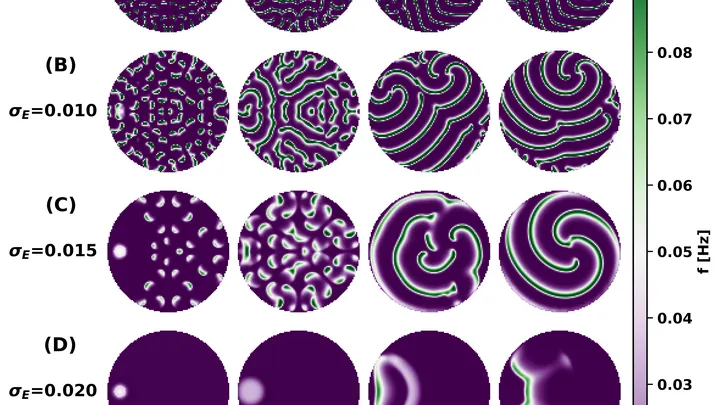
A neuron that has just calmed down is like a pianist lifting their hands from the keys. But inside, silent work continues: tiny pumps push chloride ions outward, returning the instrument to a state of readiness. If the pumps fall behind, chloride builds up, and then an inhibitory signal meant to quiet the cell suddenly starts exciting it.
Why the Second Touch Feels Different
Your hand rests on the table, and two short vibrations arrive at your wrist — one after the other. You need to say which is stronger. The task seems simple, but the answer depends on which vibration came first. If the first is weak and the second is strong, the difference feels larger than when they are swapped.
How the Brain Balances on the Edge
The brain is like a multi-story building: lower floors process simple signals, while upper floors assemble them into complex perceptions. Scientists have long suspected that this order is tied to how neurons work together. But exactly how has remained a puzzle.