The brain is the central organ of the nervous system, integrating sensory information, controlling movement, and supporting higher functions (consciousness, thinking, speech). It consists of the cortex (folded surface), subcortical nuclei, cerebellum, and brainstem. The cortex is divided into lobes: frontal—planning and personality, parietal—touch and spatial awareness, temporal—hearing and memory, occipital—vision. Inside the brain are ventricles filled with cerebrospinal fluid. The main processing unit is the neuralnetwork; information is encoded by the frequency of impulses and patterns of activity. The most important learning mechanism is long-term potentiation (strengthening of synapses) in the hippocampus.
History
The first ideas about the brain are found in the works of Hippocrates and Galen. In the 19th century, phrenology (a pseudoscience about the connection between skull shape and character) gave way to scientific research: Paul Broca in 1861 demonstrated the link between damage to the left frontal lobe and speech impairment. Carl Wernicke described the area for speech comprehension. In the early 20th century, Korbinian Brodmann divided the cortex into 52 areas based on cytoarchitectonics, and Wilder Penfield created maps of the sensory and motor cortex through electrical stimulation. In the second half of the 20th century, non-invasive imaging methods emerged, and at the end of the century, functional MRI allowed us to see brain activity in real time.
How it works
The brain processes information in parallel and in a distributed manner. Sensory signals travel through the thalamus to primary cortical areas, then to association areas where features are combined into coherent percepts. Higher-order association areas (prefrontal cortex) are involved in decision making, working memory, and goal setting. The motor system is hierarchical: association areas plan the action, premotor cortex and cerebellum construct the movement program, motor cortex activates spinal motor neurons. In learning and memory, synaptic plasticity plays a key role: strengthening or weakening of transmission. Long-term potentiation (LTP) in the hippocampus depends on activation of NMDA receptors and Ca²⁺ influx, triggering phosphorylation cascades and protein synthesis. Neuromodulators (dopamine, serotonin) regulate global states (attention, motivation, sleep). Sleep is necessary for memory consolidation: during slow-wave sleep, the hippocampus 'replays' daytime activity sequences.
In practice
Neural interfaces allow paralyzed people to control prostheses with the power of thought. Neuroimaging (MRI) diagnoses tumors and strokes, and a deep understanding of the brain leads to the treatment of depression and Alzheimer's disease.
Fun fact
The brain uses about 20% of all oxygen and calories consumed by the body, yet it weighs only 2% of body weight—an energy-hungry organ.
A forest ages in different ways. In one spot the trees thin out gradually, as if they have grown tired of growing, while in another they cling stubbornly to life, spending their strength repairing damaged branches. The aging of the brain's cortex looks much the same when you view it through the lens of thousands of MRI scans.
A jazz trio plays in the dim light of a club. The pianist leads the melody, the bassist holds the rhythm, and the drummer sprinkles out rolls. If you listen only to pairs of musicians, you can catch how the pianist adjusts to the bass or the bass to the drums.
In the 1980s, the DARPA speech recognition challenge settled the debate between statistical methods and hand-written rules, setting a common standard for the entire field.
In the dark room of the scanner, a person watches for rare flashes on a screen. An infrared camera records their pupil a thousand times per second, while an MRI scanner simultaneously logs which brain areas light up. In this way, 89 volunteers aged 19 to 78 helped scientists see how the pupil becomes a display on which the brain outputs two different signals.
In 2023, in Belgium, 101 people aged 50 to 69 spent several days in a lab where their brains were scanned, their sleep was recorded, and they were asked to solve memory and attention tasks. That is how the COFITAGE dataset was born, describing each participant from five angles: molecular, structural, physiological, genetic and cognitive.
At a crowded reception, an older person asks their conversation partner to repeat themselves again and again: the words drown in the hum of voices. This is what the bridge looks like, the one that carries sound from the ear to meaning. While that bridge holds, noise merely gets in the way, but it doesn't cut the conversation short.
The classroom goes quiet after the lesson, but the echo still rings in the child's head: faces, objects, places. It is this echo, not the lesson itself, that decides what will stay in memory. For the first time, researchers have caught it in children aged 6 to 17.
Children memorized scenes inside an MRI scanner: they were shown a room, then an object or a face in a particular spot.
A river begins high in the mountains: one channel carries more water, another less. In the same way, a person's social position sets the course of their life, but it doesn't carve the brain directly; it does so through tributaries: habits, blood pressure, blood sugar. Scientists measured these tributaries in 36,878 people to find out which ones carry away the most years.
A geologist walks along a mountain slope, running an instrument over the rocks. The instrument shows where iron ore lies beneath the surface and where the rock has cracked. A magnetic map of the brain works in much the same way: it reveals where iron has accumulated in the tissues and where the sheath of nerve fibers is damaged.
After a concussion, such imaging is especially important.
An old road atlas lies on the table. On its pages, lines connect cities, and the thickness of each line tells you how busy the traffic once was. A neural network looks at such a map and names the age of the car that drove along it. That is roughly how a model trained to predict a person's age from the map of their brain connections works.
The brain is like an orchestra, with the cortex as the conductor and the thalamus as the first violin. The thalamus relays signals from the eyes to the visual cortex. But the cortex can also send commands back, tuning the thalamus for the task at hand. This was once a hypothesis, but now it's been tested in humans.
The brain is like an orchestra, with the cortex as the conductor and the thalamus as the first violin. The thalamus relays signals from the eyes to the visual cortex. But the cortex can also send commands back, tuning the thalamus for the task at hand. This was once a hypothesis, but now it's been tested in humans.
The dummy tips backward in its chair: its head hits the floor. Inside the head, in three Petri dishes, live human nerve cells. They feel the impact just as a real brain would during a fall.
The experiment is simple: the dummy was dropped from a sitting position at angles of 30, 60, and 90 degrees.
A single blow to the head is bad enough. But what about a series of blows? That's more complicated, and standard computer models of the brain don't account for it: they treat each impact as if it were the first. But the brain isn't a steel ball: it remembers past strain.
Brain tissue is like a rubber band that has been stretched many times.
A bell hidden in a thick box can be made to ring without opening the lid. Just send a sound wave through the walls, and the clapper will tremble. That's roughly how transcranial ultrasound works: sound passes through the skull bones and makes neurons deep in the brain 'ring'—generating electrical impulses.
Blood vessel cells were seeded onto a transparent film just 700 nanometers thick — a hundred times thinner than a human hair. Flat electrodes are hidden beneath the film. They send a weak alternating current and listen as the resistance changes.
A magnetoencephalograph, a helmet-like device with hundreds of sensors, picks up the weak magnetic fields generated by active neurons. When a person listens to speech, these signals contain imprints of the heard words. But extracting them is tricky: signals from thousands of sources merge into a tangled mess.
A stadium packed with fans hears the announcer’s voice for the first time, and instantly the whole place erupts. The message sounds again and again. Only a handful of people in nearby rows respond. That’s roughly how neural networks behave in brain organoids — tiny lab-grown replicas of the brain.
A stadium packed with fans hears the announcer’s voice for the first time, and instantly the whole place erupts. The message sounds again and again. Only a handful of people in nearby rows respond. That’s roughly how neural networks behave in brain organoids — tiny lab-grown replicas of the brain.
The brain is an orchestra where each group of instruments must come in on time. In Alzheimer's disease, the musicians lose their notes: connections between brain regions get tangled, and the harmonious performance turns into cacophony. Scientists have long seen these disruptions on scans, but they didn't know if the situation could be fixed by touching just one string.
At night, when we sink into deep, dreamless sleep, a tide begins in the depths of the brain. Each heartbeat and each breath sends gentle pulses through the fluid-filled cavities (the ventricles). During the day, these pulses are timid and monotonous — the fluid sloshes back and forth almost in place.
But with the onset of slow-wave sleep, the rhythm changes.
A city at night: lights on in some windows, dark in others. If you connect with lines the windows that light up simultaneously, you get a web of connections. Researchers studied such a web in tiny brain organoids — living clusters of nerve cells grown in the lab.
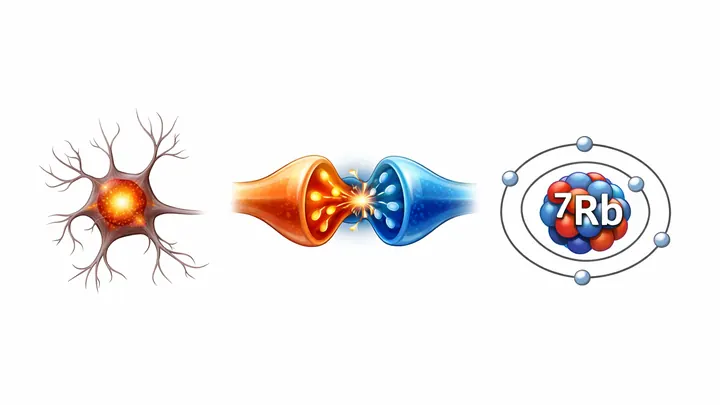
A cloud of atoms cooled to near absolute zero suddenly starts behaving like a brain. One excited atom triggers a chain reaction — neighbors light up in turn, and an avalanche of activity sweeps through the gas. Physicists call this Rydberg facilitation: atoms are easier to excite when an excited one is nearby.
The meditating brain is an orchestra, and attention is the conductor. When you're focused on your breath, all instruments play in harmony. But suddenly, a thought-cello plays a false note: that's mind wandering. An experienced conductor doesn't panic: they instantly catch the dissonance and gently guide the orchestra back to the main melody — the breath.
The brain self-cleans its waste: cerebrospinal fluid flows through narrow channels surrounding arteries. The channel walls are soft and ripple with each pulse, and the tissue is porous like a sponge. Every heartbeat turns arteries into tiny pumps, driving fluid through the pores.
The modern standard approach to AI training is like a child locked in a library: he remembers millions of books but doesn't know that fire burns and falling hurts.
Neurochips work differently from conventional computers, which are built according to the blueprints of von Neumann with separate memory and processor. At the core of these chips is a network of simple cells, similar to neurons, and, like water that evenly fills containers of any shape, they easily find a solution without unnecessary steps.
Researchers took 16 everyday activities — from washing dishes to squatting — and broke the movements down into elementary components, much like a spectroscope splits light into a spectrum. Comparing three approaches, they found an unexpected key to recognition: a single averaged snapshot is enough. Only nine joints out of dozens carried the crucial information — the rest hardly mattered.
An electron microscope is a giant pipe organ: instead of pipes (electromagnetic lenses, instead of air) a stream of accelerated electrons. It once merely painted mute frescoes of the atomic world, condemning scientists to grueling decipherment.
Inside each of us, invisible clocks are ticking. They control the release of cortisol — the hormone that helps us wake up in the morning, cope with anxiety, and keep our immune system on its toes. In adrenal insufficiency, these clocks break down: the body can't produce the right amount of cortisol on its own.
In the grand orchestra of the universe, every instrument has its own rhythm. Electrons in an atom make quantum leaps in femtoseconds, neurons in the brain exchange signals in milliseconds, and a human needs tenths of a second to become aware of the 'now.' Physicists have long sought the conductor…
Studying distant exoplanets, scientists look for signs of life — for instance, water and carbon — and signs of technology: radio signals, megastructures. But between these clues there is a yawning gap. If intelligence hasn't created machines or they've vanished, we won't notice it.
The brain doesn't learn every task from scratch: it transfers experience from one activity to another. But how do you know which tasks are truly related? Neuroscientists came up with a clever trick: let an artificial network "peek" at brain activity during one task and try to predict activity during another. If it works well, the tasks are close.
A living organism is a machine that constantly channels energy through itself and converts it into heat. This internal cycle is called internal entropy production (a measure of energy dissipation). But about 2.5 million years ago, our ancestors switched on a second loop — an external one. They picked up a sharpened stone, and then a burning branch.
A neuron resembles an electrical circuit with batteries and variable resistors. The resistors are played by ion channels — protein pores in the membrane that open and close, letting charged particles through. Whether a nerve impulse fires depends on how fast and at what voltage these pores operate.
In the 1990s, philosopher John Searle devised a thought experiment: a person sits in a room and, without knowing Chinese, follows instructions to produce correct answers in Chinese. From the outside, it seems they understand the language, but inside, it's just mechanical rule-following.
When the conductor leaves the orchestra, the musicians keep playing from memory for a while. But without a unified rhythm, each one starts to speed up or slow down on their own, and the harmonious symphony turns into disjointed noise. According to new research, the brain and heart behave much the same way in the last hours of a person's life.
A grand symphony orchestra plays, but each group of instruments follows its own score without hearing the others. The violins carry the melody of the heart, the cellos the rhythm of the liver, and the woodwinds the pulse of the brain. It sounds disjointed, even though each part is flawless on its own.
A supermarket cashier at rush hour doesn't memorize every scanned item: they keep the running total in their head and watch the queue. The brain allocates its resources similarly: the expensive, precise cortex (responsible for deliberation) and the simpler, economical subcortical nuclei (where habits live) work in tandem.
Every morning you pick up the same mug, but the coffee tastes either bitter or just right. It's not about the coffee, and not about your character. Inside us, an invisible panel with dozens of sliders is constantly shifting: fatigue, hunger, anxiety, hormone levels.