Inside the Cell: How Cancer Dodges the Drug express
A cancer cell is like a stubborn lock that changes its keys as you try to pick it. The drug acts as a lockpick, but the cell quickly finds a way to keep it out. In a new study, scientists built a computer model that mimics how cancer cells behave with various genetic glitches.
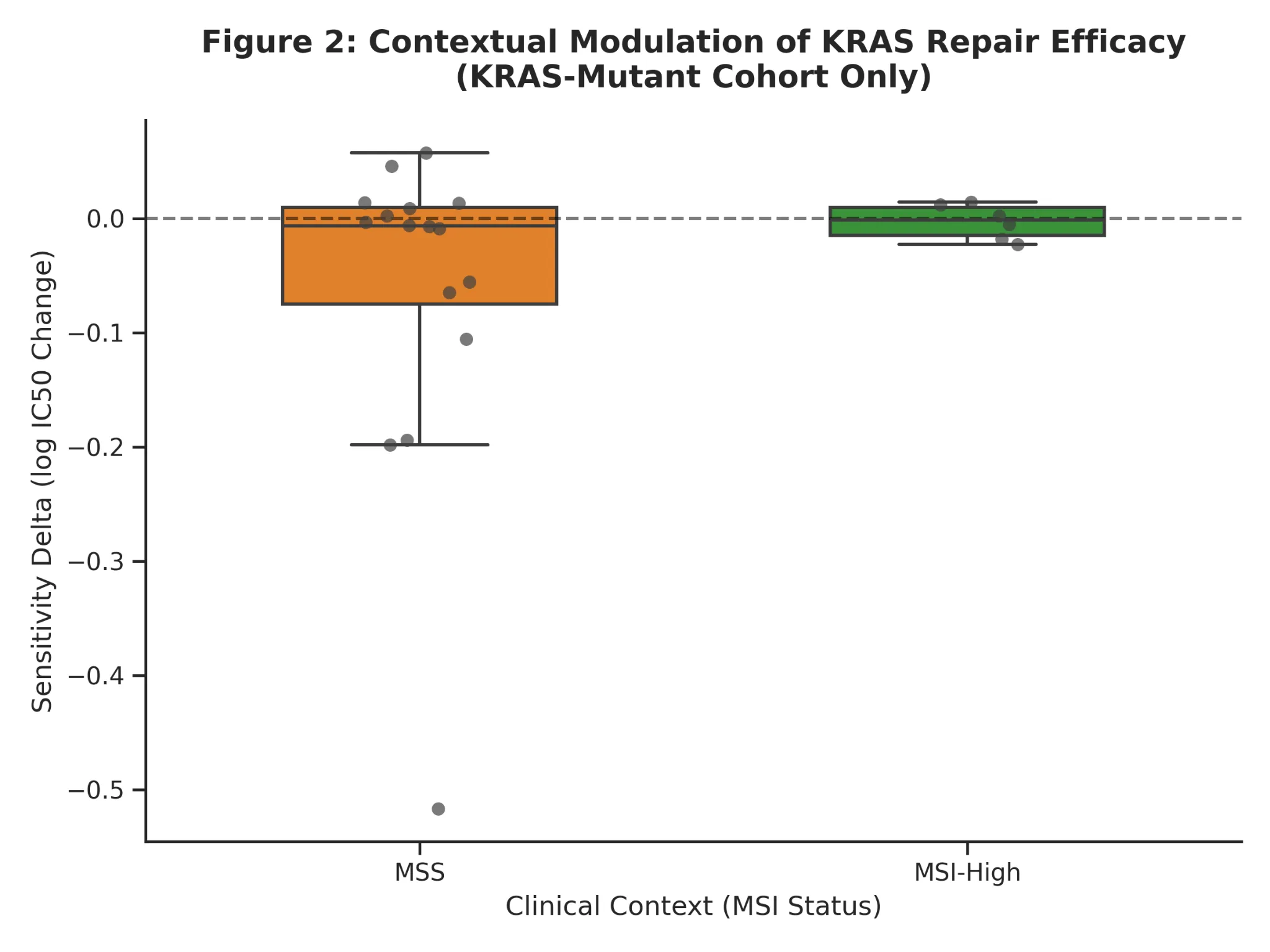
The big surprise came from the KRAS gene. Its mutation acts as a shield, blocking the cell from the drug called 5-fluorouracil. The researchers confirmed this by 'switching off' KRAS in the model, and the protection vanished. But with the PIK3CA gene, it was the opposite: when they 'fixed' it, the cell became even more resistant. It activated a backup survival pathway, like a driver who, when one road is blocked, immediately finds a detour.
Now oncologists can see in advance which mutations make a tumor invulnerable and choose drugs more precisely. This is a step toward treatment that adapts to the individual patient, not to average statistics.
Original abstract
as written by the authors arXiv:2603.02274
Precision oncology is currently limited by the small-N, large-P paradox, where high-dimensional genomic data is abundant but pharmacological response samples are sparse. While deep learning achieves predictive accuracy, it frequently fails to provide the mechanistic clarity required for clinical adoption. We present the Contextual Invertible World Model (CIWM), a Neuro-Symbolic Agentic Framework that bridges this gap by integrating a quantitative machine learning emulator with a Large Language Model reasoning layer. Utilising a stringently curated, high-fidelity data engineering pipeline on the Sanger GDSC dataset (\( N=83 \)), we isolate true biological signals from in vitro artifacts to establish a rigorous baseline predictive correlation for complex transcriptomics (\( r=0.268 \)). Through Inverse Reasoning, we perform in silico CRISPR perturbations across the colorectal landscape. The framework autonomously overturns classical mechanistic assumptions, identifying a hierarchical dominance of mutant KRAS over the APC/Wnt-axis in driving 5-fluorouracil resistance (\( \Delta=-0.0469 \)) via a "KRAS Shield" mapped to MAPK/PI3K networks. Furthermore, the agentic layer identified a "PIK3CA Paradox", revealing that repairing PIK3CA inadvertently increases chemoresistance (\( \Delta=+0.0085 \)) by triggering a compensatory feedback loop that hyperactivates the dominant MAPK survival pathway.
The model learned on its own to find unexpected connections between genes — for example, that one mutation can protect against a drug more strongly than another that was thought to be the main culprit.