Symbolic regression is a type of machine learning that searches for a mathematical formula, rather than just tuning the parameters of a pre-chosen equation, to best fit a dataset. Unlike neural networks, which often act as black boxes, symbolic regression outputs human-readable expressions like F = G·m₁·m₂/r². This makes it a powerful tool for scientific discovery, as it can reveal the underlying structure of natural phenomena directly from data.
History
The concept was popularized in the 1990s by John Koza as part of genetic programming, though earlier work on symbolic regression via genetic algorithms existed in the 1980s.
How it works
The method uses evolutionary algorithms or other search techniques to combine basic mathematical operations (+, −, ×, ÷, sin, exp, etc.) into candidate formulas. Each formula is evaluated on how well it predicts the data, and the best candidates are 'mutated' and 'crossed over' to produce new generations. The process iterates until a simple, accurate expression emerges, often guided by a penalty for complexity to avoid overfitting.
In practice
It is used in physics to rediscover laws from experimental data, in engineering for system identification, and in finance to model market dynamics.
Fun fact
In 2019, a symbolic regression algorithm independently rediscovered Newton's law of universal gravitation and other fundamental physics equations from raw observational data.
An interpreter in a crowded room tries to make out one person's speech but hears the murmur of hundreds of voices. A molecule storing quantum information in its spin finds itself in a similar situation: its spin is surrounded by the thermal jitter of atoms, and it is this jitter that gradually erases memory.
Diamond is not just a gemstone. Hidden inside its crystal lattice are defects that sense magnetic fields better than many instruments. One such defect, the NV center, acts as a tiny compass, but its needle wavers from heat and noise. For the compass to point accurately, calibration is needed.
An interpreter gets distracted by every rustle in the hall, and a one-hour meeting stretches into two. Similarly, molecular foundation models learn the language of molecules from vast corpora, but each new conversation requires fine-tuning. Monroe changes the rules: it doesn't learn a new language but instantly finds common meaning from a few examples.
A lone fish sees a shadow overhead. Should it flee? If it's just a leaf, it wastes energy and gives away its position to a predator. If it's a heron, hesitation is fatal. That's the eternal trade-off of the solitary individual: quick reactions mean many false alarms, while caution means risking being eaten.
In a school, it's different.
Holding in mind the exact position of a pen as it's slowly moved is a routine task for the brain. For artificial neural networks, it's nearly impossible. Standard recurrent networks like GRU and LSTM tend to break continuous motion into rigid steps: the pen doesn't glide smoothly but jumps from point to point.
Predicting the yield of a chemical reaction is a bit like trying to guess the harvest knowing only the soil composition. Traditionally, chemists have relied on long columns of numbers, quantum descriptors, that describe electron energies but say nothing about molecular shape.
Reconstructing a full picture from fragments is like discerning an orchestra's melody in a noisy hall. Such challenges arise in photometry, where a star's brightness is recovered from faint twinkling. Traditional methods need precise noise information, which is almost always unknown.
Ordinary AI looks at medical images like puzzles made of unfamiliar pieces: it considers any two unmatched pictures completely different. It's like trying to tell twins apart without knowing they're related. In medicine, however, patients with the same condition look nearly identical on MRI, and the algorithm mistakes 'relatives'.
Assessing image quality is a job for a meticulous inspector with a toolbox. The IQA-T1 neural network acts exactly like that: it doesn't just stare at the picture, but applies either a spectroscope or a light meter.
Cooking a complex dish requires a clear recipe: first chop, then sauté, add spices at just the right moment. Chemical transformations also follow step-by-step recipes — mechanisms where atoms of carbon and hydrogen rearrange in a strict order.
Previously, neural networks often invented nonexistent steps, like a whimsical cook swapping salt for sugar.
Neurochips work differently from conventional computers, which are built according to the blueprints of von Neumann with separate memory and processor. At the core of these chips is a network of simple cells, similar to neurons, and, like water that evenly fills containers of any shape, they easily find a solution without unnecessary steps.
The float in a toilet tank is an ideal controller: sensing the water level, it instantly brings the system into equilibrium without looking back at the past. Engineers applied this principle to neural networks.
The standard way of digitizing speech: taking volume readings thousands of times per second. It's like tasting broth with a teaspoon: each sip is watery, with almost no detail. The data stream swells, though the substance is minuscule.
Scientists proposed first "simmering down" the audio signal.
Look into the night sky — before you is not a scattering of lights, but a multi-layered manuscript. Under the bright ink of stars and galaxies appears a faded, almost erased text.
The gamma sky, captured by the Fermi telescope, is a grand symphony of thousands of sources. Here, the rhythmic pulsations of pulsars, the powerful chords of active galactic nuclei, but most of all — unidentified objects, whose part remains a mystery.
The cosmic microwave background is the first light that pierced the dense fog of the early universe. Its spectrum, like a frozen score of a cosmic symphony, preserves the tiniest density fluctuations from which galaxies grew.
Light from distant galaxies travels to us for billions of years, but along the way it gets bent and twisted by the invisible web of dark matter. This effect, predicted by Albert Einstein within general relativity, is called gravitational lensing.
Quantum spin chains resemble a line of people passing along a secret handshake: each turns to a neighbor, and how firmly they clasp palms determines how the wave runs through the entire chain. In the ideal Heisenberg chain, quantum magnetism’s bedrock, all handshakes are equal.
A black hole is not a frozen void, but a living magnetic engine. Its 'heart'—the accretion disk, pulsates: inhale, matter spirals into the funnel, exhale — magnetic reconnection tears the field lines, and plasma shoots away from the horizon.
A doctor doesn't make a diagnosis on a whim. They open a medical reference book and point to the article they're relying on. That's roughly how the new system KG-TRACE works.
X-ray detectors work like honeycombs: particles flash here and there in hexagonal cells. Conventional algorithms stretch these combs onto a square grid, creating ghostly polarization artifacts. Scientists used a neural network that lives by the rules of the hive — it processes the hexagonal structure directly, preserving the natural pattern.
Designing machines is like cooking: you need to know exactly where the 'dough' will tear. Old computer simulations check every point on a part for hours, like measuring the entire pot to make sure the handle doesn't fall off.
An artist paints a picture, glancing at the audience in the hall. If the viewer smiles, the artist adds more red and rounded lines to the canvas; if the viewer frowns, the artist removes blue and sharpens the angles.
When black holes collide, the very fabric of spacetime trembles. That rumble, gravitational waves, gets picked up by detectors, but decoding the signal used to take hours of computer simulation.
Imagine a factory where hundreds of tiny assembly lines run nonstop. Each line is a molecular motor that converts chemical fuel into motion. To make the motor go faster or in the right direction, an engineer tweaks the settings — the shape of parts, the strength of interactions.
In a hall with a hundred instruments, a symphony is playing, but the conductor is hidden behind a screen. The scientist hears only the notes played by the instruments and wants to understand who sets the rhythm. Scientific data resembles such an orchestra: we record instrument readings but do not see the hidden mechanisms that drive them.
Astronomers, like chefs, have long been preparing a description of the Universe using the same cumbersome recipes. These recipes — complex mathematical formulas — estimated how many galaxies of different luminosity and mass fill the cosmos, as well as how the invisible frameworks of dark matter are distributed. But the dishes lacked accuracy.
Show the same photo of a cat to two different neural networks, and they often reach a similar conclusion: "cat." But ask them for more detail, and their answers may diverge. One model focuses on the whiskers, another on the coat color, a third on the pose. So even within the "visual" world of neural networks, there's no complete unity.
A protein is like a chain of amino-acid beads that folds into a precise shape, and that shape dictates how the protein works in a cell. Protein designers swap beads to achieve the desired form, but the number of possibilities is enormous.
Standard cosmology relies on the Big Bang and dark energy, but there is an alternative — the Lemaître–Tolman–Bondi model, where the Universe's expansion is explained not by a mysterious force, but by natural unevenness in the distribution of matter — clusters of…
When a typical computer searches for a law of nature from data, it tries to guess a complete formula in one go. It's like a cook who, without knowing the recipe, dumps all the ingredients into a pot at once and hopes for soup. Most often, the result is an inedible mess: the formula is long but meaningless, and it fails on new data.
A cancer cell is like a stubborn lock that changes its keys as you try to pick it. The drug acts as a lockpick, but the cell quickly finds a way to keep it out. In a new study, scientists built a computer model that mimics how cancer cells behave with various genetic glitches.
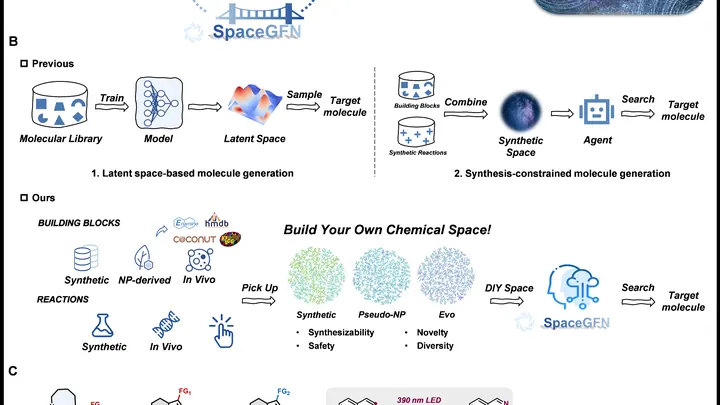
Previously, generative models for drug discovery worked like an artist painting without choosing a canvas. They learned from existing molecules and simply produced similar ones, without considering how the space of possible compounds is organized. SpaceGFN changes the approach: now chemical space is a construction set where the user specifies the parts and the assembly rules.
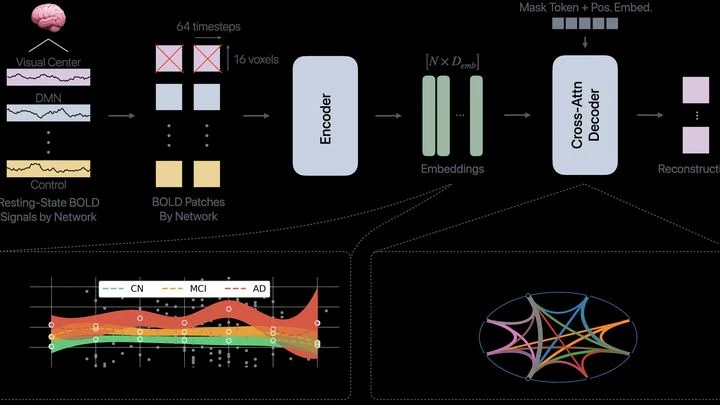
The brain isn't one big computer: it's more like an orchestra, where different groups of musicians play their parts. Neural networks for memory, attention, or emotions are constantly talking to each other. In Alzheimer's disease, this orchestra starts to go off-key: some groups fall silent, others play out of sync.
When two particles collide and scatter, physicists record the outcome as a complex mathematical formula. There are many such formulas, and invisible connections exist between them, like different recipes for the same dish: change the order of steps, and the taste stays the same. Previously, these connections were derived by hand, taking months or years.
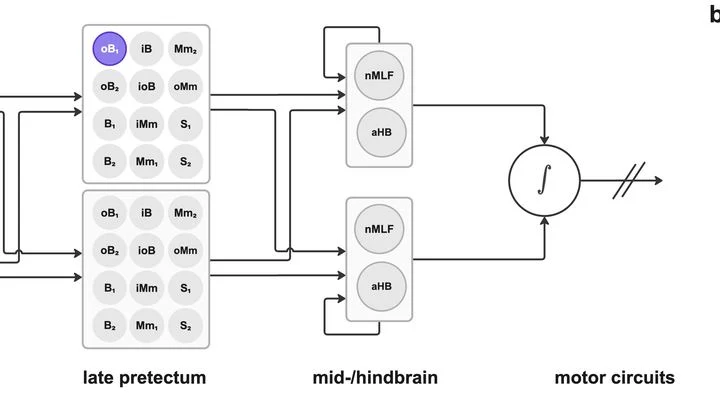
The zebrafish larva is almost transparent, and its brain can be examined under a microscope. But even in such a tiny creature, neural connections are so tangled that sorting them out by hand is nearly impossible. Scientists made a clever move: they built an exact computer replica of the larva, where every connection is known.
A chemist searching for a new drug is like a cook without a recipe: they have a list of desired properties but millions of possible ingredients. Each trial is costly and time-consuming, so you need to experiment wisely.
The new program SEISMO acts like a chef who tastes the dish after every step and immediately decides what to add next.
Every thought leaves a trace — a faint electrical blip on the scalp. A device with dozens of wires, resembling a swim cap, catches these traces and turns them into wavy lines. From those lines, you can guess what a person feels even if they stay silent. In a new study, three computer programs competed to see which could read such lines most accurately and determine whether the mood was bad, neutral, or good.
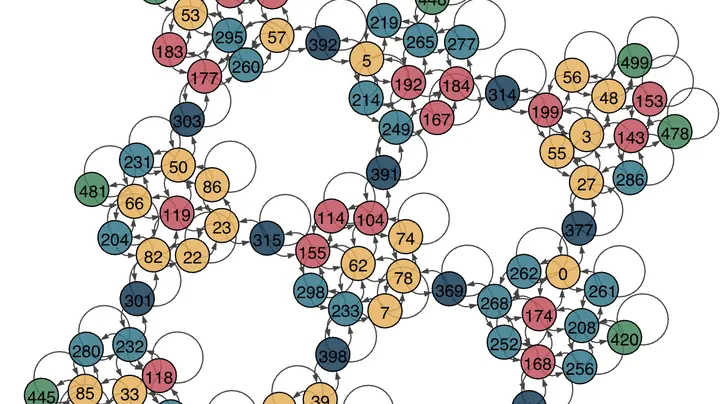
When moving to a new apartment, a person doesn't relearn how to open doors or turn on lights. Experience from the old home transfers automatically: a kitchen is a place with a stove and a sink, a bedroom is a place with a bed. The brain doesn't store an exact map but a flexible schema that it overlays onto unfamiliar space.
Scientists have built a computer model of this transfer. It has two levels.
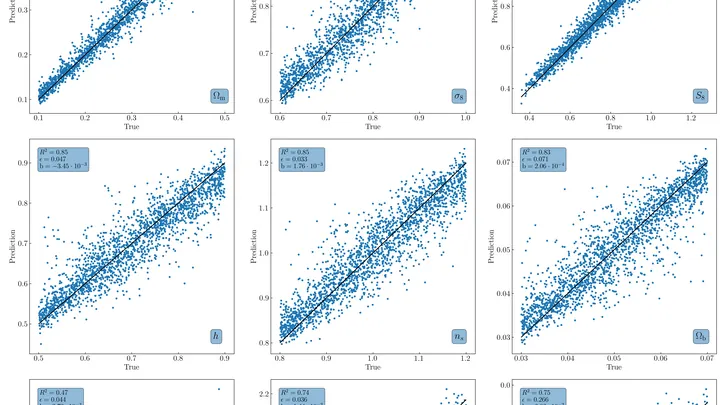
Thousands of universes were born in a computer, all to tell us about our own. Each one has its own galaxy clusters, arranged by the laws of gravity like peas in a jar shaken with varying force. From how the peas settle, you can tell what kind of hand shook the jar.