A mutation is a permanent change in the nucleotide sequence (the building blocks of DNA) of DNA, arising from replication errors (DNA duplication), recombination (exchange of segments between chromosomes), or under the influence of mutagens (factors that cause mutations). Point mutations affect a single base pair; their types: substitution (missense — amino acid substitution, nonsense — stop codon appearance), insertion or deletion, often leading to a reading frame shift (alteration of codon grouping). Chromosomal mutations are larger rearrangements: deletions (loss of segments), duplications (doublings), inversions (180° rotation), translocations (relocations). Genomic mutations change the number of chromosomes (aneuploidy — abnormal number, polyploidy — multiplication of the entire set). Mutations can be somatic (in non-reproductive cells, not transmitted) or germinal (in reproductive cells, inherited). Most mutations are neutral or harmful, but in rare cases increase fitness, becoming material for natural selection.
History
The concept of mutations as discrete changes dates back to Hugo de Vries, who in 1901–1903 described them in evening primrose, using the term "mutation" to denote sudden heritable deviations. Thomas Morgan and his school, working with fruit flies in the 1910s, established the connection between mutations and chromosomes. In 1927, Hermann Muller experimentally proved the mutagenic effect of X-rays, laying the foundations of radiation genetics. In the mid-20th century, the discovery of the structure of DNA allowed a transition to molecular understanding of mutations.
How it works
At the molecular level, mutations arise as a result of chemical changes in nucleotides or errors in template synthesis. For example, deamination of cytosine converts it to uracil, which during replication is read as thymine, replacing a C-G pair with T-A. Sources of spontaneous mutations include tautomeric shifts of bases, leading to mispairings during replication. Induced mutations occur after DNA attack by exogenous agents. If the repair system fails, the change becomes fixed in the next replication cycle. Consequences depend on the type of mutation and its location: mutations in promoter regions alter gene expression levels; nonsense mutations truncate the protein; mutations in splice sites disrupt intron removal; epigenetic changes do not affect the DNA sequence but can be heritable. The evolutionary significance of mutations is as the primary source of genetic variation for natural selection.
In practice
Mutations underlie evolution and the diversity of life, and their study helps understand the causes of cancer and create new plant varieties.
Fun fact
In humans, each germ cell carries on average about 100 new mutations not present in the parents, making us all a bit mutant.
Picture every blood test as a dot on a large map. Plot thousands of those dots and they won't scatter at random: they line up along two main roads. One road separates men from women, the other stretches from youth to old age. Follow these roads and you can see how a person grows up, lives and grows old.
Picture a wind map over a mountain range. The wind mostly blows downhill, following elevation changes. But if you look closely, in some valleys the air swirls into little eddies that keep the wind from simply flowing down. That is exactly what the mutation field in human DNA looks like.
A lab dish of cancer cells looks like a city after an earthquake: some buildings held, others collapsed, and the cracks show where the blow landed. Chemotherapy strikes DNA, but seeing that blow directly is hard: the damage is scattered across the genome and across many cells.
Picture a wind map over a mountain range. The wind mostly blows downhill, following elevation changes. But if you look closely, in some valleys the air swirls into little eddies that keep the wind from simply flowing down. That is exactly what the mutation field in human DNA looks like.
A tightly stretched membrane, squeezed into a narrow case, decides on its own where to burst. So does a cell: when it is cramped, the point of division shifts from the middle, and the two halves come out unequal. Previously, it was thought that such asymmetry is predetermined by chemical labels, but the new work shows that mechanics alone is enough.
On a crowded train, some passengers ride in silence while others push toward the exit, shoving their neighbors aside. In every person's blood, mutant cells appear with age, and their fate is much the same: most changes are neutral, like passengers who are simply along for the ride, but some give a cell an edge, and it starts dividing faster than the rest.
Evolution resembles not just a tree with diverging branches, but a woven tapestry. Threads of ancestry cross when species exchange genes — for example, bacteria pass drug resistance to each other, and plants crossbreed to produce hybrids.
Every tumor writes its own cosmology. Its cells are galaxies, and mutations are stellar flares marking the branches of a genealogical tree. The key to its history is the rhythm of accumulating genetic typos.
A family tree becomes a tangle if you account for adopted children and remarriages. Evolution often resembles such a tangle: although the Standard Model, the traditional view of divergent evolution where species branch like a tree, paints a neat tree of species, in reality genes travel not only by inheritance but also directly between unrelated organisms — a process…
Evolution flows like water. In a wide river, changes are smooth and slow, while a mountain stream churns with every stone. Population size and mutation rate set the channel: broad and calm, or narrow and rapid-filled.
DNA methylation consists of tiny chemical marks on our genes. Over the years, they change on a fairly strict schedule. Standard epigenetic clocks look at these marks and output a single number: biological age. But a number can't tell you how the pattern of marks rearranged day by day, year by year. The authors of this work decided to turn a static photograph into a continuous film.
Two passengers step into an empty car on a ring subway line and take their seats. After one full loop, they are surprised to find themselves in each other’s seats — even though nobody moved. That’s pretty much how monodromy plays out in vineyards — families of persistence diagrams, a method rooted in the work of Henri Poincaré.
The immune system is like a tireless editor, revising antibody drafts to make them stickier to viruses and bacteria. This process is called antibody maturation: random typos (mutations) arise in the genes, and natural selection keeps those that improve target capture.
Inside every cell, a complex network of genes determines what it will become — a nerve cell, a muscle cell, or part of the skin. This choice often resembles flipping a toggle switch: two stable positions, and the cell decides which way to tip. But cells have a feature rarely considered in such models: they divide.
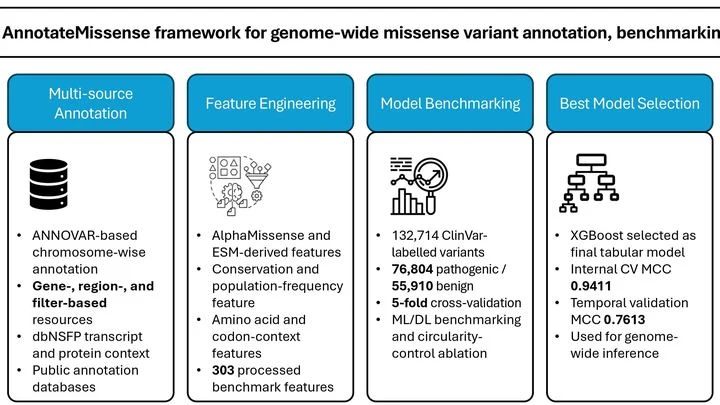
In a vast library where each book is a gene, you need to find a single typo. The error might be harmless, or it might completely change the meaning of the sentence. That's roughly what geneticists do when they hunt for harmful mutations among millions of harmless differences.
The program, named AnnotateMissense, works like a meticulous proofreader.
A patchy landscape isn't just a picture from a geography textbook. For microbes, cells, or animals, the world is a mosaic of patches: warmer here, more food there, and behind that rock — almost poison. When a mutant with a new trait appears in such a mosaic, its fate depends on which patch it lands on.
This new work ties two factors together.
Imagine a mountain range where height represents an organism's fitness. Every point on the slope is a particular set of genes. Evolution climbs upward, but the terrain of this phylogenetic network landscape is cut by ridges and valleys.
A pot of water sits on the stove. The temperature drops: plus one degree, zero, minus one — the water stays liquid. But at some point, a light breath is enough to make the whole mass instantly freeze into ice. Physicists call such jumps first-order phase transitions.
Engineers improving neural networks act like breeders: they try a variant, check the result, and keep the best. They collected 935 such trials from 161 papers and measured how often a code tweak turns out beneficial, harmful, or neutral. The picture is familiar to any biologist: 68% of changes degrade performance, 19% do nothing, and only 13% yield a gain.
A landscape cut by roads or rivers into isolated patches resembles a shared apartment after partitions are installed: residents no longer bump into each other in the common hallway. Species that once competed for the same food or space now live apart. Competition weakens, and those that would have lost to pushier neighbors in a continuous landscape now survive.
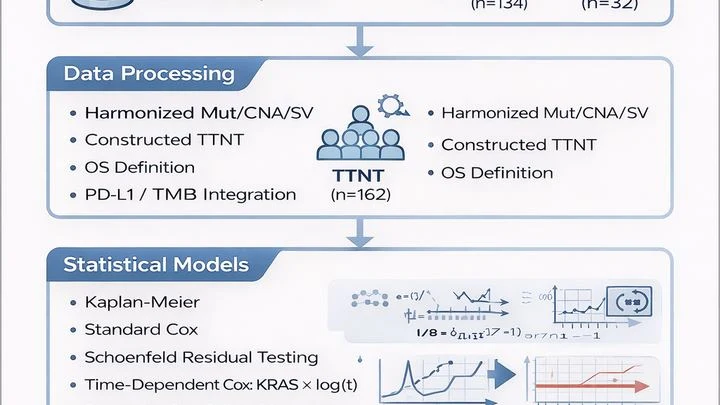
A cancer cell is like a stubborn lock that changes its keys as you try to pick it. The drug acts as a lockpick, but the cell quickly finds a way to keep it out. In a new study, scientists built a computer model that mimics how cancer cells behave with various genetic glitches.
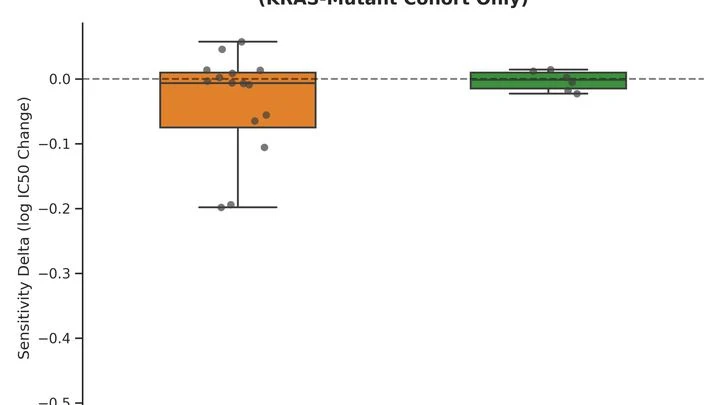
Cancer cells are like broken cars: one glitch makes them drive without stopping. In the KRAS gene, such glitches happen most often. But glitches come in different flavors: the wrong amino acid can sit in one spot of the protein, and that determines how the tumor behaves.
In the new study, two such glitches were compared: G12C and G12D.
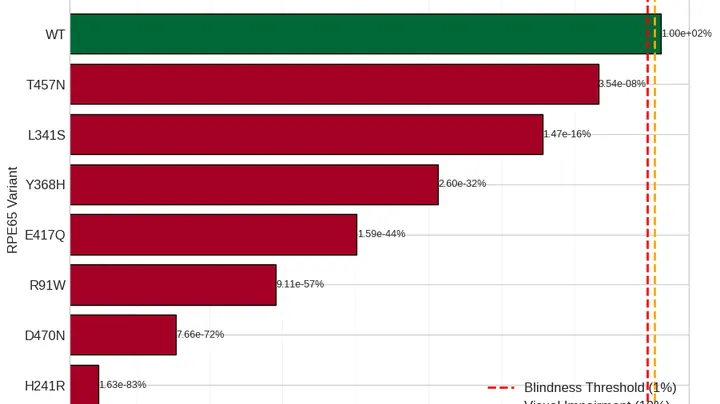
Deep in the eye, in a thin layer of cells, a tiny molecular machine works. It captures light and turns it into a signal that the brain interprets as an image. But sometimes a typo occurs in the blueprints of this machine — a single letter of the genetic code changes, and a person is born blind.
In every cell lives a tireless scribe — an enzyme that copies the long thread of DNA. It moves along it like a read head over a tape, building a new strand alongside. It picks letters by strict rule: opposite A it always places T, opposite G it places C. But sometimes, very rarely, its hand trembles, and a different letter slips in.
Genetic diagnostics is like comparing two photos taken with different cameras. If one camera slightly shifts the colors, the image will show "defects" that don't exist in reality.