Epidemics Are Distinguished by Time, Not Place express
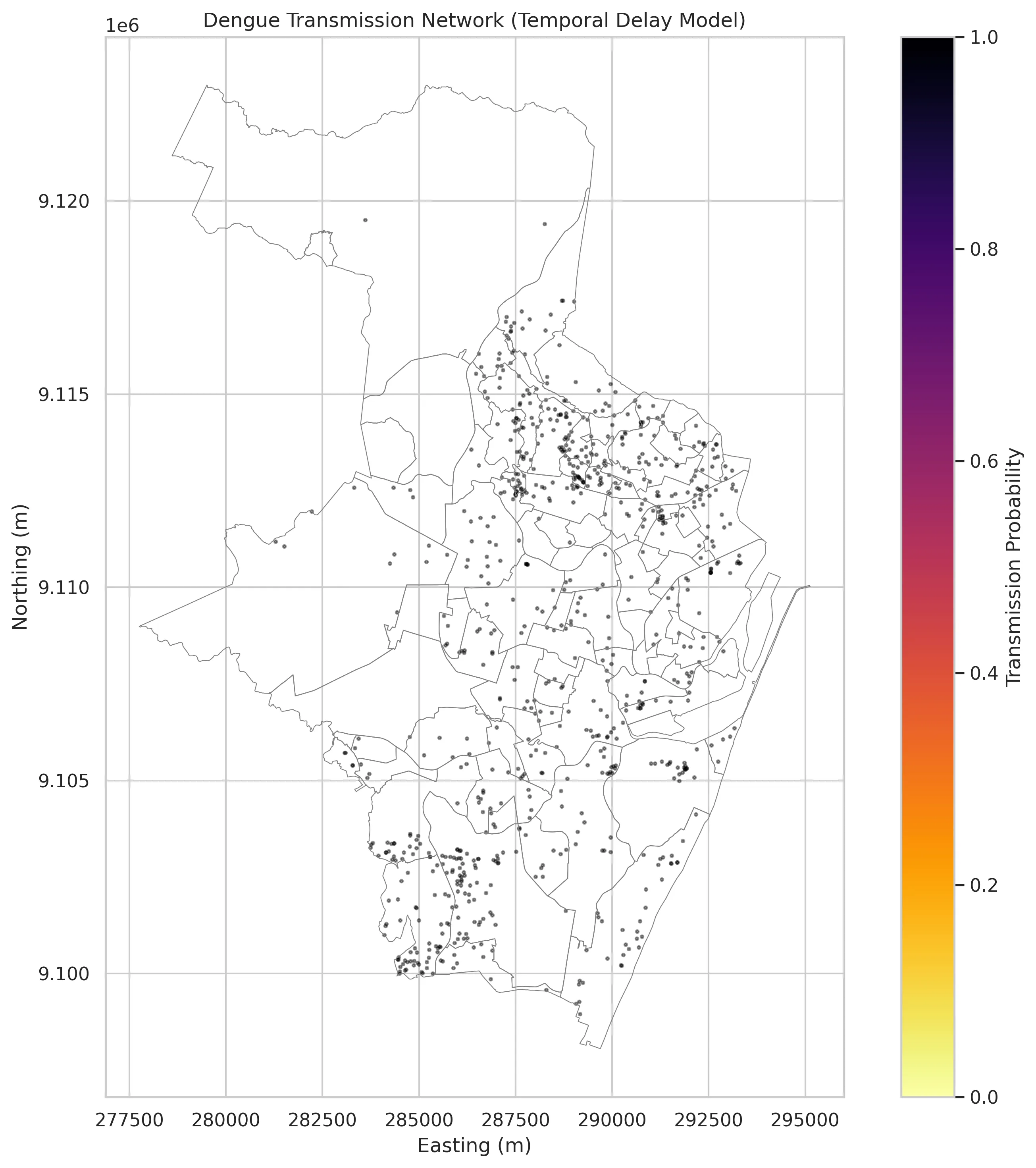
In the Brazilian city of Recife, three viruses (dengue, Zika, and chikungunya) are spread by mosquitoes. Scientists collected data on thousands of cases and built a model that assesses how infections in different parts of the city influence each other. The model looks at two things: how close cases are in space and how much time passes between them.
Time, however, turned out to be key. If you consider only short intervals, the three diseases look different, but that difference is deceptive: it arises simply because cases coincide in time. When the model was restricted to biologically plausible time frames (for example, accounting for how long a mosquito lives and how long the virus takes to mature inside it), a common transmission structure emerged for all three diseases. Differences between dengue, Zika, and chikungunya appear only when you look at delays longer than a critical window.
This approach is like tuning a radio: on short waves you hear only static, but once you set the right band, a signal appears. The reconstructed transmission networks show local hotspots, consistent with the real epidemic picture. The takeaway is simple: to tell one epidemic from another, don't look at the map — look at the clock.
Original abstract
as written by the authors arXiv:2604.11818
Understanding epidemic dynamics in urban environments requires models that capture interactions across space and time while incorporating biological constraints. In this work, we propose a probabilistic spatiotemporal framework based on pairwise interaction kernels to analyze arboviral transmission using large-scale georeferenced data from Recife, Brazil. The model describes interactions as a function of spatial distance and temporally delayed influence, with parameters estimated via maximum likelihood. Our results reveal a marked asymmetry between spatial and temporal components. The spatial parameter systematically collapses, indicating that spatial proximity does not provide discriminatory information between diseases at the urban scale. In contrast, temporal dynamics exhibit scale-dependent behavior: statistical differentiation between dengue, Zika, and chikungunya emerges only beyond a critical temporal window. We show that unconstrained models primarily capture short-term co-occurrence, leading to apparent but non-robust differences, while biologically constrained models reveal a common underlying transmission structure. Additionally, reconstructed transmission networks exhibit localized and structured interaction patterns consistent with plausible epidemic propagation. These findings demonstrate that epidemic differentiation is not intrinsic, but an emergent phenomenon dependent on temporal scale, highlighting the importance of biologically grounded and scale-aware modeling in spatiotemporal epidemic analysis.
In Recife, where the study was conducted, Aedes aegypti mosquitoes carry all three viruses at once, and a single bite can infect a person with multiple diseases simultaneously.