math.PR math.PR

17 articles

articles

Noise That Works for Us
An old aviation instrument sometimes sticks: the needle catches on the scale and doesn't move, even though the plane is already changing altitude. Engineers found a simple solution: add a slight vibration. The shaking doesn't hinder; on the contrary, it helps the needle break free and show the truth.
Echoes in a Smaller Room: How to Hear the Signal in the Noise
In a large concert hall, sound bounces off the walls, and even if you stand in a corner, the echo can reveal the shape of the room. That is essentially the problem the authors tackle: how to recover a system's hidden rhythms from the 'echo' in data collected from only part of the system.
Statistical Mech2026-01-111 minarXiv:2601.07096express
A Search Where the Team Changes on the Fly
A group of people searches for a lost item in a large park. Some get tired and leave, others join along the way. The number of searchers is constantly changing. How does this affect the search time? Until now, science had no clear answer. In a new study, a general model of such a process has been built. In it, independent participants randomly enter and leave the search.
Hidden Pathways Across an Ocean Desert
Thousands of kilometers of open ocean separate the reefs of the central Pacific from the sparse coral outposts to the east. This stretch of water, known as the Eastern Pacific Barrier, has long been considered nearly impassable for tiny coral larvae. The currents here mostly carry water westward, away from the eastern islands.
Statistical Mech2026-03-141 minarXiv:2603.13918express
Pores in the Membrane: Three Keys to Accurate Calculation
A cell is a city with gates. Each gate is a protein channel in the membrane: through it, ions, sugars, and signaling molecules pass in and out. Some gates are almost always open, while others open and close randomly, like subway doors that let a passenger through one moment and slam shut in their face the next.
q-bio.PE2026-04-101 minarXiv:2604.11818express
Epidemics Are Distinguished by Time, Not Place
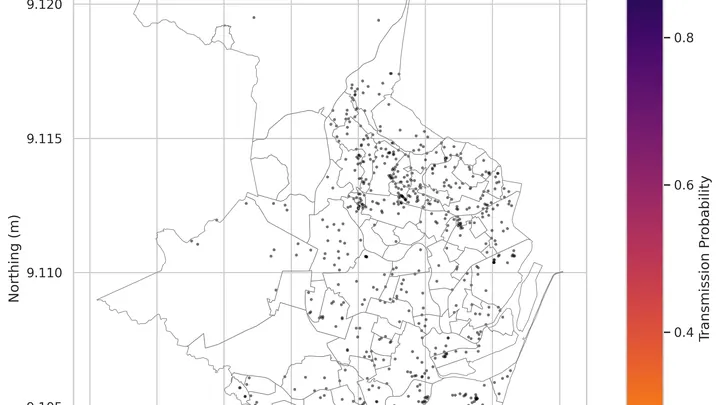
In the Brazilian city of Recife, three viruses (dengue, Zika, and chikungunya) are spread by mosquitoes. Scientists collected data on thousands of cases and built a model that assesses how infections in different parts of the city influence each other. The model looks at two things: how close cases are in space and how much time passes between them.
Dynamical Systems2026-04-192 minarXiv:2604.17528express
Five Faces of the Same Randomness
In a big city after rain, water collects in the same low spots no matter where the first drops fall. An hour later, the pattern of puddles hardly depends on where the downpour started. That is equilibrium — the outcome a system reaches regardless of its start, once the details are forgotten.
math.PR2026-06-303 minarXiv:2607.00149
Dance of the Pioneers: When Spatial Dimension Preserves Inequality Forever
Imagine a ball in an unfamiliar hall: two guests start from opposite corners. Their movements are not a smooth waltz but chaotic improvisation in search of rare treasures. Contrary to intuition, the outcome hinges not on tempo but on the geometry of the floor.
q-bio.PE2026-07-131 minarXiv:2607.11011express
How a Tumor Builds Its Family Tree
Every tumor writes its own cosmology. Its cells are galaxies, and mutations are stellar flares marking the branches of a genealogical tree. The key to its history is the rhythm of accumulating genetic typos.
q-bio.PE2026-07-131 minarXiv:2607.11520express
How Chance Drives Evolution
Evolution flows like water. In a wide river, changes are smooth and slow, while a mountain stream churns with every stone. Population size and mutation rate set the channel: broad and calm, or narrow and rapid-filled.
Math Physics2026-07-261 minarXiv:2607.23873express
Balls on a Curved Stage
In a vast hall, billiard balls are scattered about. At first they lie sparsely, each on its own. Then someone adds more, and suddenly the balls compress into dense clusters. This is a phase transition — the moment when matter abruptly changes its state. Physicists have long described such a picture with the hard-sphere model: particles are identical balls that cannot overlap.
q-bio.SC2026-08-022 minarXiv:2608.00995express
Mail Inside a Neuron: How Molecules Find Their Recipients
In the long extensions of a neuron, the dendrites, tiny couriers are constantly bustling about. These are messenger RNA molecules carrying instructions for protein assembly. Their journey starts at the cell body and ends at synapses — contacts with other neurons.
math.PR2026-08-042 minarXiv:2608.03771express
How Chaos in the Quantum World Gives Rise to Universal Order
The quantum world is a constant buzz of activity. Particles exchange energy, become entangled, and influence one another. You'd think that the more players in this game, the harder it is to predict the outcome. But sometimes, order emerges from chaos. Physicists took a close look at the SYK model — a mathematical playground for studying quantum chaos.
Statistical Mech2026-08-082 minarXiv:2608.07975express
Hidden Pathways Inside the Cell
Toss a handful of sand onto a table — the grains scatter equally in all directions. But if a magnet is hidden under the table and the sand is iron, the trajectories get trickier: an invisible structure overlays the chaos. That's roughly how molecular motion works inside a living cell.
math.PR2026-08-092 minarXiv:2608.08752express
The Hidden Rhythm of a Freezing Magnet
A magnet is slowly heated. At low temperatures, all its microscopic arrow-like spins point in the same direction: that's order. At high temperatures, they dart about chaotically. But there is a special point, the critical point, where order is just about to vanish and the system freezes in indecision.
Biological Physics2026-08-092 minarXiv:2608.08816express
The Boundary Sees All Better
If a smell seeps into a room through a slightly open door, you could stand in the middle and sniff. But the most accurate way to catch the moment the smell arrives is to stand right at the threshold. A cell behaves much the same way when it needs to measure the concentration of a substance around it.