An epidemic is the rapid spread of an infectious disease through a population, affecting many individuals within a short time. It is a dynamic process where the rate of transmission depends on how often infected and susceptible people come into contact, and how likely each contact is to result in infection. Epidemics are not just biological events; they are shaped by human behavior, social networks, and public health interventions, making them a rich subject for mathematical modeling and game theory.
History
The mathematical study of epidemics began in the early 20th century, with the foundational SIR model developed by William Ogilvy Kermack and Anderson Gray McKendrick in 1927. Their work laid the groundwork for understanding how susceptible, infected, and recovered populations interact over time.
How it works
The core mechanism is the chain of transmission: an infected person passes the pathogen to susceptible individuals, who then become infectious themselves. The spread is governed by the basic reproduction number (R0), which is the average number of new infections caused by one infected person in a fully susceptible population. If R0 > 1, the epidemic grows; if R0 < 1, it dies out. However, real epidemics are more complex, as factors like the infectious dose, the 'age' of the infection (how long a person has been sick), and the timing of quarantine measures all influence the trajectory. Individual decisions, such as whether to isolate or continue social contact, create feedback loops that can either amplify or dampen the wave of infections.
In practice
Epidemic models are used by public health agencies to forecast disease spread, evaluate the impact of interventions like vaccination or lockdowns, and allocate medical resources during outbreaks.
Fun fact
The 1918 influenza pandemic infected about one-third of the world's population, and its spread was significantly influenced by the movement of troops during World War I.
A crowd of pedestrians in a square moves chaotically: each person goes their own way, occasionally bumping into others. If every third person in that crowd wears a protective suit that blocks the pathogen, the rhythm of disease spread changes abruptly. That is exactly the scenario scientists reproduced by simulating 3000 self-propelled particles that repel each other and become infected upon close contact.
In March 2020, France emptied out: people stopped going to work, school, and cafés, and the streets filled with silence. Epidemiologists stared at the graphs and understood that the virus was not spreading on its own, but through handshakes, conversations, and metro rides. But how could they predict how many contacts a person would keep if the government announced new restrictions?
The orchestra starts playing, but each musician has their own tempo. If everyone plays at roughly the same speed, the music flows in a continuous stream. But if one group of instruments plays noticeably slower than the rest, the sound gathers into a dense clump that slowly moves forward.
Picture a flock of birds gathering around a feeder that no one built. Each bird searches for food on its own, yet they all end up together. Usually, such behavior is explained by social instinct: birds want to be near their kin. But what if the flock is simply a side effect of greed?
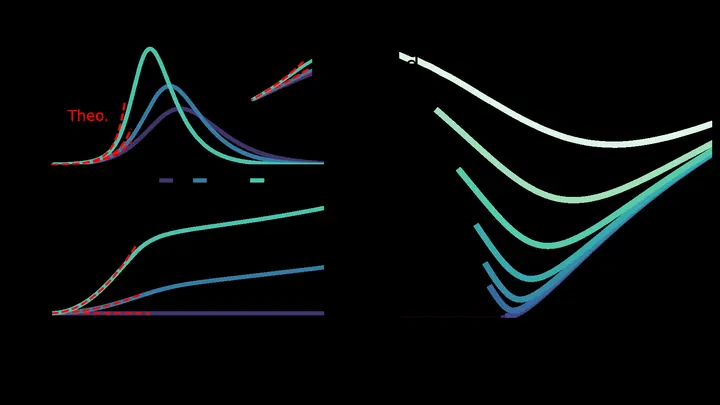
Every winter, hospitals fill up, and by summer they seem to empty. Epidemics breathe like the tide. But why do waves of disease keep rolling in, even without new mutations? Mathematicians found an answer in a tug-of-war between two strains.
Within a single epidemic, two virus variants often coexist.
Two people agree to meet, but each has their own things to do. One hesitates: what if the other doesn't come? And decides not to go. The other thinks the same. The meeting doesn't happen. That's the simple mechanism the authors dissect: a joint endeavor requires everyone to invest time, but the payoff depends on whether the partner participates.
In the model, each person keeps a to-do list ordered by importance.
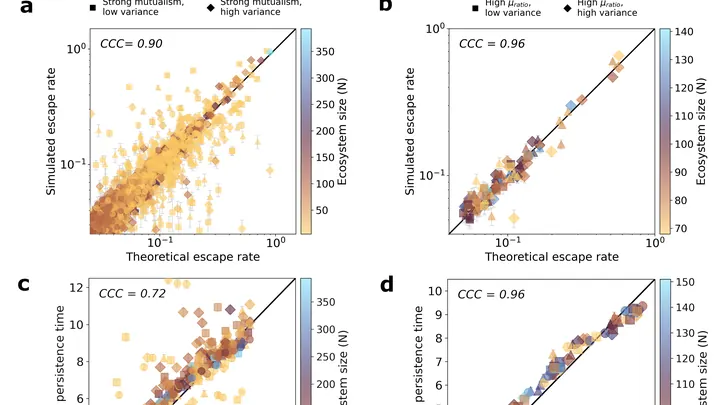
Rare species in a large community are like thin branches on a tree: a random gust can easily snap them. Even if conditions are stable, a small population simply lacks enough individuals to survive a bad season. In a new study, scientists added this factor to an ecosystem model and watched the community clean itself out.
A mail carrier delivers letters along one-way streets. As long as he only drives forward, the route is simple and predictable. But if U-turns are suddenly allowed, he'll start doubling back, crossing his own tracks, and the delivery pattern gets tangled. That's roughly how an infection behaves when people can get sick more than once.
A mosquito swarm resembles a living cloud — hundreds of bodies circle together, but no one lines up or mimics a neighbor's movements like starlings or fish. For a long time, it was unclear what held such unity together. The authors of a new study suggested that the insects communicate by sound.
In 1970, mathematician John Conway invented the Game of Life — a cellular field where just three rules generate surprisingly complex patterns. Forty years later, SmoothLife appeared: a version where space is no longer cellular but smooth, like a blurred patch. The authors of the new study took an even simpler variant of this continuous game: now everything changes smoothly in time as well.
A disease outbreak is like a wildfire: the fire runs through dry grass, and its speed depends on wind and humidity. But an infection has its own 'wind'—how often people infect each other. When this rate changes along with the fraction of already infected, the epidemic wave can behave differently.
A perfume bottle is not just glass with liquid. It is a snapshot of its time, a frozen melody of fragrant notes. From 1900 to 2024, tens of thousands of such 'melodies' have accumulated, and now they can be studied as a single organism.
A dengue outbreak is like a wildfire in the savanna: the flames leap from person to person via mosquito bites. Authorities respond in two ways — sending the sick to hospitals and spraying chemicals that kill the insects. But in reality, a hospital has only a limited number of beds, and fogging doesn't start immediately; it begins only when the number of infected crosses a critical mark.
Usually, the complexity of systems, from satellite motions to heart rhythms, is assessed with averaged entropy (a measure of unpredictability, as understood by Boltzmann). But that's like evaluating the ocean only by wave height: the average figure hides the full richness of underwater currents.
For a long time, biologists argued: if a herd of animals stably maintains a mix of aggressive and peaceful individuals, does each one alternately change behavior, or do some always fight while others always yield? In classical equations, these options are indistinguishable.
Ordinary models assume that infection is like a steady flow of water that washes over everyone equally. In reality, the stream from a sick person fluctuates: right after infection it barely trickles, then turns into a raging downpour, and later subsides. The chance of catching the virus depends on the strength of this flow at the moment of contact.
When a pipe bursts in the basement, a plumber acts step by step: locates the leak, measures the pressure, determines the cause, patches it up, and checks if it's dry. The same recipe — the standard model DMAIC — is being proposed against epidemics.
First, they determine the scope — how many hospital beds are occupied, which industries are sagging.
In the web of life, predators and prey exchange carbon and water, and each act of eating slightly increases the universe's disorder. But the intrusion of disease turns this system into a giant seesaw. When a mid-level predator gets sick, its hunting abilities decline, and it becomes easy prey.
Mathematicians confirmed: the ideal response to a pandemic is the 'hammer and dance' strategy. First, a sharp lockdown smashes the wave of infections like a hammer blow. When hospitals empty, the dance begins — a cautious, step-by-step return to normal life.
A desert where every step reshapes the terrain. Dunes settle, new slopes emerge, and the next step is dictated by what you've just trampled. That's roughly how "sandscapes" work — a mathematical model inspired by living systems.
A person reaches out to a stranger across town. That stranger will never return the favor: they'll never meet. So why help? Biologists call this indirect reciprocity: kindness comes back not from the person you helped, but from someone else, down the line.
In a new study, two variants of this idea were pitted against each other.
A living organism is a machine that constantly channels energy through itself and converts it into heat. This internal cycle is called internal entropy production (a measure of energy dissipation). But about 2.5 million years ago, our ancestors switched on a second loop — an external one. They picked up a sharpened stone, and then a burning branch.
Every group has its unspoken trios: three friends who are always together. And there are pairs that exist on their own. It turns out that how much trios "contain" pairs determines how everything, from a virus to a new idea, spreads through the group.
Scientists introduced a measure they call the nesting coefficient.
A pot of water sits on the stove. The temperature drops: plus one degree, zero, minus one — the water stays liquid. But at some point, a light breath is enough to make the whole mass instantly freeze into ice. Physicists call such jumps first-order phase transitions.
The fate of a civilization isn't just a matter of luck or disasters. Scientists simulated a thousand years of history under ten different scenarios, accounting for resource consumption, governance, and random shocks. The key metric turned out to be the 'activity coefficient' – the fraction of time when a civilization is technologically alive. At best, this fraction nears 100%; at worst, it drops to 38%.
A landscape cut by roads or rivers into isolated patches resembles a shared apartment after partitions are installed: residents no longer bump into each other in the common hallway. Species that once competed for the same food or space now live apart. Competition weakens, and those that would have lost to pushier neighbors in a continuous landscape now survive.
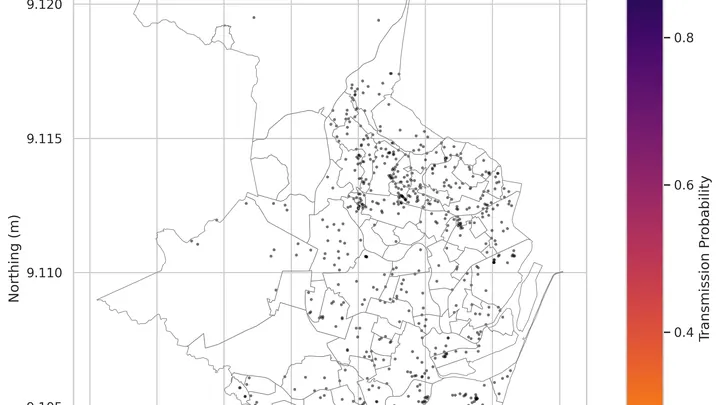
In the Brazilian city of Recife, three viruses (dengue, Zika, and chikungunya) are spread by mosquitoes. Scientists collected data on thousands of cases and built a model that assesses how infections in different parts of the city influence each other. The model looks at two things: how close cases are in space and how much time passes between them.
An epidemic is not just a virus: it's millions of personal decisions. One person keeps riding the subway; another locks themselves at home. Classical models describe the average behavior of a crowd but don't ask why each individual acts that way.
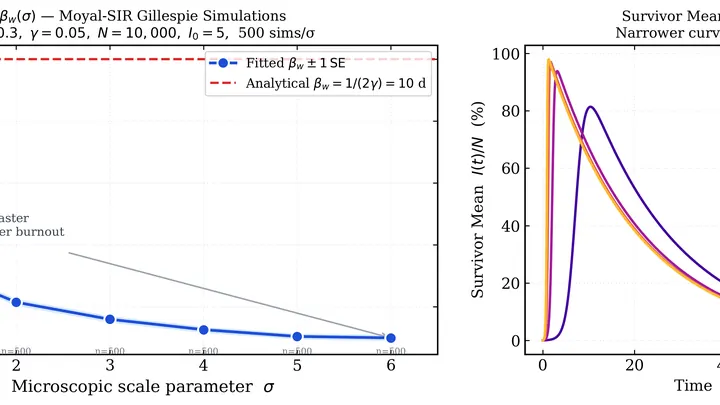
An epidemic is like a fire in a dry forest: a spark flares up, the flames leap from tree to tree, and within a week the whole area is burning. A hundred years ago, scientists devised a simple mathematical model for such a fire: they divided people into those who had not yet fallen ill, those who were ill, and those who had already recovered.
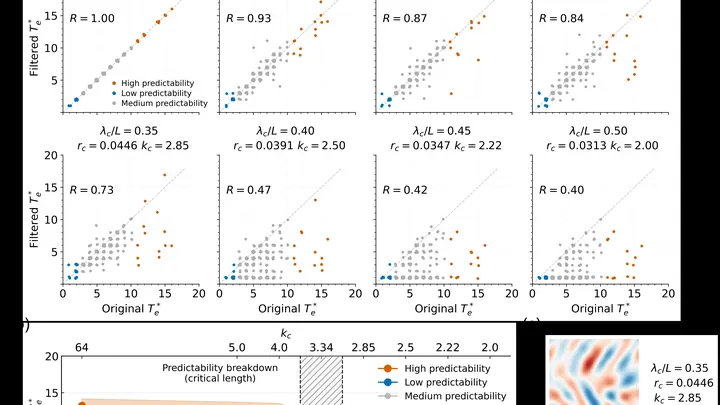
In a turbulent flow, like a raging river, energy constantly cascades from large whirlpools to small ones. Occasionally, particularly powerful bursts occur, resembling sudden waves crashing against the shore. Scientists asked: can we know in advance when such a "wave" will strike? It turns out the answer depends on which vortices are present in the flow at that moment.
An ecosystem is like a swing that someone is subtly pushing. Previously, it was thought that the main concern was that the swing wouldn't swing too wildly. But the authors of this work showed that the greater danger is when the equilibrium point itself slides toward a place where the swing can no longer return.
A tumor doesn't stay put. Individual cells or whole groups break off and set off on a journey through the body. Some crawl solo, like scouts; others stick together, like a flock. Scientists built a computer model to understand how these cells pick a direction.
In the model, cells respond to two signals.
An epidemic is not a steady stream but a series of hits. One carrier may infect no one, while another infects fifty people at once. Such rare but powerful events are called 'dragon kings': they stand out from the overall pattern and determine how severe a disease wave will be.
In the new study, the virus is compared to a billiard ball.
An epidemic is like a forest fire: the flames race toward where there are more dry branches. Similarly, a virus spreads faster where people live in closer quarters. But old mathematical models described infection as an ink blot spreading evenly across paper.
A translator who jumps at every rustle in the hall turns a one-hour meeting into two. It's the same in epidemic control: contact tracing teams try to reconstruct the chain of infections, but something always slips through. Someone forgets who they met, someone doesn't answer the phone, someone never even comes to the attention of health workers.
An infection is spreading through a city, and residents are watching each other: some have already been vaccinated, others are hesitant. Every day, they update their decisions — whether to imitate neighbors or friends who support vaccination.
A density of four people per square meter is the threshold beyond which a crowd ceases to be a sum of individual pedestrians and becomes something else. In Pamplona's Plaza Consistorial during the San Fermín festival, local density reached nine people per square meter.
A fisherman casts his net into murky water, and an hour later the catch is thrashing on the deck. That's roughly how Episcanner works: it sifts through 14 years of disease records and pulls out every fever outbreak in every one of Brazil's 5,570 municipalities. From 2010 to 2023, the net caught 18,567 dengue epidemics and 2,199 chikungunya epidemics.
Every few years, the Pacific Ocean off the coast of Peru warms up, and then fields dry out in Australia while deserts in Chile get drenched. This phenomenon is called El Niño.
Winning the lottery changes the winner's life, but for the statistics of all players it means almost nothing: the probability of winning is negligible, and the average winnings per ticket remain tiny.